5-9
Revenue vs Sales: Which Number Should You Track?
Revenue vs sales explains why a busy market day’s cash isn’t what you keep, and how to calculate revenue, sales, and net figures to choose what to track.
- Written by

- Published
- Updated
- Reading time
- 10 min read
Revenue is all the income a business brings in before expenses, while sales are the goods or services it sells, measured in units or dollars. Sales are part of revenue, and revenue can also include income such as rent or interest; net sales subtract returns, allowances, and discounts from gross sales. Track the figure that fits your business, use it consistently, and check profit too, because money coming in is not the same as money you keep.
In this guide
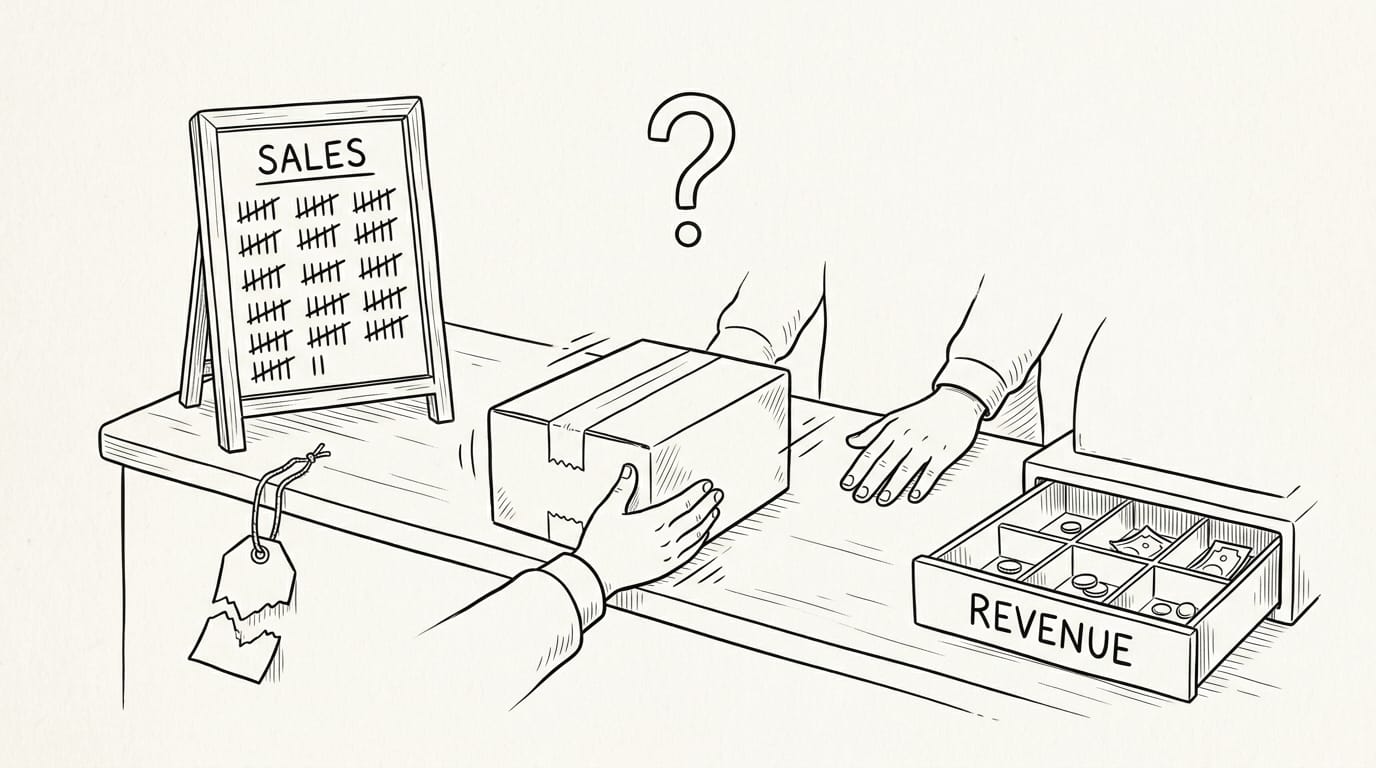
Ever had a busy market day, counted the cash in your apron, and still wondered what you actually kept? That gap comes from mixing up two words people use interchangeably: revenue and sales. Revenue is the total money coming in before any costs come out.
Sales is the act of selling, often counted in units. Both numbers matter, but they answer different questions. Here’s what each one means, how to work them out, and which one to track for your own idea.
What Revenue vs Sales Really Means
Revenue and sales get mixed up constantly, and that can make a side hustle look healthier than it is. Here’s what each term means.
Total income from operations, before expenses
Revenue is the total income a business brings in from its operations, before any expenses are deducted. It’s the top line of the income statement, the first number you see. Revenue also includes non-sales income.
Say you run a woodworking side hustle and rent out a spare parking spot. That rent counts toward revenue, even though you didn’t sell anything to earn it.
What does sales revenue mean in business?
Sales revenue is the money a business earns from selling goods or services. Each sale is a transaction: the customer pays, and you deliver. You can count it in units sold or in dollar value.
Sales revenue is a subset of total revenue, so every sale counts toward revenue, but not all revenue comes from sales.
Take a potter who sells 100 mugs at $20 each. Her sales revenue is $2,000. The unit count shows how much moved, while the dollar value shows how much money came in. Same sales, two different answers to two different questions.
Why net sales come in below gross
Gross sales is everything sold before anything is taken back or taken off. Net sales is what’s left after three deductions:
- Returns: money refunded when customers send items back.
- Allowances: credits given when goods arrive damaged or flawed and the customer keeps them.
- Discounts: price reductions, such as a holiday sale.
That gives you the formula: net sales = gross sales minus returns, allowances, and discounts.
Say a candle maker has $1,000 in gross sales, refunds $80 for returned candles, and gives $50 off in a holiday promotion. Her net sales are $870, and that’s the number to plan around.
Retailers report both numbers, so the gap between them shows what returns and discounts cost.
Other ways people use these words
These words show up elsewhere too, which can cause confusion in reports and conversations.
- Sales as a department: the team that does the selling.
- Sales as an act: the activity of selling itself.
- Government revenue: the money a government collects, such as taxes and fees.
When you hear either word, check which meaning is in play before you run any numbers.
How Revenue and Sales Differ in Practice
Revenue and sales overlap, so this section sorts out where each comes from, how deductions change them, and when they match.
Where each kind of income comes from
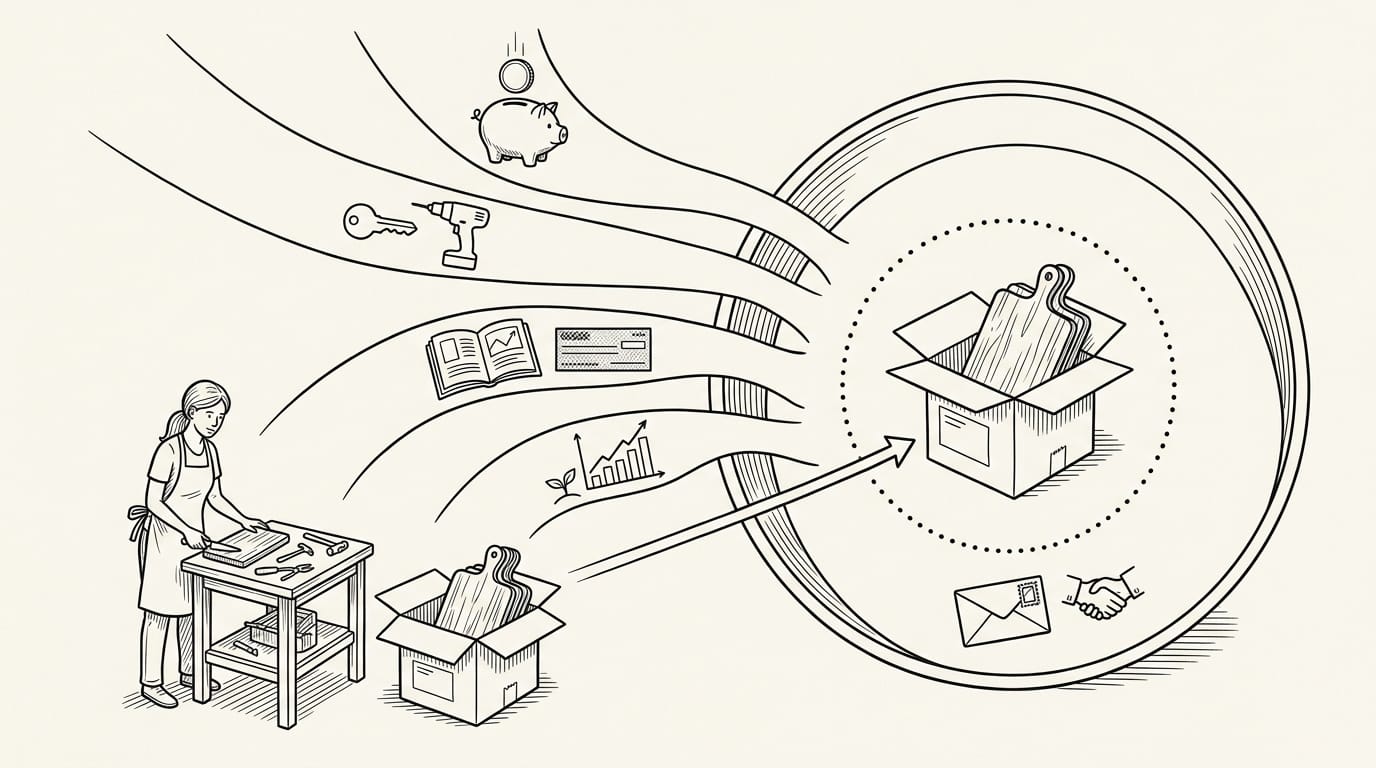
Revenue is the broad category: everything a business earns, before costs come out. Sales is the narrower one, counting only income from transactions, meaning goods or services a customer buys. Revenue also picks up income that isn’t a sale:
- Interest on savings
- Rent from equipment or space
- Royalties on a design
- Investment income
- Licensing fees from secondary operations
Consider a side hustler who makes cutting boards and licenses one design to a home goods company. Her board orders are sales. The licensing fee is revenue, not a sale.
How deductions affect the final figure
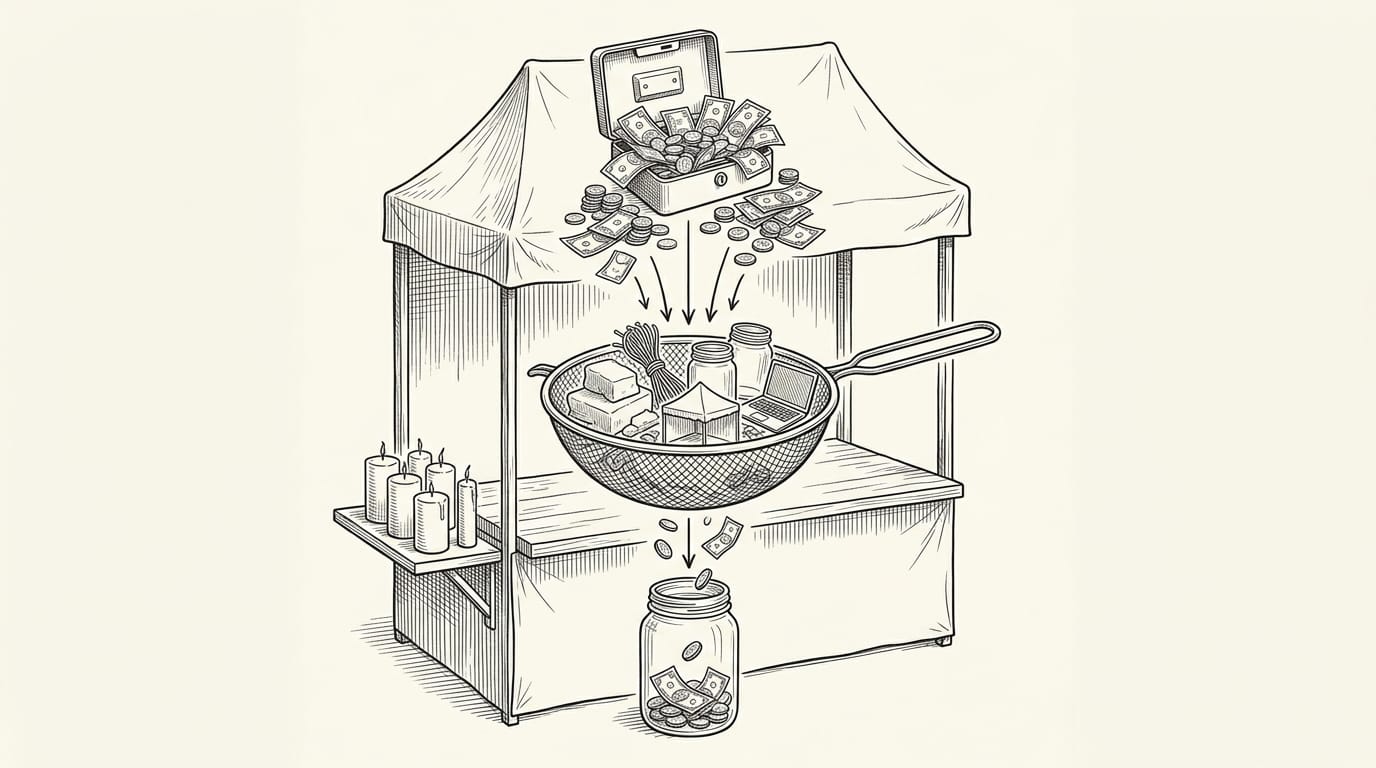
Revenue is the top line: the total before anything comes off. Returns are goods customers send back for a refund, and discounts are price cuts you give to close a sale.
What’s left after both is net sales, which always lands below the figure it started from.
If that cutting board seller refunds a cracked board, the refund comes off her net sales. Net sales is the more honest figure, since it removes money you handed back.
When revenue and sales match exactly
Revenue includes sales, so they only split when something other than a sale shows up. Retail goods businesses are the usual case: a shop selling only products has no other income, so its revenue and sales are identical.
The same holds for any business whose income comes solely from sales. One source, one number.
Side-by-side examples from three businesses
| Business | Sales come from | Other revenue | Revenue vs. sales |
|---|---|---|---|
| Tech company | Software subscriptions | Interest on cash reserves | Revenue is higher |
| Auto parts manufacturer | Parts sold to dealers | Rent from spare warehouse space | Revenue is higher |
| Florist | Arrangements sold | None | Equal |
Tech company. Subscriptions are sales, but the interest on its cash is revenue, so the total runs higher.
Auto parts manufacturer. Parts shipped to dealers are sales. Renting out a spare warehouse bay raises revenue while sales stay put.
Florist. A side-hustling florist sells every arrangement and has no other income, so one number covers both. One figure to check against her flower costs.
Working Out Revenue, Sales and Net Figures
Here’s how each figure works, from the first sale to profit.
Working out revenue from units and price
Revenue is quantity sold times price. A candle maker who sells 200 candles at $25 has $5,000 in revenue.
Net revenue is revenue minus refunds and discounts: Net revenue = revenue − returns − discounts. Plan around that number, since refunds are money you won’t keep.
Accrual accounting counts a sale when it’s made, while cash accounting counts it when the money arrives. A freelancer paid in July for June work books it in June under accrual and in July under cash.
Recording a sale means writing a journal entry, which has a debit and a credit that must match. Is sales revenue a debit or credit? It’s a credit, so a $25 cash sale debits Cash and credits Sales Revenue.
Net sales step by step, with an example
Net sales works down from gross sales:
- Start with gross sales, the total before anything comes off.
- Subtract returns, sales refunded to customers.
- Subtract allowances and discounts: price cuts for flawed goods, coupons, and bundle deals.
The candle maker starts with $5,000 in gross sales, refunds 10 candles ($250), and gives a $200 bundle discount: $5,000 − $250 − $200 = $4,550.
Gross sales after cost of goods sold
Subtract cost of goods sold from net sales: the materials for what you actually sold. If those candles cost $1,800 in wax, wicks, and jars, your gross profit is $4,550 − $1,800 = $2,750.
Then deduct operating expenses, the running costs not tied to any one item, like $300 in stall fees and $60 for software: $2,750 − $360 = $2,390. Revenue shows what came in; profit shows what stayed.
Why Telling These Two Apart Matters
Revenue and sales often get used interchangeably, but mixing them up throws off your reports, budget, and taxes.
Keeping reports accurate for analysis and lenders
Accurate reporting starts with labeling each number correctly. Book orders before refunds, and every report built on them overstates what you earned.
Performance analysis depends on the same discipline. Comparing this month to last only holds up if both months use the same definition.
Bankers and creditors read these reports too, and a mismatch between your loan application and your books invites questions.
Planning budgets and spotting sales trends
Build your budget and forecasts on income you can count on, not your best month.
Sales trends show what customers are buying, while revenue trends show whether the business is growing.
Some tax obligations are based on gross receipts, the total you took in before returns or discounts come off. Which figure goes on your return depends on the form and your local rules, so ask a tax professional before you file. Don’t guess.
What investors look for in your numbers
Investors care less about what comes in and more about what you keep. They look at net sales first, which is what’s left after returns and discounts, because it shows what actually held up.
Revenue shows broad health: how much comes in across your products, customers, and channels. Profit indicates efficiency: how well you turn that revenue into money after costs.
How much is a business worth with $1,000,000 in sales? Sales alone can’t say. Buyers pay for profit they can count on, so a business valuation built on thin margins can come in well below that top line.
Outside forces that move the numbers
Plenty of things move your numbers without any change in how well you run the business:
- Economic conditions. When customers tighten their budgets, sales can dip even if your product hasn’t changed.
- Promotions and subscriptions. Discounts can lift sales while shrinking what you keep per order, and subscriptions smooth income across months.
- One-off events. A single big order or a viral week can inflate one month, so don’t build next year’s plan on it.
- Online sales. Marketplace sales can spike, but platform fees and refunds come out of what you keep.
- Revenue recognition timing for prepayments. A freelance web designer collects $1,800 up front for six months of hosting. The cash lands in March, but revenue counts as it’s earned, so only $300 of it belongs to March.
Why Revenue Doesn’t Tell You Profit
Revenue tells you what came in. Profit tells you what you kept.
The main types of profit to know
- Gross profit: revenue minus cost of goods sold (COGS), the direct costs like materials and shipping.
- Operating profit (EBIT): gross profit minus overhead, such as rent and software. EBIT means earnings before interest and taxes.
- Net profit: what’s left after everything, including taxes. It’s the bottom line.
- EBITDA: earnings before interest, taxes, depreciation, and amortization. It’s an alternative metric that can look rosier than net profit.
How an income statement is laid out
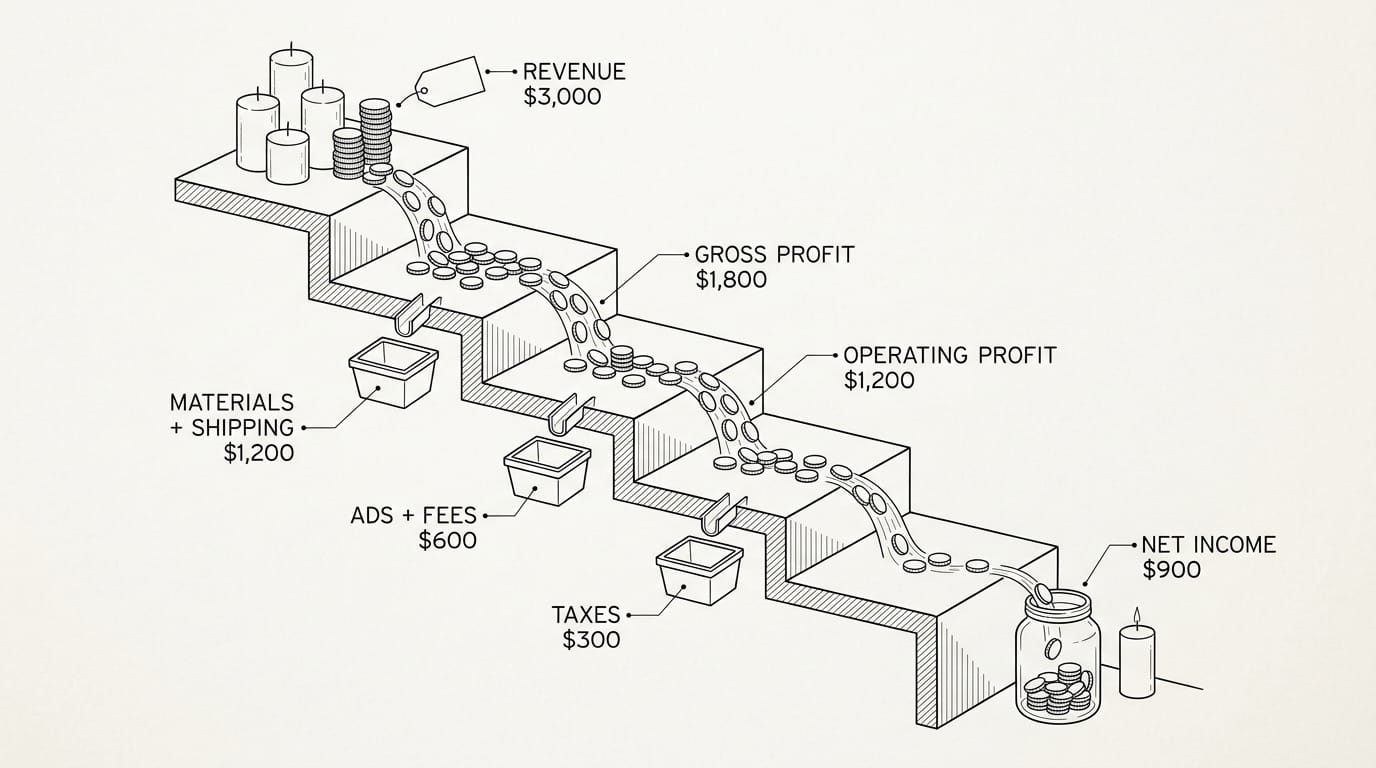
An income statement reads top to bottom:
- Revenue tops the list: everything you billed.
- Subtract COGS to get gross profit.
- Subtract overhead to get operating profit.
- Subtract interest and taxes, and what’s left is net income at the bottom line.
Say you sell hand-poured candles from your spare room and bill $3,000 in a month. Materials and shipping take $1,200, leaving $1,800 gross profit. Ads and fees take $600, leaving $1,200 operating profit. After $300 in taxes, you keep $900 as net income.
Why profit usually matters more
Profit keeps a business alive. Revenue can look impressive while each sale loses money, and selling more doesn’t fix that. Pets.com and WeWork are often cited as cautionary tales about chasing growth before profit.
You can grow profit by raising prices, cutting COGS, or trimming overhead. A $2 price bump on 100 candles adds $200 with no extra materials.
Investors prefer profit margins, which show profit as a percentage of revenue. Your candles keep 30 cents of every sales dollar.
Count your unpaid hours, too. If those candles take 60 hours a month, your $900 works out to $15 an hour.
Picking the Right Number to Track
Revenue and sales both sound like money in, but the one you watch shapes your next move. Here’s how to pick the right one.
Why chasing revenue alone can backfire
Revenue is every dollar that comes in before anything is subtracted. It feels like progress, but high revenue doesn’t mean high profit. The question is less about how much came in and more about what you kept.
Consider a weekend baker who celebrates a big wedding order, then finds that flour, boxes, and delivery ate most of it.
Returns and defects undermine growth too. A returned order isn’t a real sale, and defects bring refunds and lost repeat customers.
Hiring salespeople raises costs. Pay, commissions, and training come out of the same money, so if a new seller’s sales don’t cover what they cost, revenue rises while profit falls.
How your business model changes the choice
The right number depends on what you sell:
- Service businesses use gross revenue. A freelance designer or house cleaner rarely deals with returns, so the total billed is the number to track.
- Goods businesses use net sales. Subtract returns, refunds, and discounts from gross sales. A candle maker with a few cracked jars sent back gets a truer picture this way.
- Use metrics consistently. Switching between gross and net makes one month look better or worse for reasons unrelated to the business. Same definition, every month.
- Track after-fee marketplace payouts. Platforms take their cut before the money reaches you, so track the payout, not the listed price.
Sales tell you how much you’re moving, and revenue tells you what that brings in. Neither one tells you what you keep, so profit has to sit right beside them.
For your idea, pick the number that answers your current question, and quote it the same way every time.
A big top line can hide a thin margin, so check what’s left after costs before you celebrate. A full cash box feels great, but a profit you can keep is what turns a side hustle into something that lasts.
Questions
What is the difference between sales and revenue?
Sales refers to the act of selling or the goods and services sold, often measured in units or dollars. Revenue is the total income a business earns from its operations before expenses, including sales and potentially other income such as rent or interest.
What are the 7 stages of sales?
A commonly used seven-stage sales process is prospecting, preparation, approach, needs assessment, presentation, handling objections, and closing. Many businesses add follow-up as a separate stage or include it after the sale.
How much is a business worth with $1,000,000 in sales?
There is no fixed value for a business with $1,000,000 in sales. A valuation depends on factors such as profit, margins, growth prospects, assets, debts, and how dependable the sales are.
Is sales revenue a debit or credit?
Sales revenue is normally recorded as a credit because it increases revenue. In a cash sale, the corresponding entry is typically a debit to Cash and a credit to Sales Revenue.
Are revenues the same as net sales?
No. Revenue is the broader amount of income from business operations, while net sales are gross sales minus returns, allowances, and discounts. Net sales are a component of revenue.
What does sales revenue mean in the context of business?
Sales revenue is the money a business earns by selling goods or services. It can be measured as the dollar value of sales or as units sold; it is part of total revenue, which may also include non-sales income.