6-9
Write-Off Meaning in Accounting Explained Simply
Write-off meaning in accounting: see how unpaid invoices change your books, which journal entries record them, and how write-offs differ from tax deductions.
- Written by

- Published
- Updated
- Reading time
- 12 min read
- Sources
- 2 cited
In accounting, a write-off is an entry that removes an asset or amount from the books when there is no reasonable expectation of recovering its value, such as an unpaid invoice or damaged stock. It records the loss as an expense, reducing assets and profit, and should be supported by collection records or other evidence; it does not cancel a debt or automatically qualify as a tax deduction. Timely, documented write-offs keep financial statements realistic, while tax treatment depends on the rules that apply.
In this guide
Ever sent an invoice and then realized the money isn’t coming? Your books may still count it as income on its way.
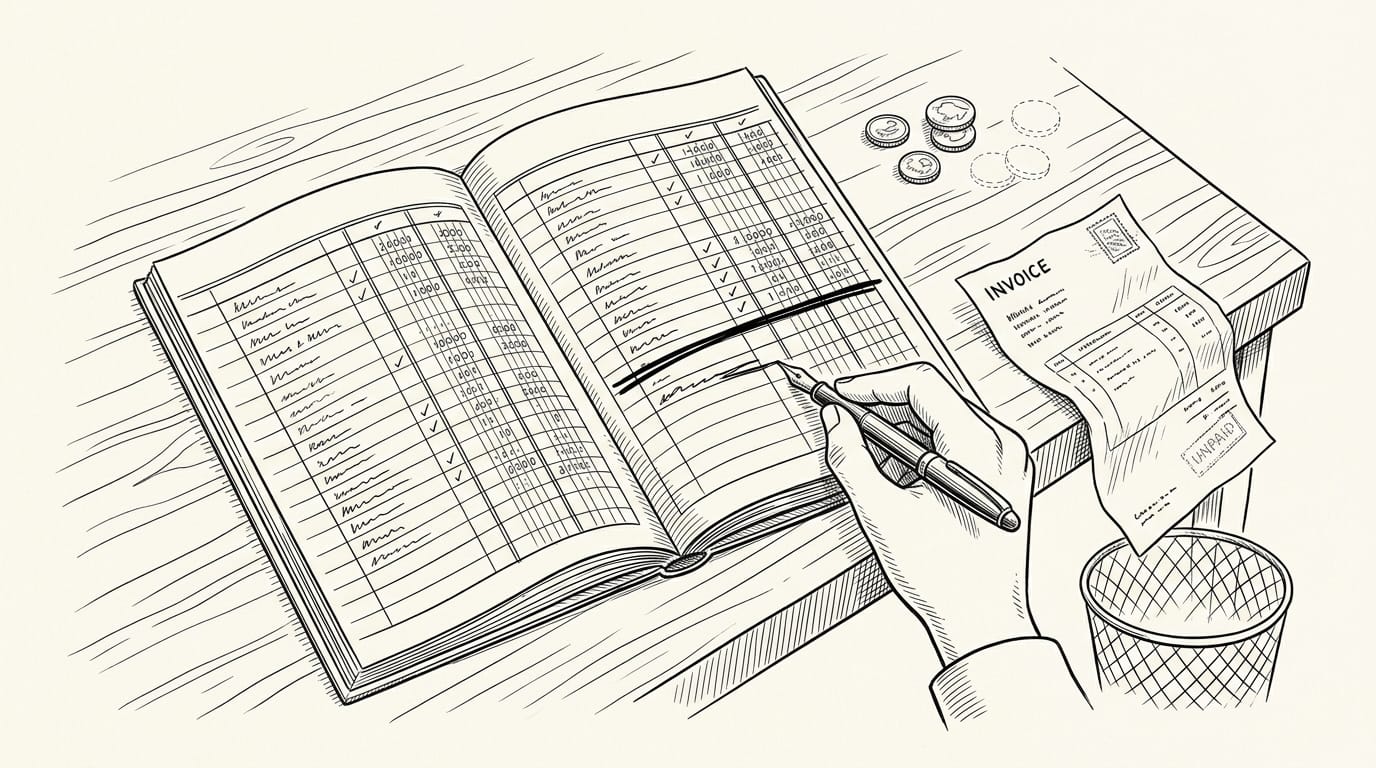
That’s where a write-off comes in. It’s an accounting entry that reduces the value of an asset on your books when you no longer expect to collect or recover it. It’s an honest correction, not a shortcut.
Here, we’ll cover the types, journal entries, effects on your statements, tax treatment, and how to tell a write-off from a deduction.
Write-off Meaning in Accounting and Its Purpose
A write-off is simpler than it sounds. Here’s what it means and when it’s justified.
Recognizing money or value that is lost
A write-off formally recognizes that money or value is gone, whether that’s an uncollectible debt or a worthless asset. You remove it from your books and record it as an expense, so your statements show what you have, not what you hope to collect.
Think of a freelance designer whose client never pays for a finished project. Until she writes it off, her books still count that amount as money on its way. Now they match reality.
What write-offs help a company achieve
Here’s where the payoff shows up:
- Accurate financial reporting. Money that’s gone stops showing up as if it’s still coming in.
- Lower taxable income. The written-off amount counts as an expense, which can reduce what’s taxed.
- Matching principle compliance. Expenses land in the same period as the revenue they helped earn.
- Better decisions and cash flow planning. Current numbers show the cash you can count on.
Deciding when a write-off is justified
Not every unpaid bill is ready for a write-off. The trigger is no reasonable expectation of recovery, and before you get there, keep documented collection attempts like:
- reminder emails
- follow-up calls
- a final notice
Those records back up your decision.
Customer bankruptcy is another clear trigger. If a candle maker’s wholesale customer files for bankruptcy, the money she’s owed is unlikely to arrive, so it’s worth reviewing that balance for a write-off.
Timing depends on certainty, not on how old the invoice is. Write off too early and you may lose money still coming in. Wait too long and your books show income you’ll never see.
Common Kinds of Write-offs
A write-off is when you remove an amount from your books because you no longer expect to recover it. It isn’t free money, though: it only trims the income you’re taxed on.
Writing off bad debts and unpaid invoices
When a customer doesn’t pay, that invoice still counts as money you expect to receive. After a fair effort to collect, it becomes a bad debt you write off.
Consider a freelance designer whose client goes silent after a logo project. After several reminders, she writes off the invoice.
Loan defaults, insolvent clients (ones that can’t pay their debts), and customers who stop paying for months follow the same logic. The test isn’t whether a client promised to pay, but whether you can still reasonably expect it.
Writing off damaged or expired stock
If you sell physical products, shelf stock counts as an asset until it sells. When it’s damaged, expired, or obsolete (no longer sellable because it’s outdated), it stops having value and you write it down. Spoiled or stolen goods get the same treatment.
Think of a home baker selling jam at a farmers market who finds a case of jars with broken seals. She writes off their cost, so her inventory matches what she can actually sell.
Equipment and investments that lose value
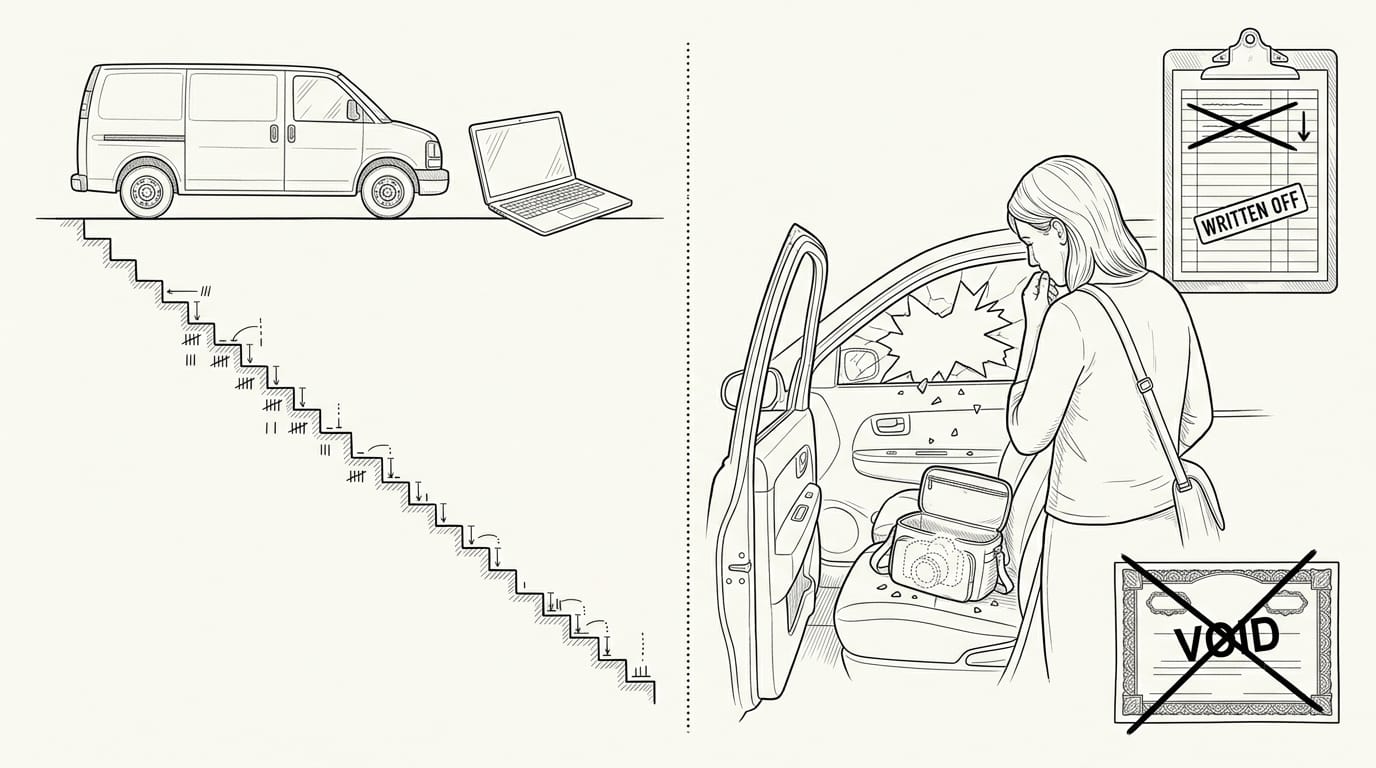
A fixed asset is something you use for the business over several years, like a laptop or a van. Gradual wear is spread out through depreciation, while a write-off clears what’s left when an item suddenly stops being useful.
Picture a photographer whose camera is stolen from her car. Its remaining value comes off the books in full.
Investments work the same way: worthless shares come off your books.
What is a business expense?
When we say business expense, we mean a cost you pay to run the business and earn income, such as:
- Rent for a studio, shared workspace, or desk you use for work.
- Salaries for staff who help with the work.
- Travel to a client meeting, trade show, or supplier.
Deductible business expenses lower the income you’re taxed on. The question is less about what you bought and more about why. A grocery run for your household is personal, even if it happened on the way home from a client meeting. Purpose is the test.
Methods for Booking Write-offs and Journal Entries
Once a balance won’t be paid, it has to leave your books correctly. Accounts payable runs the other way: when you no longer owe a bill, you debit accounts payable to clear it and credit income.
What is writing off accounts receivable?
Writing off accounts receivable means you’ve decided an unpaid invoice won’t be collected. Two things happen.
The receivable leaves your balance sheet (the snapshot of what you own and owe), and the loss shows up as an expense on your income statement (the report of money in and out).
Say a freelance web designer invoices a client $1,000 and the client goes silent. Once she writes it off, her books stop counting money that’s never arriving.
To remove a written-off account, post this entry and keep the client’s history on file in case they pay later.
Recording losses directly when they are certain
When a loss is certain, use the direct write-off method. You debit bad debt expense (the cost of invoices that won’t be paid) and credit accounts receivable.
It’s simple, but it can distort reporting, because the loss lands when you write it off, not when you made the sale.
Using the designer’s $1,000 invoice, the entry looks like this:
- Debit: Bad debt expense, $1,000
- Credit: Accounts receivable, $1,000
Estimating bad debts before they happen
The allowance method takes a different route. You estimate bad debts upfront and record them in an allowance for doubtful accounts, a running balance set aside for expected losses.
This follows the matching principle, which pairs expenses with the revenue they helped create in the same period. It’s preferred under Generally Accepted Accounting Principles (GAAP), the standard rulebook for financial reporting.
For the designer, booking the estimate debits bad debt expense and credits the allowance. When her invoice goes bad, she debits the allowance and credits accounts receivable, so the expense is already on the books.
Recovering money after a write-off
Sometimes a written-off client pays after all. Reverse the original write-off first: debit accounts receivable and credit whichever account you used. Then record the payment by debiting cash and crediting accounts receivable.
It sounds fiddly. It’s really two entries.
If the designer’s client pays later, she reverses the write-off and records the $1,000 payment, so the money shows up once. Recovered money is taxable as income, so it counts as income in your books.
How Write-offs Change Your Financial Statements
Ever wonder where a write-off shows up? Mostly on your balance sheet (what you own) and your income statement (what you earned).
What it does to assets and profit
Four effects stand out:
- Lower asset base. Writing off an item removes its value from your assets, so your balance sheet shows less than before.
- Reduced net profit. It’s booked as an expense, lowering your net profit: what’s left after costs come out of revenue.
- Timing differs by method. Under the direct write-off method, you record the loss once you’re sure an invoice won’t be paid. Under the allowance method, you estimate losses early, so profit takes the hit sooner.
- Non-cash impairment effects. An impairment is a write-down when an asset is worth less than your books say. No cash leaves your bank, yet assets and profit both shrink to match reality.
Consider a side hustler who sells handmade candles and has jars that sat unsold for a year. Once the scent fades, she writes them off. Her profit dips, but her numbers are honest rather than hopeful.
When she applies for a loan, the lender sees books that match her shelf. Smaller, but true.

Downsides and risks to watch for
Watch for these risks:
- Regulatory and audit scrutiny. Large or frequent write-offs can draw a closer look from tax authorities and auditors. Keep proof for each one.
- Credit rating impact. Lenders read your statements before approving a loan, and a sudden write-off can make your profit look weaker.
- Investor perception. One write-off is normal. Repeated ones with no explanation can signal to investors that you’re losing track of what you own.
- Added accounting complexity. Each write-off is another entry to record, track, and explain at tax time. Once they pile up, it may be time for a bookkeeper.
How Write-offs Are Taxed
Tax treatment depends on where you file, so here’s how the United States and India handle write-offs.
Tax rules for write-offs in the US
A write-off generally lowers your taxable income, the figure your tax is calculated on after deductions.
The Internal Revenue Service (IRS) bad debt rules control when you can claim one. For tax purposes, the direct method lets you deduct a bad debt in the year you decide it’s worthless.
Proof of worthlessness is the hard part. A bill that’s late isn’t worthless. Keep your reminders and any client replies as evidence.
Take a freelance designer whose client goes silent after the final invoice. Her unanswered reminders become her proof, and she can deduct the loss once she decides the debt is gone.
What Indian tax law says about write-offs
- Section 36(1)(vii) covers bad debts you write off as a deduction.
- Section 36(2) sets the conditions a debt must meet before the deduction applies.
- Section 41(4) covers recoveries. According to Tax Update India, a bad debt written off earlier and later recovered is taxable in the year you receive it.
- Section 36(1)(viia) covers banks’ provisions, so it matters mainly for lenders.
- Section 37(1) covers general business expenses that don’t fit a more specific section.
A write-off lowers your income, but a recovery adds to it. Say a Pune freelancer wrote off an unpaid invoice, then the client pays in full later. Under Section 41(4), she must count that payment as income in the year she receives it.
How Write-offs Differ from Similar Terms
Several accounting terms look like write-offs but work differently.
Write-offs, write-downs, and write-ups compared
A write-off removes an unrecoverable amount, like an unpaid invoice, from your books. A write-down lowers a value without erasing it, and a write-up raises it.
- Full versus partial reduction. A write-off takes the balance to zero. A write-down cuts it partway, leaving some value on the books.
- Reversal possibilities. A write-off is typically final. A write-back reverses an earlier write-down, raising recorded value again once the reason for the cut is gone.
- Income statement impact. Write-offs and write-downs show up as expenses that cut profit. A write-back adds income when value returns.
Write-offs versus gradual depreciation and amortisation
Depreciation and amortisation spread an asset’s cost over the years it’s used, so they’re easy to confuse with a write-off.
- Immediate versus gradual. A write-off lands all at once. Depreciation and amortisation spread it out over time.
- Tangible versus intangible assets. Depreciation covers physical things like a laptop. Amortisation covers intangibles like a software license. A write-off can hit either.
- Unpredictable versus scheduled. A write-off follows something going wrong, like a client who stops paying. Depreciation and amortisation follow a schedule set in advance.
Why a write-off isn’t a loan waiver
Think of a freelance designer whose client goes quiet with an invoice still unpaid. She writes the invoice off so her books stop counting money she may never see. The books change. The debt doesn’t.
- Debt legally still owed. The client still has to pay, and you can still record a late payment.
- Accounting action versus tax benefit. The write-off is an accounting entry first. Whether it also cuts your tax bill depends on your tax rules, which is a separate question.
Good Habits and Mistakes to Avoid
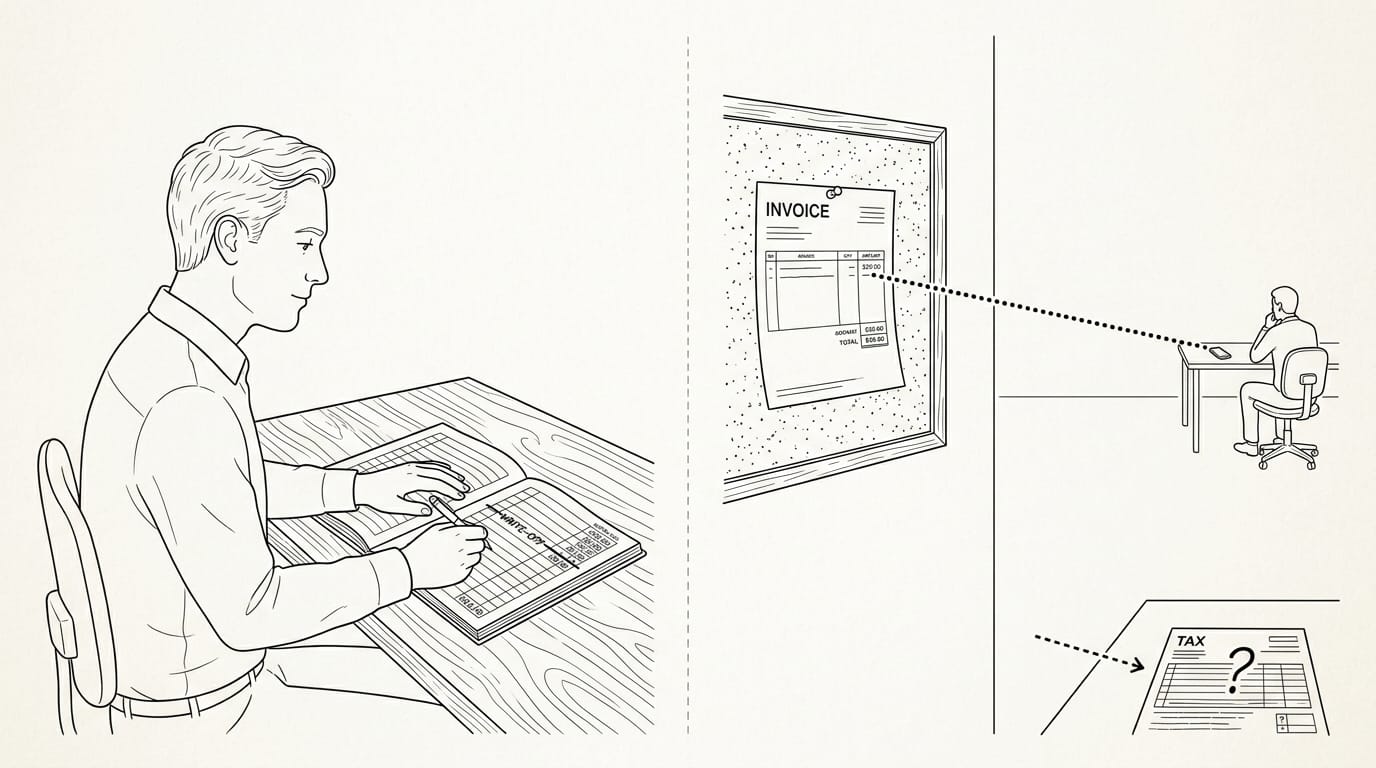
A write-off should be the last step, not the first. Here’s how we’d make yours hold up.
Keep records and get approval first
- Collection records. Log every reminder, call, and email to a client who hasn’t paid.
- Senior approval required. Have a second person sign off. Solo? Ask your bookkeeper.
- Separation of duties. Don’t let one person bill, record payments, and approve write-offs.
- Standard request forms. Use one template: customer, invoice number, amount, what you tried, and why.
A two-person photography studio splits billing from approvals. When a $300 invoice stalls, the second partner checks the reminders and may find the client is just late. Check first, write off later.
Ways to improve your write-off process
- Integrate financial systems. Connect invoicing, banking, and bookkeeping so unpaid bills show in one place.
- Monitor write-off trends. Watch the pattern across quarters, not each write-off alone. A rising trend often signals a pricing or client problem.
- Automate estimates. Let software estimate likely losses from past results instead of guesses.
- Review aging reports. An aging report sorts unpaid invoices by days overdue, so chase the oldest first.
Mistakes people make with write-offs
- Confusing write-down with write-off. A write-down lowers a value; a write-off removes it entirely.
- Ignoring tax conditions. A write-off in your books isn’t automatically a tax deduction. Tax rules usually require the debt to be truly uncollectible.
- Inadequate documentation. Without those records, a write-off is just a number you typed in.
- Using the direct method under Generally Accepted Accounting Principles (GAAP). The direct method books a loss only once one invoice is judged bad, which can shift it to a different period than the sale. GAAP generally requires the allowance method, which estimates losses up front.
Real Examples and Common Questions
Big banks and companies write off bad debt too, so the same logic applies at every size.
Write-offs at well-known banks and firms
- Indian bank write-offs. Non-performing assets (NPAs) are loans where repayments have stopped or fallen far behind. According to the Reserve Bank of India, Indian banks have written off NPAs.
- News Corp and Dow Jones. The scale is far bigger, but the bookkeeping is the same: an amount judged uncollectible comes off the books.
- Washington Mutual crisis. When unpaid debts pile up faster than a business can absorb them, write-offs stop being a routine step. Small, timely write-offs keep your own books honest.
Answers to the questions people ask most
Continuing collection after write-off. Writing off an invoice doesn’t cancel the debt, so you can keep collecting. Say a freelance photographer writes off a $300 invoice, then gets $150 from the client months later.
She records it as a recovery, not a new sale. Late money still counts.
Credit score effects. A write-off changes your own books, not your credit score. Sending an unpaid bill to a collections agency is a separate step with its own consequences, so check before you take it.
How long to wait. No single waiting period fits every business. Pick a rule, like writing off after a set number of months of follow-up, and apply it the same way each time.
Is it a tax deduction? Not automatically. Whether a write-off lowers your tax bill depends on how you file and whether that income was ever counted as earnings, so confirm with a tax professional first.
Write-offs aren’t about giving up on money. They’re about keeping your books honest, so your profit picture matches what’s really happening in your side hustle.
Record what you won’t collect, note why you wrote it off, and check the tax treatment before you file. Those habits make it far easier to spot what’s actually working and what needs a rethink.
Honest books now mean fewer surprises later.
References
- Publications — rbi.org.in (2025)
- Bad Debts Deduction Under Section 36(1)(vii) Before the September 30, 2026 Tax Audit: The Write-Off Test and the Move to Section 31 of the Income-tax Act 2025 — taxupdate.in (2026)
Questions
What is a business expense?
A business expense is a cost paid to run a business and earn income, such as rent, employee salaries, or work-related travel. Deductible business expenses can lower taxable income; whether a cost qualifies depends largely on its business purpose.
What is writing off accounts receivable?
Writing off accounts receivable means removing an unpaid customer invoice from the books when there is no reasonable expectation of collecting it. The receivable is credited and a bad debt expense is debited, or an allowance for doubtful accounts is used if the loss was estimated earlier.
What is the meaning of write back in accounting?
In accounting, a write-back generally reverses a previous write-down, increasing an asset’s recorded value when the reason for reducing it no longer applies. It can be recorded as income, increasing profit.
How do I remove a written off account?
To remove a written-off receivable, debit bad debt expense and credit accounts receivable under the direct write-off method. If you use an allowance, debit the allowance for doubtful accounts and credit accounts receivable; keep the customer’s history on file in case they pay later.
How do you write-off accounts payable?
When you no longer owe a payable, debit accounts payable to clear the liability and credit the appropriate income or gain account. Confirm that the obligation is actually canceled or no longer due, and retain supporting documentation for the entry.