7-6
Market Research to Start a Business: Complete Guide
Market research helps you start a business by testing demand cheaply before you quit your day job, then turning findings into a practical business plan.
- Written by

- Published
- Updated
- Reading time
- 14 min read
- Sources
- 4 cited
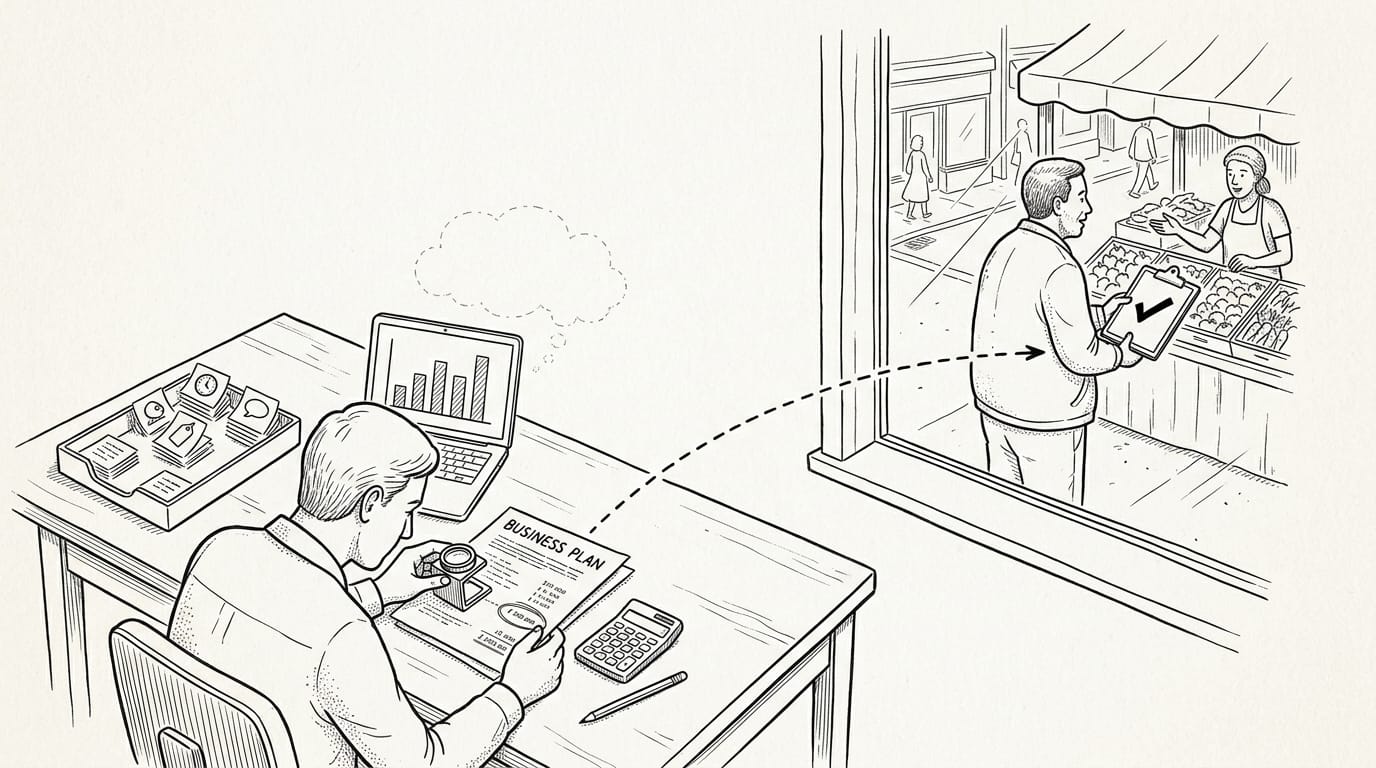
Market research for starting a business means gathering and analyzing information about customers, competitors, and the market to find out whether people need your offer and what they will pay. Combine existing data with direct customer conversations and low-cost tests, then use what people actually do to refine your audience, pricing, and business plan. Testing demand before investing heavily helps you make a practical go, change, or stop decision while mistakes are still cheap.

In this guide
Think about the last time you bought something big. You likely checked reviews, compared prices, and asked a friend who’d already bought one.
That’s the instinct behind market research: finding out whether people actually want what you plan to sell, who they are, and what they’d pay for it.
This post covers the main research types, a step-by-step process, key areas to focus on, and tools that speed things up. We’ll also show you how to test demand cheaply before you quit your day job.
Market Research Before You Start a Business
Before you spend money on a new idea, we’ll look at what market research covers and why it’s worth doing first.
What market research actually covers
Market research means gathering and analyzing information about customers, competitors, and the market you’re entering. It covers three areas:
- Collecting and analyzing market data. See how big the market is and where it’s heading.
- Customers, competitors, and industry trends. Learn who buys, who sells, and what’s changing.
- Fact-based, not assumption-based decisions. Choose each step from evidence, not gut feel.
The goal is evidence rather than hunches. Take a freelance designer who wants to sell invoice templates to caterers. She checks which caterers already buy templates and what they pay. Those answers turn a vague idea into a plan she can test.
What good research gets you
Good research pays off in five ways:
- Spot gaps and opportunities. Find needs that current options miss.
- Reduce risk and avoid costly mistakes. Learn what won’t work before you pay for it.
- Clarify who customers are. Swap a vague audience for a specific buyer.
- Sharpen marketing messages. Use the words your customers already use.
- Validate or adjust the idea. Confirm it works, or change it while changes are still cheap.
Why so many startups fail without research
According to a 2026 survival-rate analysis of U.S. businesses, about 22% of new U.S. businesses close within their first year, about 49% within five years, and about 65% within ten.
Lack of market need is a documented cause of failure. A PMFtracker review of startup postmortems cites CB Insights’ analysis, which found that 42% of failed startups cite no market need as the reason.
Guesswork versus evidence is the real divide. Build on a hunch, and you learn whether people want it after you’ve spent the money. Research flips that order.
How research wins over investors and lenders
Investors and lenders want proof rather than enthusiasm. Good research gives them three things:
- Data showing demand. Evidence that real people are looking for what you offer.
- Projected profitability. A realistic estimate of prices, costs, and margins showing the business can pay its way.
- Commitment to market fit. Proof you tested the idea, not just dreamed it up.
A plan built on hopes gives a lender little to check. One built on what customers actually said gives them something to verify.
Research Types and Methods to Choose From
Not every method suits every idea, so choose yours on purpose. Here’s what each one does well, and where we’d start.
Your own data versus existing sources
Research data comes from two places. Firsthand data is what you collect yourself, like survey answers or a simple sales test. Existing third-party data is research someone else already published, such as industry reports or government figures.
It’s quicker to find but may not match your niche exactly.
Combine both: existing sources show market size, and your own data shows whether your version appeals to people in it.
Numbers versus the reasons people buy
A paper on qualitative and quantitative research in marketing draws the line: quantitative research uses numerical data to identify patterns, while qualitative research helps explain the reasons behind buyer behavior.
Numbers and statistics tell you what people do. Conversations tell you why.
Most side hustlers need both, so plan your time and budget for each. Lean on numbers to check market size and on conversations to learn what would make someone choose you.
Picking surveys, interviews, or focus groups
Here are the main options:
- Surveys and questionnaires: Written questions sent to a group, often online.
- One-on-one interviews: A longer conversation with one person to dig into the reasons.
- Focus groups: A small group talking through your idea together.
- Survey panels: Pre-recruited groups who’ve agreed to answer questions.
Surveys reach the most people but stay shallow, while interviews go deep with only a few. Focus groups and panels land in between. Pick the simplest method that answers your question. Cheap beats perfect.
Think of a home baker testing a weekly sourdough subscription. A short neighborhood survey shows how many might sign up, and a few interviews reveal why they’d pick her loaves over the grocery store’s.
That’s enough to decide whether buying flour in bulk is worth the risk.

Where to find existing market data
Check these before paying for new research:
- Industry reports: Studies on a sector’s size and trends. Some are free, and others cost money.
- Government and census data: Official figures on population, income, and businesses in an area.
- Google Trends: A free tool from Google showing how often people search a term over time.
- Trade publications and news: Industry magazines, newsletters, and sites that show what’s changing.
- Academic journals: Peer-reviewed studies. Thorough but dense, so start with each summary.
Newer tools like chatbots, VR, and eye-tracking
These tools gather feedback in new ways:
- Chatbots: Automated chat programs that can ask website visitors questions at any hour.
- Virtual reality (VR): Simulated spaces where people can try a product or store layout before you build it.
- Eye-tracking tools: Software that records where people look on a page, showing what gets noticed and skipped.
Start with the basics, then add these when a specific question calls for them.
Your Research Process, Step by Step
Good research doesn’t have to be big or expensive. Here’s a practical path we’d suggest you work through in your spare time.
What are the 7 basic questions in market research?
You don’t need a memorized checklist. Start with the question that matters most: what decision are you trying to make? This is less about collecting data and more about answering it.
Write it as one specific sentence, like “Will busy parents pay for a weekly meal-prep service?” Then note whether you’re testing for yourself or convincing investors, and set your objectives before you collect anything.
Budget wisely and focus on what matters
- Preliminary research budget. Set a limit before you start, even if it’s zero.
- Prioritize key findings. Chase answers that would change your decision, not every interesting fact.
- Start with free secondary sources. Public data, industry articles, and competitors’ websites cost only time.
- Cap research to evenings and weeks. Set a fixed window so it fits around your day job instead of swallowing it.
Figure out exactly who your buyers are
Start with demographics (age, location, job) and motivations (why they’d buy). Then split your audience into segments with different needs, and write a buyer persona for each: a short profile of one typical customer.
Consider a home baker testing a cake-decorating class. Parents wanting a weekend activity and small business owners needing custom cakes might both sign up, but they need different pitches.
Personas tell her which pitch goes to which group, and that’s the difference between a sale and a shrug.
Finding people willing to take part
- Existing and former customers. Current and past buyers are often the easiest to reach and the most candid.
- Word of mouth. A friend’s introduction usually gets a better hearing than a cold email.
- Social media calls. Post a short invitation where your audience already gathers, offering a quick call.
- Dedicated research platforms. Paid services can recruit people who match your criteria.
Writing neutral questions and running the study
- Neutral, non-leading questions. Ask “How do you handle invoicing now?” instead of “Don’t you hate chasing late payments?”
- Tailored questions. Match each one to a segment and the decision you’re making.
- Reduce interviewer bias. Stay quiet after you ask, and don’t pitch mid-conversation.
- Customer discovery approach. Learn what frustrates potential customers before you build anything.
Sample customer questions to start with:
- What’s the last time this problem came up for you?
- What have you tried so far, and what happened?
Turn findings into changes you can make
- Spot trends and patterns. One comment is an anecdote. The same complaint across several conversations is a pattern.
- Market, competitor, and customer insights. Sort findings into those three buckets, then write an actionable report that opens with your decision.
- Refine your plan with gaps. Where research shows an unmet need, adjust your offer before you spend.
Even YouTube started elsewhere: a Yahoo Tech story reports that its early concept was a video-dating service before it became a general video-sharing platform.
Decide go, fix, or stop. Go when demand is clear. Fix when the problem is real but your offer misses it. Stop when people don’t care, and count that as a cheap lesson.
Watch for two common mistakes:
- Bias. Surveying only friends, or asking leading questions, gives you flattering answers.
- Tiny samples. A couple of conversations isn’t proof. Keep going until the same patterns repeat.
Good research doesn’t tell you what you want to hear. It tells you what to do next.

Where to Focus Your Research
Research should zero in on the few questions that decide whether an idea is worth pursuing.
What your customers need and spend
Start with buyers. Focus on what they already spend, not just who they are.
- Needs, pain points, and preferences. What problem are they solving now, and what do they care about most?
- Purchase habits. Where do they buy, how often, and who makes the call?
- Spending power. Can they afford what you plan to sell?
Picture a side hustler selling dog treats. She asks park owners what they wish their treats did better, and that answer shapes her first recipe.
Sizing up what your competitors are doing
- Strengths and weaknesses. What do they do well, and what do reviews complain about?
- Messaging and content. How do they describe what they sell, and what do their posts emphasize?
- Gaps your offering fills. Which needs go ignored or underserved?
- Market share. This is the slice of total sales each competitor captures.
Don’t copy what competitors say; study what they leave out. Those silences are your opening.
Trends and market size, TAM to SOM
- Growth and changing preferences. Is demand rising, flat, or shifting?
- Market size and saturation. How many buyers are served, and how crowded is the space?
- Historic product performance. How have similar products sold before?
The total addressable market (TAM) is everyone who could buy something like your product. The serviceable available market (SAM) is the part you can reach through your channels.
The serviceable obtainable market (SOM) is the share you can realistically win early on.
A candle maker’s TAM covers every buyer in the country, but her SOM is the regulars at her local market. A huge TAM means little if you can’t reach those buyers. Be honest about the SOM.
Pricing, location, costs, and what buyers pay
- Pricing. What do comparable products sell for, and what do you keep after costs?
- Location. Does where you sell help or hurt demand?
- Operating and marketing costs. What does each sale cost to make, ship, and promote?
- Labor needs. How many hours will it take, and who does them?
- Testing willingness to pay. Willingness to pay is the highest price a buyer will accept.
A freelance photographer testing weekend mini-sessions offers two rates in a local parents’ group and books the one that fills first. Asking ‘would you buy this?’ gets polite yeses.
A small deposit or pre-order shows what people do, which matters more than what they say. Ask for money, not opinions.
Running a SWOT check on your idea
A SWOT analysis sorts what you’ve learned into four parts:
- Strengths and weaknesses. These are internal, like your skills and time. Where do you have an edge, and where do you fall short?
- Opportunities and threats. These are external, like trends or new competitors. What could help you, and what could hurt you?
Keep each list short, and aim for a clear answer: is this idea worth the next step?
Tools and AI That Speed up Research
Software can handle much of the busywork, leaving you free to focus on the decisions. Here’s where each type fits.
Survey platforms and panels for targeted groups
Online survey platforms let you send the same questions to many people and collect every answer in one place.
Participant panels are pools of people who have agreed to take surveys, so you can reach the exact profile you need.
Targeted segment deployment means sending your survey only to the group you care about. If you’re testing a weeknight meal-prep service, ask only working parents. Focus on who answers, not just how many.
AI for faster analysis and desk research
Real-time data gathering lets you watch results as responses come in, so you can spot a pattern early.
Faster analysis is where AI helps most. It can group open-ended answers into themes, so you aren’t reading every comment by hand.
AI business plan generator tools can draft a plan quickly. Treat that draft as a start, and check every figure against your own costs.
Use AI for desk research only. Desk research means digging into existing information, like published reports and competitor sites. AI can speed that up, but it can’t stand in for customers.
An AI summary tells you what might be true, while your own surveys tell you what is. Check it yourself.
Analytics and marketing tools to track results
These tools show who’s paying attention and what they do next.
- Buzzsumo and SEMrush. Buzzsumo shows which content gets shared most in your topic. SEMrush shows what people search for and which competitors rank for it.
- Google Analytics. It tracks how visitors reach your site and what they do once they arrive. A simple landing page test shows whether anyone is looking.
- Marketing automation software. It handles repetitive follow-up, like a welcome email to everyone on your waitlist, and tracks who opens it.
Research Techniques That Cost Very Little
Good research doesn’t need a big budget.
Learning from forums, groups, and reviews
- Quora questions. Search the questions people ask about your topic.
- Reddit subreddits. Reddit’s topic communities. Scan the most-replied threads.
- Facebook groups. Scroll for repeated complaints and recurring questions.
- Amazon book reviews. Five-star reviews show what readers value; one-star reviews show what they wish were different.
Asking customers and tracking what they do
What people say and what they do often differ.
- Post-purchase surveys. Ask recent buyers what sold them and what nearly stopped them.
- Non-purchase surveys. Ask people who looked but didn’t buy what held them back.
- Website analytics. Show where visitors arrive and where they leave.
- Marketing automation tracking. Software that logs which emails get opened and links get clicked.
- Short customer interviews. Ask about the problem, not your idea.
The 50/100/500 rule is a startup rule of thumb: about 50 conversations to confirm a problem is real, 100 survey responses to see whether it’s widespread, and 500 people reached to see whether they’ll act.
Picture a home baker who wants to sell weekly meal-prep boxes. She asks coworkers what they struggle to cook on busy weeknights. When the same complaint keeps coming up, she knows the problem is real before buying a single container.
Pre-selling means taking orders before building or buying anything. She could take orders first and buy ingredients only after payment comes in. Compliments are free, so watch the wallet.
Free and cheap data to start with
- Public government data. Population and employment figures show how many people in your area might need what you sell.
- Google Trends. Shows whether searches for your topic are rising, falling, or seasonal.
- Competitor public materials. Pricing pages and reviews show what others charge and promise.
Turning Research into Your Business Plan
Research only pays off when it lands in your business plan. Here’s where each part of it comes from.
Plan sections that research should shape
Each section needs different evidence:
- Market analysis: who buys, and who else sells to them.
- Financial projections: your prices and costs, tested against what buyers will pay.
- Strategy and marketing: the channels you’ll use and the offer you’ll lead with.
- Executive summary: a one-page overview, written last so it reflects what you found.
Why your plan guides decisions and funding
Your plan is a roadmap for decisions, like whether a new product still fits your numbers. Lenders and investors usually want one before they commit money, and a plan built on evidence beats one built on hope.
Update it regularly. Sales come in and costs shift, so revisit your plan on a set schedule. Plans go stale fast.
Coffee shop, real estate, and theater examples
Consider someone opening a coffee shop. Their market analysis might show the nearest competitor closes at noon, pointing to a morning-and-lunch menu. Their financial projections then test whether the foot traffic covers rent.
A side hustler buying a rental unit needs a realistic rent, an honest vacancy estimate, and a repair budget in the real estate plan. If the numbers only work at full occupancy, you’ll see that before you sign.
A movie theater’s strategy and marketing come from local research: which films draw the crowd, which showtimes suit commutes, and how concessions add to ticket sales. The plan then reflects the town it serves, not hunches.
Good market research turns guesswork into evidence. You learn who your customers are, what they struggle with, and what they’ll pay, all before you spend your savings or weekends on a product nobody asked for.
Start small. Run a few customer interviews this week, put a simple offer in front of real people, and let their response guide your next step. Every answer makes your plan more honest and your decisions easier.
Demand either shows up or it doesn’t. You’d rather learn that from a few honest conversations than from a resignation letter.
References
- Qualitative and Quantitative Research in Marketing — doi.org (2024)
- What Percentage of Businesses Fail? Survival Rates by State (2026) — mainstayfiling.com (2026)
- What “No Market Need” Actually Looks Like: 5 Postmortems — pmftracker.com (2026)
- The first video uploaded to YouTube, 18 years ago, featured cofounder Jawed Karim at the zoo. Watch it here. — yahoo.com
Questions
What is the 50/100/500 rule startup?
The 50/100/500 rule is a startup rule of thumb for testing demand: have about 50 conversations to confirm the problem is real, collect 100 survey responses to see whether it is widespread, and reach 500 people to gauge whether they will act. Treat these numbers as practical targets, not a guarantee of success.
What are the 7 basic questions in market research?
Seven useful market research questions are: Who are the target customers? What problem or need do they have? How do they solve it now? What do they buy, and how often? How much are they willing and able to pay? Who are the competitors? What would make customers choose this offer? Tailor the questions to the decision you need to make.
How to research a business market?
Start by stating the decision you need research to answer, then identify your target customers and competitors. Review existing sources such as government data, industry reports, search trends, and competitor reviews, and collect firsthand evidence through neutral surveys, interviews, or a small sales test. Look for repeated patterns in demand, pricing, costs, and unmet needs, then use the findings to decide whether to proceed, revise the offer, or stop.
What business can make $10,000 a month?
Many kinds of businesses can reach $10,000 in monthly revenue, including consulting or freelance services, online education, software, e-commerce, and local services. Whether one reaches that amount depends on pricing, customer demand, costs, sales volume, and the owner's skills and capacity. Revenue is not the same as profit, so account for operating and marketing costs.
Is market research a hard job?
Market research can be demanding because it takes careful planning, recruiting suitable participants, asking unbiased questions, and interpreting the results. It does not have to be complicated or expensive: begin with free existing data, a few customer conversations, and a simple test of a real offer. The work becomes more manageable when you focus on evidence that could change your decision.
Sources
- What Percentage of Businesses Fail? Survival Rates by State (2026), mainstayfiling.com,
- What "No Market Need" Actually Looks Like: 5 Postmortems | PMFtracker, pmftracker.com,
- Qualitative and Quantitative Research in Marketing, doi.org,
- The first video uploaded to YouTube, 18 years ago, featured cofounder Jawed Karim at the zoo. Watch it here., yahoo.com