5-11
How Do You Get Net Sales? A Practical Guide
How do you get net sales? Subtract returns, discounts, and allowances from gross sales, then see how late returns and fees affect the final figure.
- Written by

- Published
- Updated
- Reading time
- 8 min read
- Sources
- 1 cited
Net sales is the revenue your business keeps after subtracting returns, partial refunds or allowances, and discounts from gross sales. Calculate it for a chosen period using gross sales minus those deductions; do not subtract sales taxes, operating costs, or cost of goods sold, and check separately how fees are recorded. Track net sales regularly to spot rising refunds or discounting and make budgets, forecasts, and sales goals reflect revenue you can count on.
In this guide
Imagine a Saturday yard sale. The cash box is full by afternoon, but it’s not the whole story. A buyer returned a lamp that didn’t work, and you knocked a few dollars off a table for a neighbor.
The money left in the box is closer to what you actually took in. Net sales works the same way: it’s your total sales after subtracting returns, discounts, and allowances (price cuts for damaged goods).
This post covers how to calculate it, what does and doesn’t come off the top, and the tricky edge cases like late returns and fees, plus how to track it.
How Do You Get Net Sales and Why It Matters
Your headline sales total shows what customers ordered. Net sales shows what you actually kept, and we’ll show you how to track it.
Revenue left after deductions
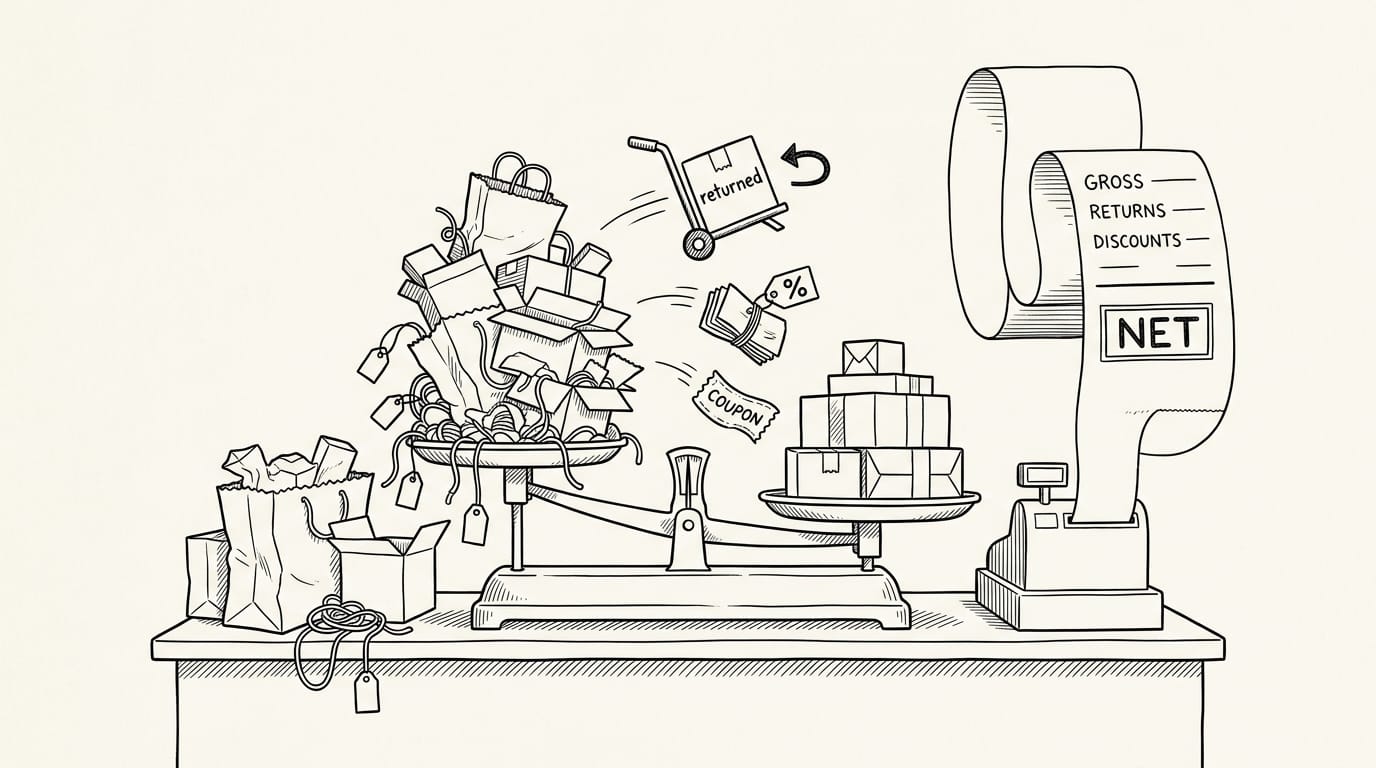
Net sales is revenue after deductions. Start with gross sales, the total of every order before anything comes off. Subtract:
- returns (items sent back for refunds)
- allowances (partial refunds for damaged goods)
- discounts (price cuts and promo codes)
Net sales sits on your income statement, the summary of money in and out over a set period.
Headline revenue is the big number on your dashboard. Real revenue is what’s left after deductions. Plan around the smaller one. Choosing between revenue and sales as your main figure is a decision worth making early.
Why tracking net sales pays off
Picture a candle seller on an online marketplace. Her gross sales jump in December, but January returns pile up and her net sales end up flatter.
She tracks net sales monthly, so she spots the pattern early and checks for a product issue or holiday discount.
Tracking net sales helps you:
- Spot revenue trends before they snowball.
- Evaluate performance and profit against your costs.
- Identify revenue-draining deductions like climbing returns.
- Benchmark against industry peers.
- Build investor credibility with clean, consistent figures.
Using net sales to plan ahead
Build your budget and forecast on net sales so you don’t plan to spend money that returns will take back. For cash flow management, net sales shows the money you can count on for reorders and bills.
Set sales quotas on net sales so a month of heavy discounting can’t pass for a win.
Net sales also feeds your gross profit margin: subtract the direct cost of what you sold, then divide the rest by net sales. Get that number right first.
How Gross Sales and Net Sales Differ
Two numbers sit at the top of most sales reports, and they’re easy to mix up. The gap between them says a lot about your business.
Is net sales just total revenue?
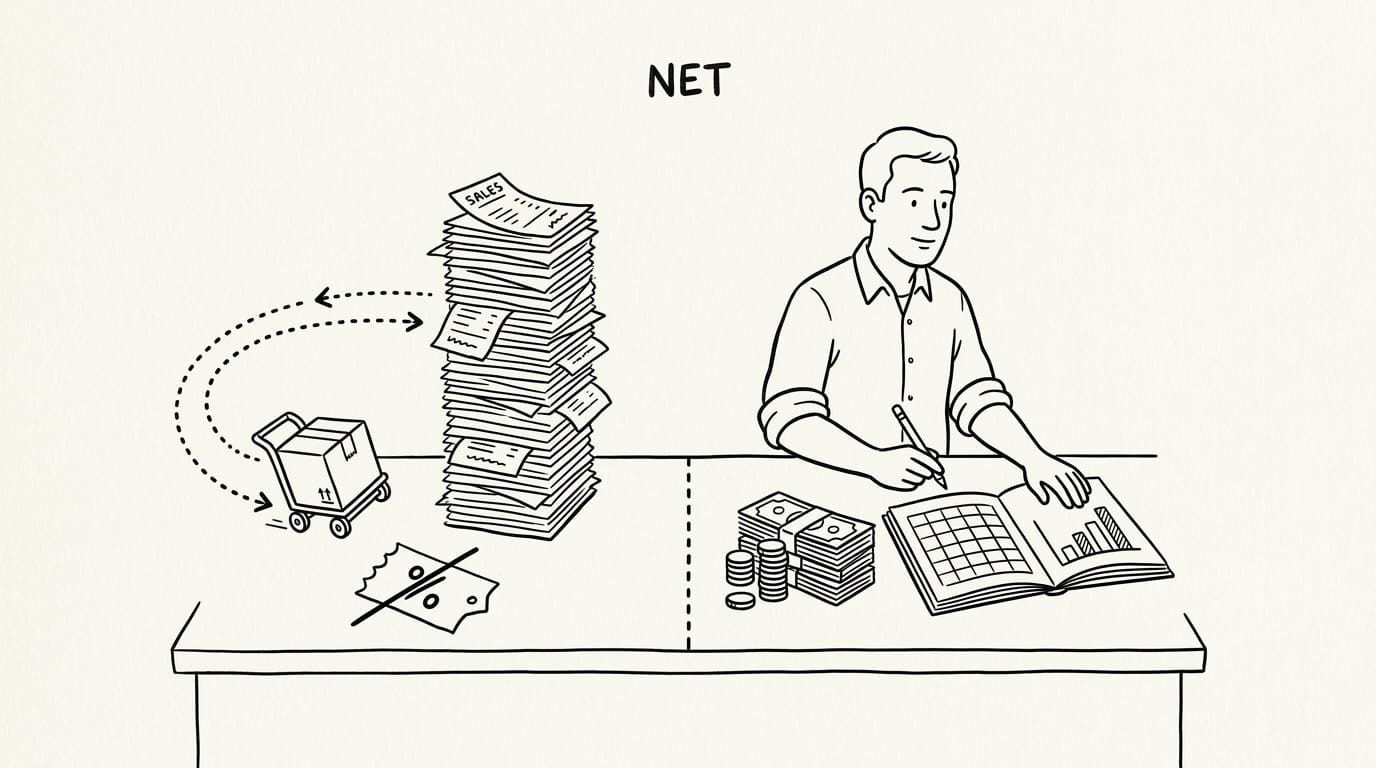
Not quite, and the terms often get blurred. Gross sales is the total before anything comes off: every order at its full price. Net sales is what remains after returns and discounts are subtracted. Gross is what you billed; net is what you kept.
Net sales also isn’t net profit. Net sales stops at returns and discounts, while net profit keeps going and subtracts the costs of running the business.
Gross still has a job. It’s a useful baseline for seeing how much your product is moving, because it shows demand before returns and discounts muddy the picture.
Net is the sturdier sign of health. Say a side hustler sells handmade candles and books $5,000 in a month, but refunds $800 and gives $400 in holiday discounts. Her gross looks strong, yet her net is $3,800. That’s the number to budget around.
Reading the gap between the two
A large gap is a flag worth checking. Work through these four points:
- Returns or discounts. A wide gap usually points to one or both, so find out which is driving it.
- Pricing policies. If discounts or refunds are the cause, re-evaluate your pricing policies. A one-time promotion can quietly become your normal price.
- Short-term profitability. A busy sale month can look great on gross while shrinking what you keep.
- Competitors. Compare your gap with similar sellers to see if it’s normal for your niche.
Working Out Your Net Sales Figure
Here’s how to get a figure you can actually plan around.
Subtract deductions from gross sales
Start from total sales. Your gross sales is what customers paid before refunds or price cuts. Subtract the deductions to get your net sales:
Net sales = gross sales - (returns + allowances + discounts)
Returns are refunds, allowances are partial credits for flawed items the customer keeps, and discounts are reductions given at checkout. Write it as one line or itemize each deduction. Either way, net sales is what you kept, not the receipt total.
Real shop examples to follow
A small clothing shop with $10,000 in gross sales has $600 in returns, $150 in allowances for a torn hem, and $400 in discounts. Net sales is $8,850.
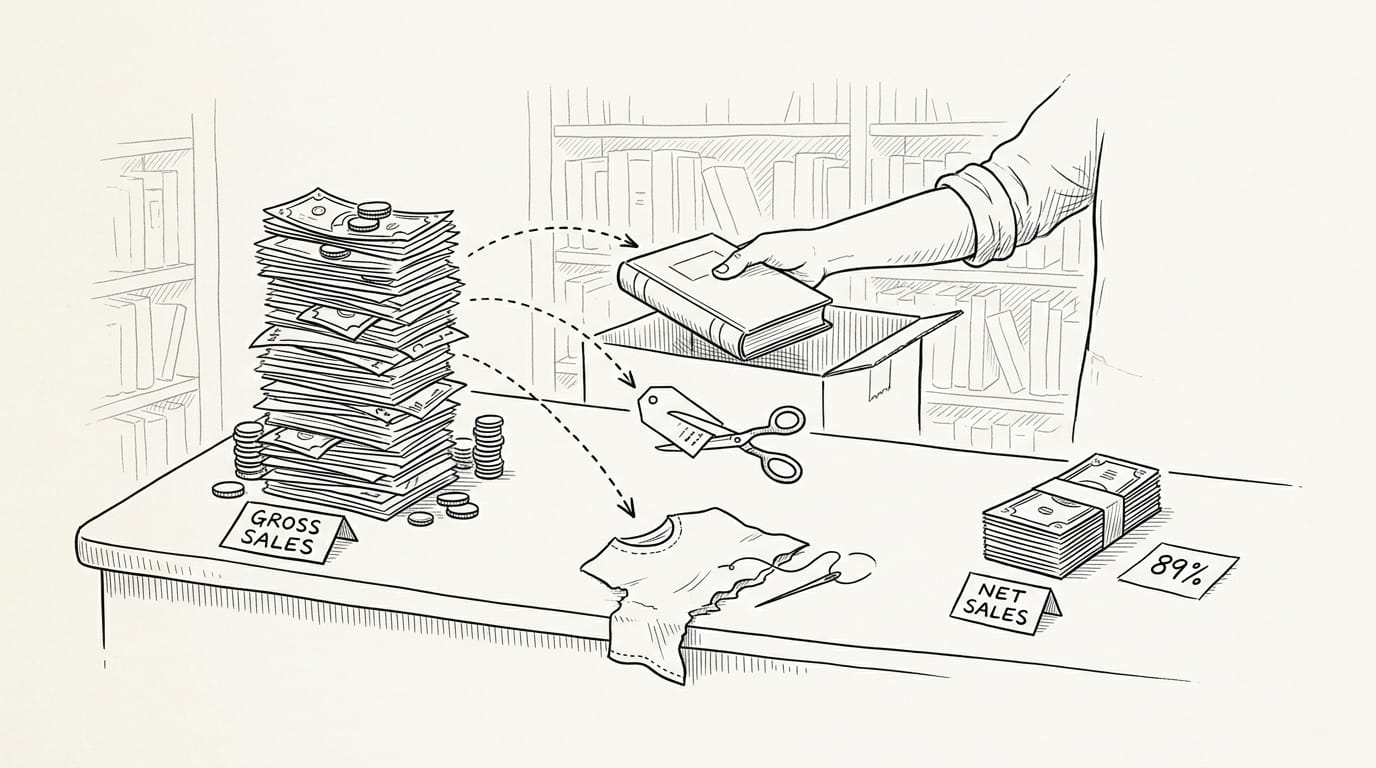
A bookstore with $5,000 in gross sales works step by step:
- Start with $5,000.
- Subtract $250 in returns, leaving $4,750.
- Subtract $300 in discounts, leaving $4,450 in net sales.
To see your net as a percent of gross, divide net sales by gross sales. The bookstore keeps 89%.
An online candle seller logs $2,000 in gross sales, with $260 in returns, allowances, and discounts. Net sales is $1,740, or 87% of gross. That’s the number to plan next month’s stock around, not the $2,000 that came in.
Adding up net sales by period
The same method works for monthly, quarterly, or annual periods. Quarterly and annual totals add up the months inside them, so the candle seller’s $1,740, $1,900, and $2,100 make a $5,740 quarter.
For the year, add the twelve monthly figures rather than averaging them. Get each month right, and the year follows.
What Chips Away at Gross Sales
Gross sales is everything you ring up before anything comes off. Net sales is what’s left, and this is where small sellers most often lose track.
When customers send products back
When a customer sends an item back for a full refund, that sale stops counting.
An older accounting text, An Accounting System for the Retail General Store, explains that sales returns are deducted from gross sales because a returned article is really not sold.
Return windows usually run 30 to 90 days, and you set yours. A return that arrives after your period closes is a timing question: decide how you’ll handle it, write the rule down, and apply it every time.
A few returns are normal, but a rising pile points to a problem with the product, the listing, or the expectations you set. Picture a side hustler selling $40 candles from her kitchen table.
Six of 50 come back for full refunds, so $240 never stays in her account, even though her gross number looks strong.
Partial refunds for damaged goods
Sometimes the customer keeps the product and you refund part of the price, because it arrived defective or damaged. A full return takes back the whole sale. A partial refund takes back only part of it.
These are less frequent than returns, but they still come off your gross sales.
Early payment, bulk, and coupon discounts
Discounts feel like marketing. They’re also deductions:
- Early payment discounts reward customers who pay quickly.
- Bulk purchase incentives reward bigger orders.
- Coupons and promotions bring in new buyers.
Each one lowers what the customer pays, and that lowers what you keep. On a thin-margin product, a discount that seems generous can wipe out most of your profit. Before you cut prices on a thin-margin product, learn how to calculate your break-even point.
What Never Counts Toward Net Sales
Some money that moves through your business never belongs in net sales. Knowing what stays out keeps your number honest from the start.
Why taxes and duties stay out
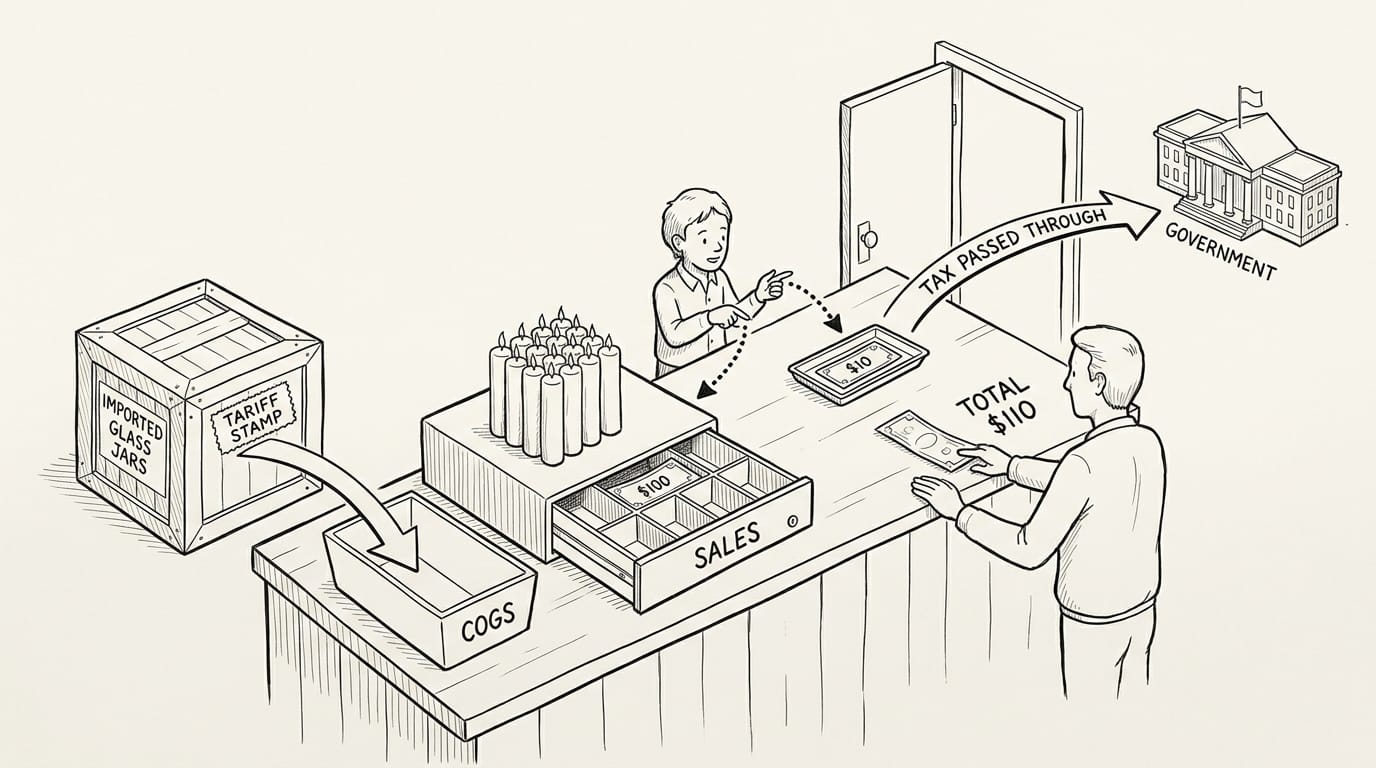
Sales tax isn’t part of your sales at all. Say a small candle seller takes a $100 order and charges $10 sales tax at checkout.
The customer pays $110, but her net sales stays at $100, because that $10 is money she collects for the government, not money she earned.
Excise tax and value-added tax (VAT) get the same treatment, so they stay out of net sales too.
Tariffs work differently. They’re import taxes on the goods you buy, so they land in cost of goods sold (COGS) rather than reducing your sales. Your sales figure doesn’t budge.
Costs that aren’t subtracted here
Net sales doesn’t subtract your costs. COGS is reported separately, on its own line. Administrative costs, such as bookkeeping fees, and general business expenses, such as software subscriptions, stay out of this figure too.
Platform and payment fees deserve their own look. Ask your accountant how yours should be recorded, because that determines where they land.
COGS shrinks your profit, not your sales. It’s the number you subtract from net sales to get gross profit.
Reporting sales to the tax office
The Australian Taxation Office (ATO) wants your gross income declared, meaning the full amount coming in before costs come out. For sales reporting, use your net sales figure, so track both and you can answer either question without scrambling.
Ways to Track and Grow Net Sales
Growing net sales often means keeping more of each sale, not just selling more.
Lifting sales without giving more away
Discounts are the quickest way to shrink net sales. A candle maker who runs a store-wide code every weekend is likely discounting sales she’d have won anyway. Limit the code to first-time buyers instead.
Upselling adds value at checkout, like a larger size or a matching item. Gift notes and small samples also lift the purchase without cutting your price, so add value before you discount.
Aim for full-price sales rather than discounted ones by saying what’s included and when stock will run low.
Answer sizing and shipping questions on the product page, and build your return rate into your pricing so returns don’t erode your net sales.
Tools and habits for tracking accurately
Sales or accounting software keeps orders, discounts, and refunds in one place. Pair it with these habits:
- Log discounts daily. A quick evening entry beats trying to remember.
- Record allowances immediately. Credit for a damaged item goes on the books that day.
- Reconcile returns monthly. Match every refund to its original order.
- Reconcile marketplace payout reports. Check each deposit against your own sales records.
Real-time dashboards can flag a sudden sales drop or refund spike early. Small leaks add up, so don’t wait until quarter-end to spot them.
When an advisor can help
Once your records are clean, a financial advisor can review your pricing and margins. For bigger purchases, ask about capital budgeting, which weighs whether a major spend pays for itself over time.
And keep operating expenses, the ongoing costs of running the business, lean. Unused subscriptions drain what you keep, so cut those first.
Net sales may not be the flashiest number in your business, but it’s one of the most honest. Subtract returns, discounts, and allowances from your gross sales, and handle the edge cases with care.
Keep your records clean and check them often, especially before you celebrate a strong month. Gross sales show the demand. Net sales show what that demand was really worth.
References
- An Accounting System for the Retail General Store — hdl.handle.net
Questions
How do I find my net sales?
Add up your gross sales for the period, then subtract returns, allowances, and discounts. The formula is: net sales = gross sales − (returns + allowances + discounts).
How to go from gross sales to net sales?
Start with gross sales and subtract the value of returns, partial refunds or allowances, and discounts. For example, $5,000 in gross sales minus $250 in returns and $300 in discounts gives $4,450 in net sales.
Is net sales just total revenue?
No. Gross sales is the total before deductions, while net sales is what remains after returns, allowances, and discounts are subtracted. Net sales is also different from net profit, which further subtracts business costs.
Sources
- An Accounting System for the Retail General Store, hdl.handle.net