6-13
Net business income is what you keep after expenses
Net business income shows what remains after costs. Calculate it, compare it with gross income, and estimate take-home pay after self-employment tax.
- Written by

- Published
- Updated
- Reading time
- 10 min read
- Sources
- 5 cited
Net business income is the profit a business keeps after subtracting all its costs from revenue, before an owner’s personal withdrawals. Track every expense, compare the result over time, and distinguish it from gross revenue, gross profit, and taxable income. Use net income to judge whether the business is sustainable, make realistic spending and growth plans, and set aside money for taxes before paying yourself.

In this guide
Think of a side hustle’s income like the total on a grocery receipt. The big number at the bottom doesn’t tell you what you actually kept.
Net business income is what remains after you subtract the costs of running the business, and it’s the figure that shows whether an idea can pay its own way.
In this post, we’ll show you how to calculate it step by step, untangle how it differs from gross, operating, and taxable income, and turn it into a real take-home figure after self-employment tax and your own pay.
What Net Business Income Means
Net business income is what your business keeps after every cost, not what it brings in. Here’s how it’s named, reported, and read when it turns negative.
Other names for the bottom line
You’ll see it under several names:
- Bottom line: the last line of the income statement, after every expense is subtracted.
- Net profit and net earnings: other names for the same figure.
- Take-home after all expenses: casual wording. Taxes still come out of it.
Don’t mix up the bottom line with net operating income (NOI), which is revenue minus day-to-day operating costs, before interest and taxes. NOI measures operations, while the bottom line measures everything.
What tax forms call it
Tax forms rarely use the phrase net income as a label. For a sole proprietorship, look for the net profit on Schedule C, the form for reporting business profit or loss.
Taxable income on Form 1040 (the main individual return) is the figure your tax is based on, which can differ from your business number. Which label you need depends on the job.
When income turns positive or negative
When revenue exceeds expenses, you have positive net business income to reinvest or pay out to owners as dividends. When expenses exceed revenue, you have a net loss, meaning the business spent more than it brought in.
A repeating loss can raise debt and solvency risk, meaning the business may struggle to cover what it owes.
Think of a freelance photographer who pays for gear, software, and travel from the same account her client payments land in. Money in isn’t money kept, and only what’s left after those costs shows whether her side work pays.
Calculating Net Income Step by Step
Net income is what you keep, not what you bring in.
The basic formulas to use
- Revenue minus total expenses. Money in, minus every cost.
- Revenue minus cost of goods sold (COGS) minus expenses. COGS covers what you spend making or delivering what you sell.
- Gross profit minus operating expenses (opex), interest, and taxes. Gross profit is revenue minus COGS. Opex covers day-to-day running costs.
Include every expense category, from rent to software. Count your own time as cost, or the bottom line flatters you.
Business examples worked out line by line
- Monthly income statement. Sales at the top, net income at the bottom, with each cost line in between.
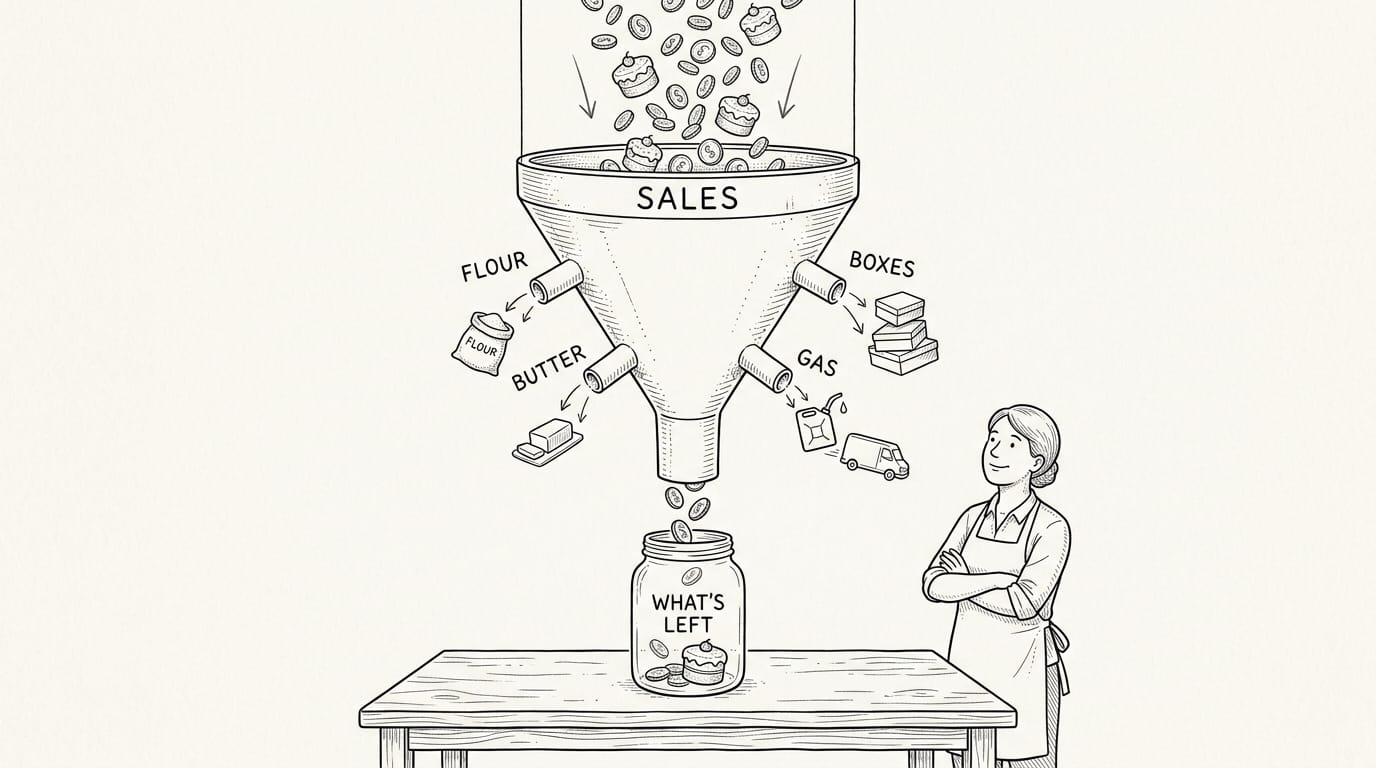
- Bakery. A home baker subtracts flour, butter, boxes, and delivery gas from her weekend cake sales. What’s left is what she can plan around.
- Database company. Subscription revenue comes in, while hosting, licenses, and support go out.
- Tech startup, first year. Software and contractor costs can push the bottom line below zero.
- Sole proprietor, Schedule C. Schedule C is where you report business income and expenses. Its bottom line is your starting point.
What does net salary mean?
Net salary is your take-home pay: according to a journal article on pretax payroll deductions, it’s gross income remaining after taxes and deductions, such as insurance and retirement contributions.
- Gross income sources. Everything you earn before anything comes out, from wages to side-hustle payments.
- Taxes and payroll deductions. Self-employed? No payroll takes these out, so a freelance designer sets aside a share of each invoice before paying herself.
- Insurance and retirement contributions. Health insurance and retirement contributions can come out of the check too.
- Take-home percentage. Divide take-home pay by gross pay to see how much you actually keep.
- Net salary vs net income. Net salary is what you receive. Net income is what the business keeps after costs.
How Net Income Differs from Gross Figures
Gross figures and net income often share a spreadsheet, but they answer different questions.
What gross income and profit cover
Gross income is everything you earn before deductions. Two versions matter here:
- Individual gross: your total pay before taxes and deductions.
- Business gross: your revenue, the total from sales before costs.
Gross profit is revenue minus cost of goods sold (COGS), the direct costs of making or buying what you sell. Take a candle maker who sells $1,000 of product and spends $400 on wax, wicks, and jars.
Her gross profit is $600: what’s left to cover everything else, not what she keeps.
Putting the numbers side by side
Two businesses with the same gross margin can still net very different amounts, usually due to overhead like rent and software.
Her gross margin, gross profit as a share of revenue, is 60%. After another $400 in running costs, her net income (what’s left after every business expense) is $200, a net margin of 20%.
Gross margin tells you whether your product works. Net margin tells you whether your whole business does.
The most common mix-up is treating gross profit as net income. Gross looks bigger. Net is what you keep.
Read them together, since each answers a question the other can’t.
Where people often go wrong
Three habits trip people up most:
- Budgeting from gross income. Revenue feels like money you can spend, but supplies, overhead, and taxes come out first.
- Ignoring gross profit trends. A slipping gross margin shows up in net income later, so watch the direction, not just one month’s total.
- Comparing mismatched metrics. Setting your net margin beside someone’s gross margin doesn’t tell you anything useful.
Why This Number Matters so Much
Net business income shows whether the work is paying off. Strong sales can hide a business that’s quietly losing money.
How it reveals overall business health
- Measures true profitability. It shows what the business keeps. A candle maker grossing $3,000 a month might net only $400 after materials and booth fees.
- Shows the cost of running the business. Every expense you subtract becomes visible, including the small ones.
- Acts as a management efficiency indicator. Comparing periods shows whether you’re getting better at turning work into profit.
- Informs salaries and bonuses. You can only pay yourself or a helper from what the business can really support.

What lenders and investors look for
Lenders and investors care less about revenue and more about what’s left over.
- Assesses financial health. A steady positive figure shows the business can stand on its own.
- Signals dividend capacity. It shows how much profit could go to owners as dividends without starving the business.
- Reveals debt repayment ability. It shows whether earnings can cover loan payments.
- Guides funding decisions. A clear, consistent figure helps them decide whether to lend or invest.
Using it to plan your own money
For a self-employed owner, this is the starting point for a personal budget. Say a freelance designer invoices $6,000 in a good month, but after software and home-office costs, her net business income is $3,500.
Budgeting from the $6,000 would leave her short in slow months. Use the lower number.
- Realistic budgeting. Plan around your average month, not your best one.
- Savings planning. Set aside a fixed share of each month’s profit for slow stretches and tax bills.
- Actual spending power. Know what you can actually spend, not what your invoices suggest.
Where it feeds other ratios
It also feeds other measures you’ll run into:
- Used for return on equity (ROE). Net business income divided by owner’s equity, the money you’ve put in, shows how hard that money works.
- Component of financial statements. It’s the bottom line of the income statement and feeds the balance sheet.
- Fundraising support. A clean, well-documented figure gives you a credible number to bring to a bank or backer.
Get this number right, and the other numbers become far easier to trust.
Ways to Raise Your Net Income
Your net business income isn’t just about how much comes in. It’s about how much you keep. Here’s where to start.
Strategies that lift the bottom line
- Revenue growth. Sell more of what already works before building something new. A baker might add a weekly pickup slot for regulars.
- Cost management. Review recurring expenses each quarter and cut what you’re not using.
- Pricing strategy. Set prices around what you need to keep, not what feels comfortable to ask.
- Resource allocation. Move hours and money toward your best-paying work. A freelance designer might shift time from her lowest-paying client to her top one.
- Diversified revenue streams. A second product or service can keep income steady if the first one slows.
- Check price before cutting costs. A candle seller who buys cheaper wax might lose the repeat buyers who noticed. Test a small price increase first.
Tips to tighten spending and margins
Monitor your gross margin trends, the share of each sale left after paying the direct cost of making it. Check it monthly, since a slipping margin shows up here first.
Control your operating expenses, the everyday costs of running the business. Ask whether each one earned its place this quarter.
If you sell more than one thing, check your profit margins by product. A bestseller can hide an item that loses money on every sale.
A jewelry maker might love her beaded necklaces, but once materials and packaging are counted, her bracelets may pay better per hour.
Some tax-advantaged accounts can reduce the income that gets taxed, so ask a tax professional which ones fit your situation.

What Net Income Looks Like for Startups
Is a loss always a red flag? Not necessarily, but you still need to read the numbers correctly.
Why startups often lose money early
Negative net income is common among venture-backed startups in their early years, according to a study of venture-capital-backed firms that examined companies posting losses before their initial public offering (IPO).
Startups may make substantial upfront investments while revenue is still developing. A financial plan for a start-up notes that a company usually can’t generate enough sales to cover its costs in the early stage.
Some founders also put growth over profit on purpose, reinvesting to reach more customers. That choice shows up as a loss on paper.
Revenue lag, the gap between spending and earning, is where timing bites. Consider a side hustler who pays for recording gear and a course platform before a single student enrolls.
Her books show a loss, but it reflects when the money moved, not whether the course works.
Research and development (R&D) spending can push net income down. Some of it may qualify for a tax credit, a direct cut to the tax you owe. Whether yours qualifies depends on local rules, so check with a tax professional.
Why startups should track it anyway
A loss is still information. Tracking it pays off in four ways:
- Investor relations. Investors will look at net income to judge whether you’re moving toward profit.
- Operational efficiency. A regular review shows where costs creep up and which expenses aren’t paying off.
- Growth trajectory. Watching it over several periods shows whether the loss is shrinking.
- Funding timing. Knowing how fast losses are moving tells you how long your cash lasts, so you can raise before you’re forced to.
How Taxes and Industry Shape Your Numbers
Your net income drives your tax bill, and your industry shapes your margins.
How taxes are based on net income
Businesses are taxed on net income, not gross income: revenue minus allowable expenses.
Net taxable income is what’s left of net income after any further adjustments the tax rules allow.
Categorizing matters: a freelance designer who books her software as a business expense lowers her net income and tax bill.
Timing counts too: the year you record income or expenses can move them to another tax year.
Your net income also determines your tax rate.
If you’re self-employed, self-employment tax applies to net profit, not sales.
Net income is what the business earned; owner’s pay is what you withdraw for yourself.
How margins differ across industries
Margins are the share of each sale you keep.
Retail runs tight: a margin roundup from Commerce Quarterly puts the whole retail band between 1% and 7% net.
Service margins can differ too: a study of nine French service industries compared average profitability margins across industries.
Think of a side-hustler selling candles at weekend markets. Wax, wicks, and booth fees come out first, so another industry’s benchmark could overstate what she keeps.
Seasonal swings matter. A landscaper’s income may bunch into busy months, so judge your margin across the full year. Your best month flatters you.
Getting help with bookkeeping and filings
Accounting software providers can sort most of this once it’s set up right.
A bookkeeper or tax professional can catch costly slips, like a personal purchase logged as a business expense. Keep three things current:
- Invoices: record every invoice you send.
- Bills: log each expense you pay.
- Tax remittance: send what you owe on time.
Net business income is the figure that turns a promising idea into an honest answer. Track it month by month, subtract every real cost, and set aside what you’ll owe in self-employment tax before you pay yourself.
Whether the number is growing or stalling, it tells you what to do next. Trust the math over the total on the invoice, and you’ll always know where your money really stands. Build your plan on the number you can actually prove.
References
- The Information Content of the Deferred Tax Valuation Allowance: Evidence from Venture-Capital-Backed IPO Firms — doi.org (2025)
- Profit Margins by Niche: Every Published Dataset, One Table — commercequarterly.com (2026)
- Pretax Payroll Deduction for Parking? An Illustrating Example — doi.org (2023)
- Financial plan for a start-up — theseus.fi (2018)
- Dispersion and Heterogeneity of Firm Performances in Nine French Service Industries, 1984-1987 — doi.org (1991)
Questions
What is considered your net income?
Your net income is what remains after subtracting expenses and other applicable deductions from gross income. For a business, it is revenue minus all business expenses; for an individual, it generally means income remaining after deductions and taxes, depending on the context.
What is net operating income (NOI)?
Net operating income (NOI) is revenue minus day-to-day operating costs. It measures how the business performs before interest and taxes are subtracted.
What is net taxable income?
Net taxable income is the amount of income subject to tax after allowable deductions and adjustments are applied. It can differ from a business’s net income because tax rules may permit additional adjustments.
What does "net salary" mean?
Net salary is your take-home pay: gross salary remaining after taxes and deductions such as insurance premiums or retirement contributions. It is the amount you receive, unlike business net income, which is what the business keeps after its costs.
Sources
- Pretax Payroll Deduction for Parking? An Illustrating Example, doi.org,
- The Information Content of the Deferred Tax Valuation Allowance: Evidence from Venture-Capital-Backed IPO Firms, doi.org,
- Financial plan for a start-up, theseus.fi,
- Dispersion and Heterogeneity of Firm Performances in Nine French Service Industries, 1984-1987, doi.org,
- Profit Margins by Niche: Every Published Dataset, One Table, commercequarterly.com,