5-10
Digital Products to Sell: A Complete Guide
Digital products to sell can start with a spreadsheet or template; compare product ideas, test demand cheaply, and pick a sales platform before building.
- Written by

- Published
- Updated
- Reading time
- 13 min read
- Sources
- 10 cited
Digital products to sell are downloadable files, courses, or other online offerings that customers access electronically, such as templates, printables, ebooks, and lessons. Choose a format that fits your skills and time, focus on a specific buyer need, and test willingness to pay before investing heavily; compare selling platforms, fees, and marketing needs. Start small and price for the value and costs, since repeat sales are possible but income depends on finding buyers and delivering something useful.
In this guide
Think about the meal plan spreadsheet you’ve quietly refined for years, or the budget template you built at the kitchen table. Chances are someone else would happily pay for it too.
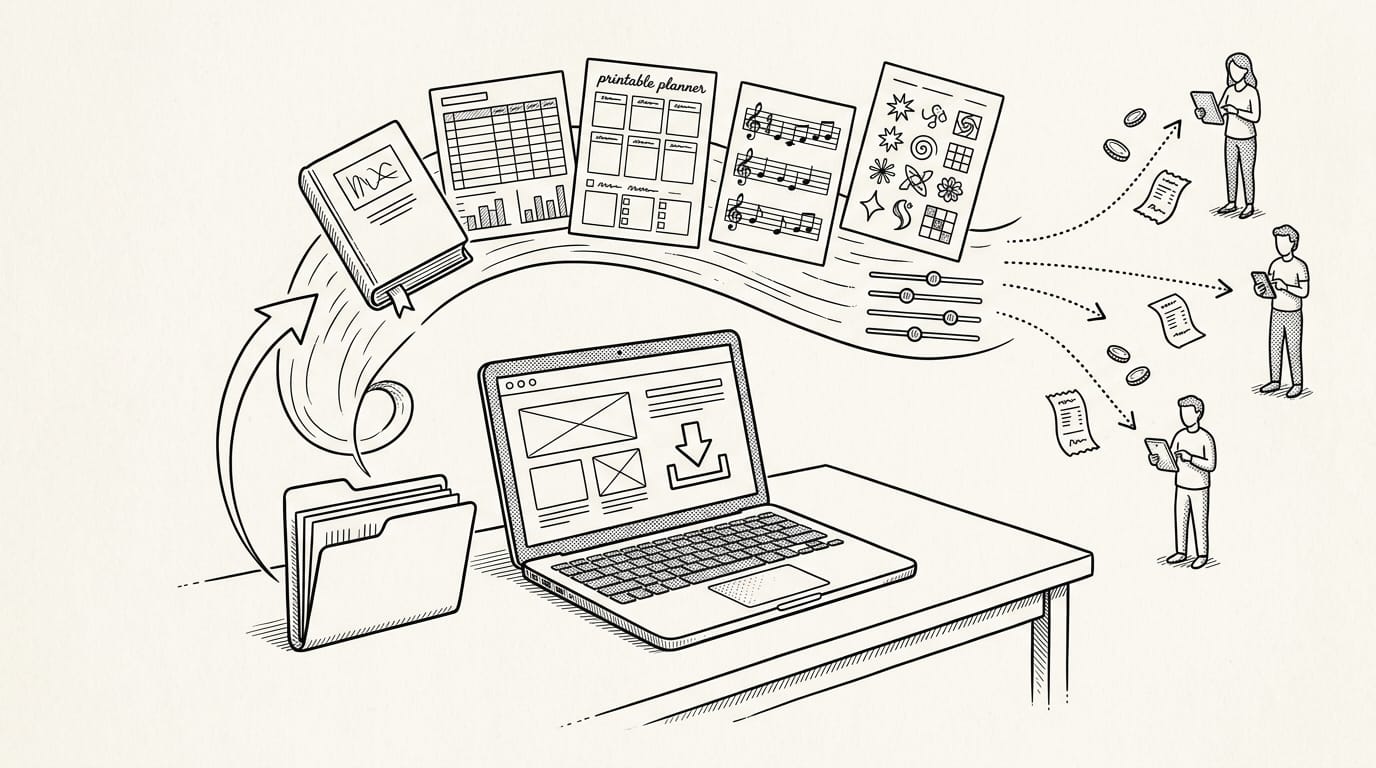
That’s the heart of a digital product: a file, guide, or course you create once and sell over and over, without packing a single box.
Here’s the short answer: the right digital product is one people already want, priced so it’s worth their money and yours. Finding out what people already want is where market research to start a business begins.
In this post, we’ll walk through the product types and ideas that sell best, how to choose and build one, where to sell it, and how to test your idea cheaply before you put weeks into it.
Why Digital Products to Sell Make Sense
Before you pick a product, here’s what qualifies, why side hustlers favor it, and where demand is heading.
What counts as a digital product
A digital product is intangible: customers use it but can’t hold it. You create it, store it electronically, and deliver it online, so buyers get instant access after they pay. Formats include:
- ebooks
- templates
- planners
- presets
- online courses
Perks of selling without stock or shipping
There’s no inventory to stock, no boxes to pack, and no trips to the post office. According to a research paper on the digital continuum, reproduction costs for ebooks and downloadable code are minimal. The perks add up:
- High profit margins. Each extra sale costs you very little, so more of each payment stays yours.
- Create once, sell repeatedly. The work happens once, not with every buyer.
- Low startup costs. You can often begin with tools you already own.
- Global reach. A file reaches a buyer overseas as easily as one down the street.
- Automation and passive income. Delivery can run on autopilot, though you’ll still answer questions.
Take a freelance designer who spends one weekend building invoice templates. She can keep selling them to other freelancers, even during weeks her client calendar is full. One weekend, ongoing sales.
Where demand is growing right now
Projections are hard to verify, so check any headline figure before you trust it. According to a Gartner survey from October 2020, 67% of respondents said demand for new digital products and services increased in 2020, and 83% expected it to rise in 2021.
Health and fitness is one niche on the rise: a post-pandemic analysis of mobile health and fitness apps reports that the pandemic significantly accelerated demand for home-based exercise and remote health monitoring.
Product Types and Ideas That Sell Best
Digital products differ in how long they take to build and how they earn. Some take months to pay off, while others you can list in a weekend.
Writing and selling ebooks and guides
An ebook is a downloadable book, and a guide is a shorter one that solves a single problem. Fiction and non-fiction both sell, but non-fiction is the usual starting point for side hustlers, since readers buy it to fix something.
Finance and wellness are popular niches. With self-publishing, you handle the production and sales yourself and keep a royalty, your share of each sale. Pricing ranges widely, so check what similar titles charge before you set yours.
Courses, webinars, coaching and memberships
Courses are often top earners because buyers pay for a path to a result. Live webinars let you teach in real time and charge for attendance or replays. Coaching comes one-on-one or in groups, with several people sharing your time at a lower price each.
A membership charges a regular fee for access, so you earn recurring rather than one-time revenue, but only while you keep delivering. Popular course niches follow the same logic: pick a topic people already pay to improve.
Printables like planners and worksheets
Printables are files buyers print at home, so you’ll test an idea in days rather than months. Common types include:
- Planners and trackers: daily, weekly, or habit pages.
- Wall art and party printables: decor and invitations for events.
- Educational materials for teachers: classroom worksheets and resources.
- Workbooks and journals: guided prompts for self-study.
- Coloring pages and patterns: designs for relaxing or crafting.
- Seasonal demand spikes: holiday and back-to-school printables peak at predictable times, so list them early.

Ready-made templates and design assets
Templates save buyers setup time. Popular types include:
- Social media templates: post layouts buyers customize themselves.
- Resume and business templates: resumes, invoices, and proposals.
- Notion templates: prebuilt workspaces for tracking projects in Notion, the note-taking app.
- Fonts, graphics, and brand kits: matching type, icons, and colors.
- Lightroom presets: saved edits that give photos one consistent look.
- Website templates and themes: ready-made site layouts to customize.
If you’re wondering what sells really quickly, templates are one of the best answers, since buyers can use them the day they download.
For example, a side hustler who builds one resume template does the layout work once, then sells copies with little extra effort. Build it once. Sell it again and again.
Selling music, sounds, photos and video
Creative files can sell repeatedly, but each sale runs on a license, the permission you grant a buyer to use your work. Licensing models vary, so spell out the terms before anyone buys.
Music and sound effects, stock photos and video, and meditation audio are all files you can sell or license. Podcast subscriptions work differently, since listeners pay to keep receiving new episodes.
Software, AI packs and newer formats
Here’s how the newer formats break down:
- Software, plugins, and extensions: tools that add features to existing programs.
- Games and indie development: small games from independent creators.
- AI (artificial intelligence) prompt packs: curated prompts that help buyers get better results from AI tools.
- NFTs (non-fungible tokens): unique digital tokens that record ownership of a specific file.
- PLR (private label rights) content packs: ready-written material you can rebrand and sell as your own, within your license terms.
Test these before you build, since demand is harder to predict.
How to Choose and Build Your Product
Pick a product that fits what you already know and the hours you have. Validate demand first: ask a few people in your niche whether they’d pay for it, and let their answers decide whether you build.
Match your product to skills and niche
Start with expertise and interests, since you’ll only finish a product you care about. A bookkeeper who already builds invoice templates for clients can sell that template to other small business owners and earn from work she’s already done.
Niche down before you scale. A checklist for freelance photographers speaks to a buyer more directly than a planner for everyone. Start narrow, then widen. Splitting buyers into groups with shared needs is the core idea of customer segmentation.
Beginners do best with checklists or templates, which need little more than a document and a clear outcome. Advanced formats like courses and software take longer to build and test, so save them for after your first sale.
Start with skills you already have, and pick a product that fits your spare hours, not one that needs your whole weekend.
Tools and shortcuts to build faster
Tools speed up the build, but they also set your timeline. As a study of AI-assisted product teams points out, the tools you choose, from design software to artificial intelligence (AI), can change how a product reaches market.
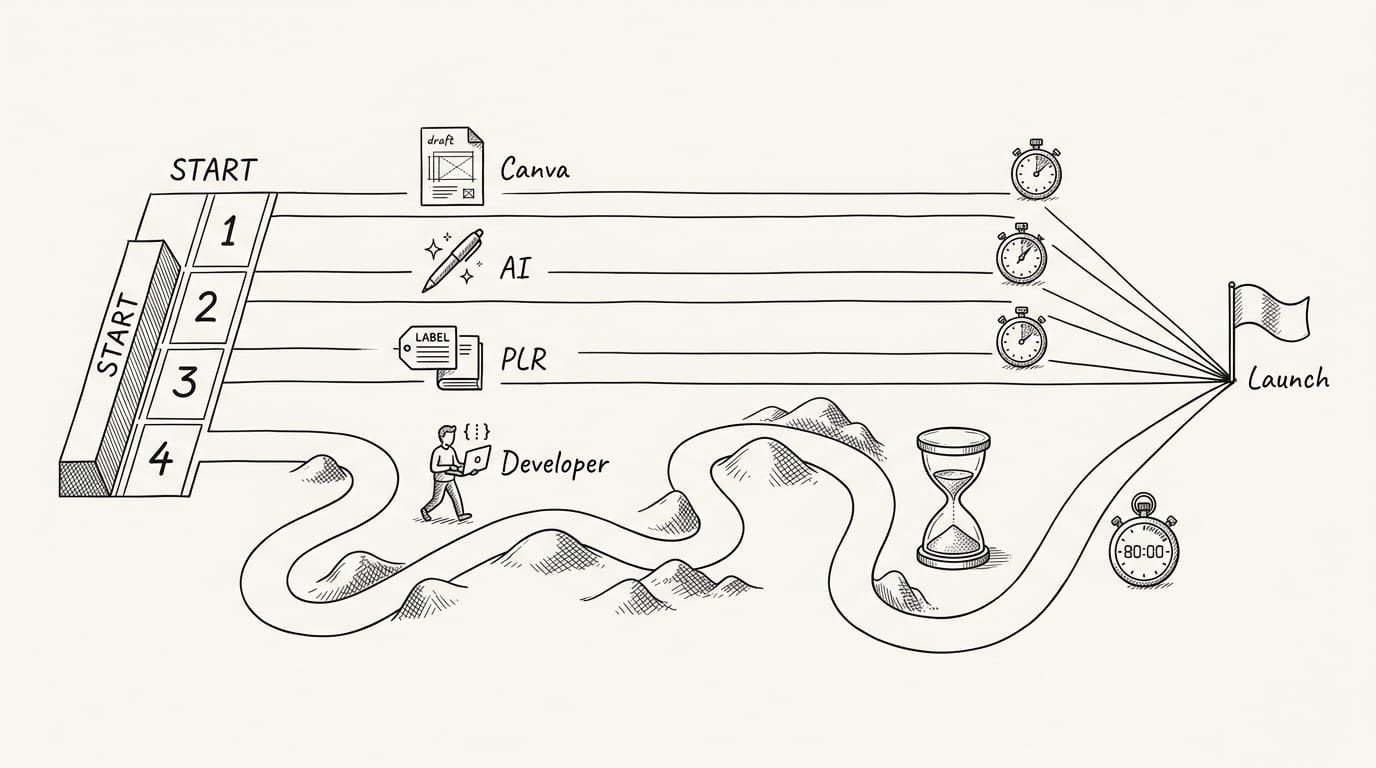
- Canva for design: Covers and worksheets come together fast, even if you’re not a designer.
- AI tools for content: They can draft outlines and first passes, but edit for accuracy and your own voice.
- Private label rights (PLR) products: Ready-made content gives you a head start. Check the license before you resell.
- Hiring developers: Only bring one in when the product needs code, like an app. A checklist doesn’t.
Here’s how the options compare on time to launch:
| Option | Time to launch |
|---|---|
| Canva templates | Quickest |
| AI-drafted content | Quick |
| PLR products | Quick, once rebranded |
| Hired developer | Slowest |
Where to Sell Your Digital Products
Where you sell shapes how much you keep and how much marketing you’ll do yourself. Here’s how the main options compare.
Direct-sale platforms like Gumroad and Payhip
With a direct-sale platform, the buyer pays through the tool, and the tool delivers the file. Gumroad, Payhip, Sellfy, and SendOwl all work this way, so the customer is your customer.
Podia and other all-in-one tools bundle a storefront with email and more, so you have fewer tools to juggle.
Some sellers skip the storefront. Link-based checkout means sharing a payment link in an email or post. Think of a bookkeeper who sells a spreadsheet template to freelancers.
Her newsletter link tests whether anyone will pay before she builds a full website.
If you want your own look, customizable storefronts let you brand the page so buyers see your name, not a generic listing.
Platforms for courses and memberships
A download link won’t cover a course or membership. A course platform hosts lessons and handles enrollment. Teachable and Thinkific are built for this, as are Klasio and EzyCourse.
MemberPress is aimed at memberships, where subscribers get ongoing access as long as they keep paying.
Planning to teach live? Confirm live class support first, since not every course tool handles live sessions.
Marketplaces that bring their own shoppers
A marketplace already has buyers browsing, but you’re selling through someone else’s shop, and they take a cut. Etsy works well for printables, Creative Market suits design assets, and stock media marketplaces sell photos, video, and audio.
Kindle and other book stores carry ebooks, while ThemeForest, CodeCanyon, and Envato cover themes and code.
Consider a freelance illustrator selling a brush pack on Creative Market. Design buyers are already browsing there, so she skips building an audience from scratch, but she still prices with the marketplace’s cut in mind.
Building a store with Shopify or WordPress
Shopify suits sellers who want a fully branded store. If your site runs on WordPress, Easy Digital Downloads adds file sales to it. Before you commit to either, check which plan unlocks taking payments and delivering files.
How fees and plans compare
Fees are where the choice gets real. According to Where to Sell Digital Products: Fees and What You Keep, transaction fees differ across platforms, and as that guide puts it, “Cheap products punish fixed fees.” Check these four things:
- Transaction fees. Compare what you keep, not the sticker price.
- Free versus paid plans. Free tiers are the cheapest way in, but check what they limit.
- Marketplace commissions. Marketplaces take a cut of each sale, so price with that cut in mind.
- Payment processor requirements. Some platforms need a processor (a service that moves buyers’ money into your account) connected before you can get paid.
Say you’re a teacher selling a low-priced printable planner. A fixed fee on every sale takes a bigger bite from a small price, so the platform that charges less per sale keeps more of what you earn. Fees add up fast.
What’s the Most Profitable Thing to Sell?
The most profitable thing to sell online isn’t always the one with the biggest price tag. It’s the one that sells steadily at a price that covers your time.
What most products sell for
Typical prices look like this:
- Printables: $3-$40
- Ebooks: $7-$49
- Courses: $97-$499+
- Business templates: $20-$50
How much you can realistically make
Monthly earnings can vary by product type. In a study of digital creators in urban India, 51.4% earned below ₹15,000 a month and only 14% earned above ₹75,000.
For your first year, treat early sales as feedback, not a paycheck. Income compounds over time, since each listing can keep selling after you publish it.
Traffic isn’t income. In a case study of an online home-based business, John’s Cultureak saw a tremendous jump in page views, yet its income only reached about $350 monthly.
Say you spend a weekend on a meal planner printable. Multiply the hours until your first sale by the hourly pay you want, then divide by what you keep per sale. That’s your break-even point: the number of sales it takes to pay you back.
Setting prices that match your value
Price for value, not effort. For printables, a Liberty University study notes that sellers can set whatever price they wish after figuring in the base cost of creation.
Test two price points with real buyers before you commit. A quick poll costs little and beats guessing.
Low-ticket items are easier to say yes to, while high-ticket items need more trust. Courses are priced by what they offer, and a study of edX’s pricing structure treats a MOOC (massive open online course) as a knowledge product.
Bundles group several products into one offer, often at a small discount, which can lift your average sale.

Getting Buyers and Growing Your Sales
A great product still needs buyers. Here’s how we’d bring them in and keep them coming back.
Bringing visitors in from search and social
Start with search engine optimization (SEO), which means wording your listing so search engines can match what people type. Use long-tail keywords, which are longer, specific phrases like ‘meal planner printable for busy parents.’
Promote on social media where buyers already spend time. Build an email list with a lead magnet, a free download people get in exchange for their email address.
Pinterest suits printables, since people pin templates to use later. TikTok videos can send traffic too.
A side hustler selling budget spreadsheets gives away a one-page version, then emails that list a link to the full set. The free file earns the contact; the email earns the sale.
Tactics that lift sales and repeat buys
- Bundling: sell related products together at one price, like a planner plus its matching tracker.
- Affiliate programs: let partners promote your product for a commission on each sale.
- Coupons and discounts: use them sparingly, or buyers learn to wait for a sale.
- Upselling in webinars: after a webinar (a live online workshop), offer a higher-priced version of what you taught.
Aim for repeat buyers, not one-time ones. Follow each purchase with a related product, like the next template in the set.
Building a reputation buyers trust
- High-quality designs: proofread everything and confirm files open on common devices.
- Brand reputation: keep your name, colors, and style consistent.
- Customer retention: answer questions fast and follow up after each sale.
- Update based on feedback: read reviews, then revise. Buyers notice fixes.
Post a clear refund policy so buyers know what happens if a file won’t open. Clarity builds trust. Some sellers add each buyer’s name to files for basic file protection against piracy.
Do I Need an LLC to Sell Online?
Whether you need an LLC (limited liability company, a business structure that can separate your personal assets from business debts) depends on where you live and how much risk you’re carrying. Treat it as a question for a local accountant or attorney.
Licensing rules and disclaimers to know
Run three checks before you publish:
- Canva licensing guidelines. Confirm your graphics and fonts allow resale as part of a product.
- Disclaimers for finance content. If you offer money advice, state that it’s general information, not personalized financial advice.
- Legal and ethical practices. Credit the creators whose work you use, and never pass off their design as your own.
Don’t overlook sales tax and VAT (value-added tax, a consumption tax that can apply to digital purchases). The rules depend on where you and your buyers are, so check both before you set prices.
Downsides, crowded niches and platform rules
Printables have a few downsides:
- they’re easy to imitate
- buyers can see them as low-value
- a basic template is hard to tell apart from the next one
Take a side hustler who builds a budget printable for new parents and finds a crowd of near-identical listings, many cheaper.
Her way forward is a sharper angle, like a planner built around one situation her buyers face, so she competes on value instead of chasing the lowest price.
Every marketplace sets its own rules for what you can list and how you describe it. Break one and your listing can disappear. Read the policy first.
Digital products reward a little patience and a lot of curiosity. Start small, confirm someone will pay before you build the whole thing, and price it so the math works for your life, not just your spreadsheet.
Every product you finish makes the next one easier to launch. The idea either sells or it doesn’t, and either way, you’ll know more than you did before you started.
References
- Post-Pandemic Dynamics of Mobile Health and Fitness Applications: An Analysis of User Profiles, Market Developments, and Emerging Trends — doi.org (2025)
- Content Creation as a New-Age Entrepreneurial Career: An Empirical Investigation of Digital Creators in Urban India — doi.org (2026)
- Vibe Coding in Product Teams: Reconfiguring AI-Assisted Workflows, Prototyping, and Collaboration | Proceedings of the 5th Annual Symposium on Human-Computer Interaction for Work — dl.acm.org (2026)
- Decoding the dynamics of knowledge pricing: An empirical investigation of MOOC platform edX’s pricing structure and signaling effects — doi.org (2024)
- The digital continuum: the influence of ownership, access, control, and Cocreation on digital offerings | AMS Review — link.springer.com (2019)
- IT after the Coronavirus pandemic: Back to normal? — aisel.aisnet.org (2021)
- Dream It & Do It: A Look at the Online Apparel Business Market for Entrepreneurial Designers — digitalcommons.liberty.edu (2019)
- Web Content: A Case Study of Monetization of an Online Home-Based Business — papers.ssrn.com (2016)
- Where to Sell Digital Products: Fees and What You Keep — onlinemm.org
Questions
What is the most profitable thing to sell online?
There is no single most profitable product for everyone. Courses can earn more per sale, but the best choice is a product people want that sells steadily at a price covering your time and costs.
What are some examples of a digital product?
Examples include ebooks, online courses, planners, worksheets, resume or invoice templates, social media designs, photo presets, stock photos, and software plugins. Buyers receive these files or access online rather than as physical goods.
Do I need an LLC to sell digital products?
You generally do not need an LLC just to sell digital products, but requirements depend on where you live and your circumstances. Check local rules and consult an accountant or attorney about liability, taxes, and the right business structure.
What sells really quickly?
Templates can sell quickly because buyers can use them as soon as they download them. Printables are also relatively quick to create and list, though actual sales depend on demand, pricing, and reaching buyers.
Sources
- The digital continuum: the influence of ownership, access, control, and Cocreation on digital offerings | AMS Review | Springer Nature Link, link.springer.com,
- IT after the Coronavirus pandemic: Back to normal?, aisel.aisnet.org,
- Post-Pandemic Dynamics of Mobile Health and Fitness Applications: An Analysis of User Profiles, Market Developments, and Emerging Trends, doi.org,
- Knowledge Marketplaces: An Analysis of the Influence of Business Models on Instructors’ Motivations and Strategies, doi.org,
- Dream It & Do It: A Look at the Online Apparel Business Market for Entrepreneurial Designers, digitalcommons.liberty.edu,
- Decoding the dynamics of knowledge pricing: An empirical investigation of MOOC platform edX's pricing structure and signaling effects, doi.org,
- Content Creation as a New-Age Entrepreneurial Career: An Empirical Investigation of Digital Creators in Urban India, doi.org,
- Web Content: A Case Study of Monetization of an Online Home-Based Business, papers.ssrn.com,
- Where to Sell Digital Products: Fees and What You Keep, onlinemm.org
- Vibe Coding in Product Teams: Reconfiguring AI-Assisted Workflows, Prototyping, and Collaboration | Proceedings of the 5th Annual Symposium on Human-Computer, dl.acm.org,