4-8
Marketing CAC Explained: The Formula and How to Use It
CAC marketing shows what you spend to win each customer. Get the calculation, see how CAC relates to lifetime value and payback, and spot ways to lower it.
- Written by

- Published
- Updated
- Reading time
- 13 min read
- Sources
- 4 cited
CAC marketing measures how much a business spends on marketing and sales to win one new paying customer, calculated by dividing acquisition costs by first-time customers in the same period. Include labor and other costs that help win customers, compare CAC with customer lifetime value, profit margins, and payback time, and break it down by channel to see what works. The right CAC depends on the business, so track it consistently and improve targeting, referrals, retention, or sales processes before deciding where to spend more.
In this guide
Every new customer you win came at a price, even if you never wrote it down. Maybe it was a local ad, a sponsored post, or a booth at a weekend market.
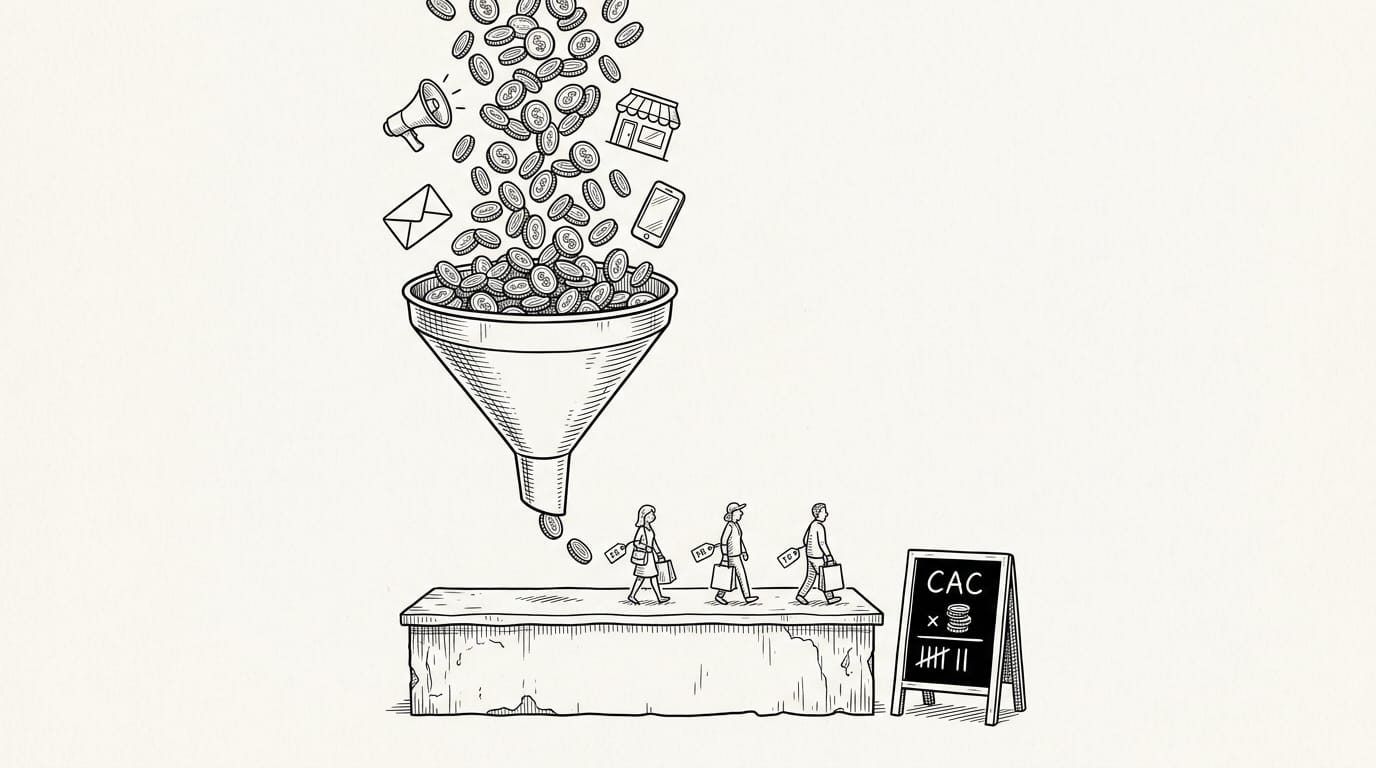
Customer acquisition cost (CAC) is the total you spend on marketing and sales to land one new paying customer, and it’s one of the most useful numbers a small business owner can track.
Put simply, CAC is what you spent divided by how many customers you won. In this post, we’ll walk through the formula, how CAC connects to lifetime value and payback, what shapes it, and simple ways to calculate and lower yours on a small budget.
CAC Marketing Basics and Why They Matter
Every new customer costs you something to win. Customer acquisition cost (CAC) is how you put a number on it.
What CAC means for each new customer
CAC is the average cost to win one new customer. Add up your marketing and sales spend over a set period, like a month, then divide by the new customers you won in that window.
Consider a side hustler who sells handmade leather wallets. She totals a month of social ads and sales time, divides by the buyers that month brought in, and learns what each one really cost her.
Now she can check whether a wallet’s price covers that cost.
What CAC reveals about growth and budgets
CAC shows five things about how you grow:
- Growth efficiency: whether each new customer is getting cheaper or pricier to win.
- Profitability and sustainability: whether customers spend more than it costs to win them.
- Budget allocation: which channels bring customers in at a price you can live with.
- Growth forecasting: how much more to spend to hit your next customer goal.
- Investor and board reporting: a clear read on whether growth is being bought wisely.
Reading CAC as a strategy signal
CAC reflects the health of your whole customer strategy, not just your ads. A high number might point to a weak offer or a price buyers don’t expect.
The question is less about whether your marketing works and more about what your number says about the path to a repeat buyer.
Never read CAC in isolation. What counts as good depends on your business: a cost that looks steep on a cheap product can be a bargain on a premium one. The number is a starting point, not a verdict.
Working Out Your CAC Step by Step
Before you can lower your customer acquisition cost (CAC), you need a number you trust. Here’s how we’d get it from your own books.
Divide spend by new customers
CAC is total spend divided by new customers in the same period:
- Choose a measurement period. Pick a month, quarter, or year, and use it for everything.
- Count net-new customers. Only first-time buyers count.
- Divide spend by customers. Divide your total spend by that count.
A side hustler selling leather wallets spends $600 on ads and sample packs in a quarter and wins 30 first-time buyers. That’s $20 each, and she can now check it against her margin on every wallet. Honest inputs are the hard part.
Which costs belong in the calculation
Include every cost that goes toward winning customers:
- Ad and campaign spend. Paid ads and promotions.
- Salaries and commissions. Pay for anyone who sells.
- Tools and software. Outreach and email tools.
- Agency and contractor fees. Freelancers for ads or pitches.
Skip retention spending and overhead like rent. Those keep the business running, but they don’t win new customers.
Don’t leave out labor, including your own unpaid hours. Six hours a week of cold emails is 78 hours over a 13-week quarter, or $1,950 at $25 an hour.
Worked examples for SaaS and small firms
A software as a service (SaaS) product uses the same formula, and so do small firms. Take a solo bookkeeper:
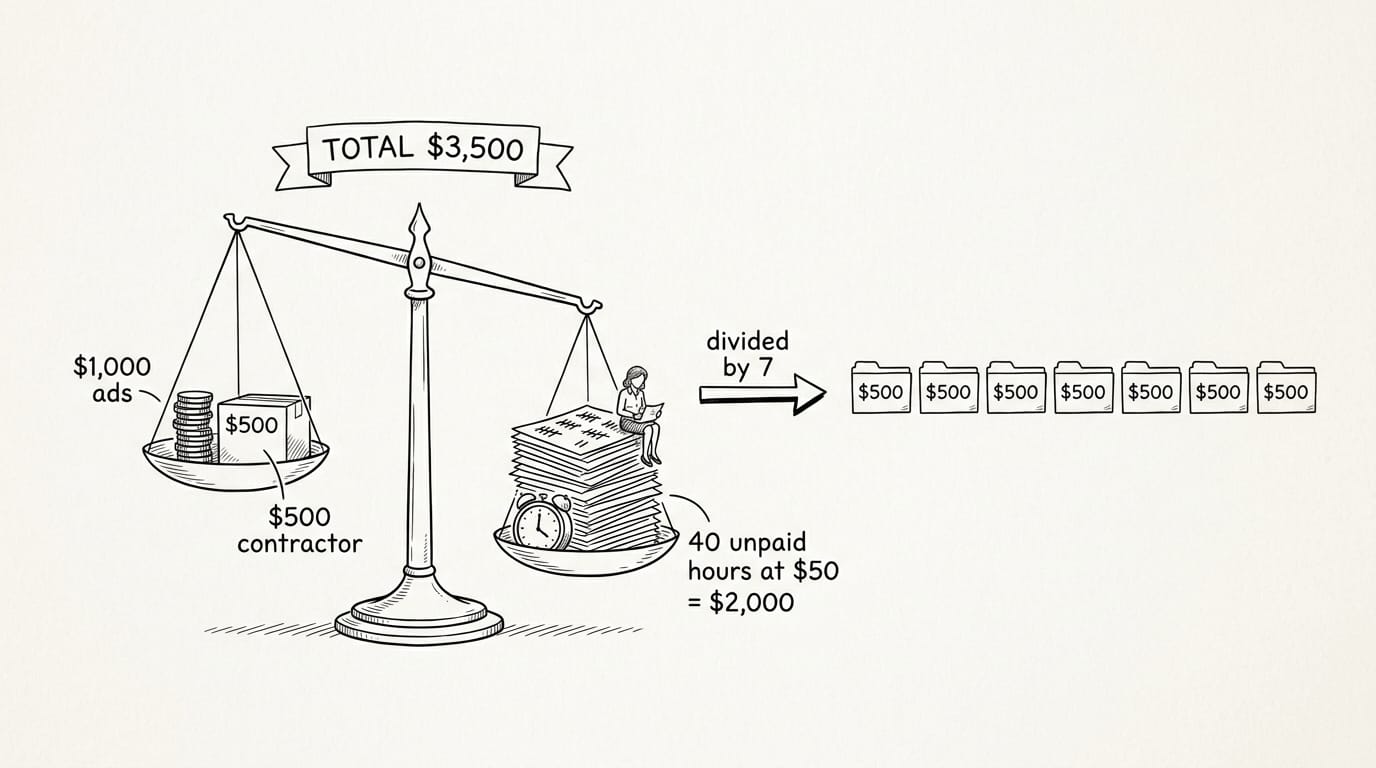
- Add the costs. $1,000 in ads, $500 to a contractor, and 40 unpaid hours at $50 an hour: $3,500 total.
- Count new clients. Seven signed up that quarter.
- Divide. $3,500 divided by 7 is $500 per client.
Her unpaid hours are the biggest line, not the ads. For illustration, a SaaS scheduling tool spending $4,500 a quarter to win 45 subscribers lands at $100 each.
Keep it consistent and break it down
Keep your cost scope the same each period, or a falling CAC may only mean you changed what you counted.
Break it down by channel or campaign. A blended CAC (one number across all channels) can hide the gaps, like ads at $55 and referrals at $12 blending into one $40 figure.
Track cohorts, the groups of customers who joined in the same period, and compare them over time.
Recalculate whenever your mix changes. Start with one total and one count, then go detailed by channel and cohort as your spend spreads out.
Mistakes that skew your CAC
- Including irrelevant costs. An office lease or a tool used for other work doesn’t belong.
- Excluding necessary costs. Skip the contractor or your own hours and CAC looks better than it is.
- Counting reactivated customers. Someone returning after a year isn’t new, so counting them artificially shrinks CAC.
- Ignoring the LTV/CAC ratio. Lifetime value (LTV) is what a customer is worth to you over time. CAC shows what you spent. LTV/CAC shows whether it was worth it.
How CAC Compares to LTV and Payback
A low customer acquisition cost (CAC) only looks good until you check what the customer is worth.
Checking if lifetime value beats CAC
Your customer lifetime value (CLV, also called LTV) is the total gross profit a customer brings before leaving, and it should always beat your CAC.
A healthy benchmark is a 3:1 CLV-to-CAC ratio. Below 1 means you’re paying more to win someone than they’ll return. The ratio matters more than the raw number.
Say a candle maker pays $60 to win a subscriber who nets $10 a month in margin. After a year, that’s $120, a 2:1 ratio, below target.
- Blended CAC divides all acquisition spending by all new customers.
- Paid CAC counts only ad spend against customers won through ads.
How fast you earn back CAC
The payback period is how long a customer’s margin takes to cover your CAC: CAC ÷ (monthly revenue × gross margin). For the candle maker, $60 ÷ ($20 × 50%) comes to six months.
Shorter payback means better efficiency, since cash comes back sooner. For cash planning, you’ll fund six months of spending on each customer before they pay off.
When low CAC hides high churn
Churn, the share of customers who cancel, can hide behind a cheap CAC. A discount might fill your list fast, but if many cancel after one shipment, the low CAC misled you.
Loyal subscribers are worth far more. One who stays two years pays back its CAC several times over. The question isn’t how cheap a customer is. It’s how long they stay. Cheap isn’t the same as profitable.
Balance CAC and retention together, since a cheap customer only pays off if they stay.
What Shapes CAC and Typical Benchmarks
Is your customer acquisition cost (CAC), what you spend per new customer, healthy? It depends on your margin, channels, and the market.
Judging whether your CAC is good
There’s no universal good CAC. It varies by industry and business model, and it runs higher in early growth stages.
Your best benchmark is your margin. Say a side hustler sells a $40 candle set and keeps $20 after materials and shipping. Spend $12 to win a sale, and you keep $8. Spend over $20, and you lose money on that sale. Setting your selling price from those costs plus a margin is the idea behind cost-plus pricing.
That $20 is your max CAC, the most you can spend per customer.
How CAC varies across marketing channels
How much you spend matters less than where you spend it. The seven types of digital marketing are a bigger topic, so we’ll focus on the channels that shift CAC.
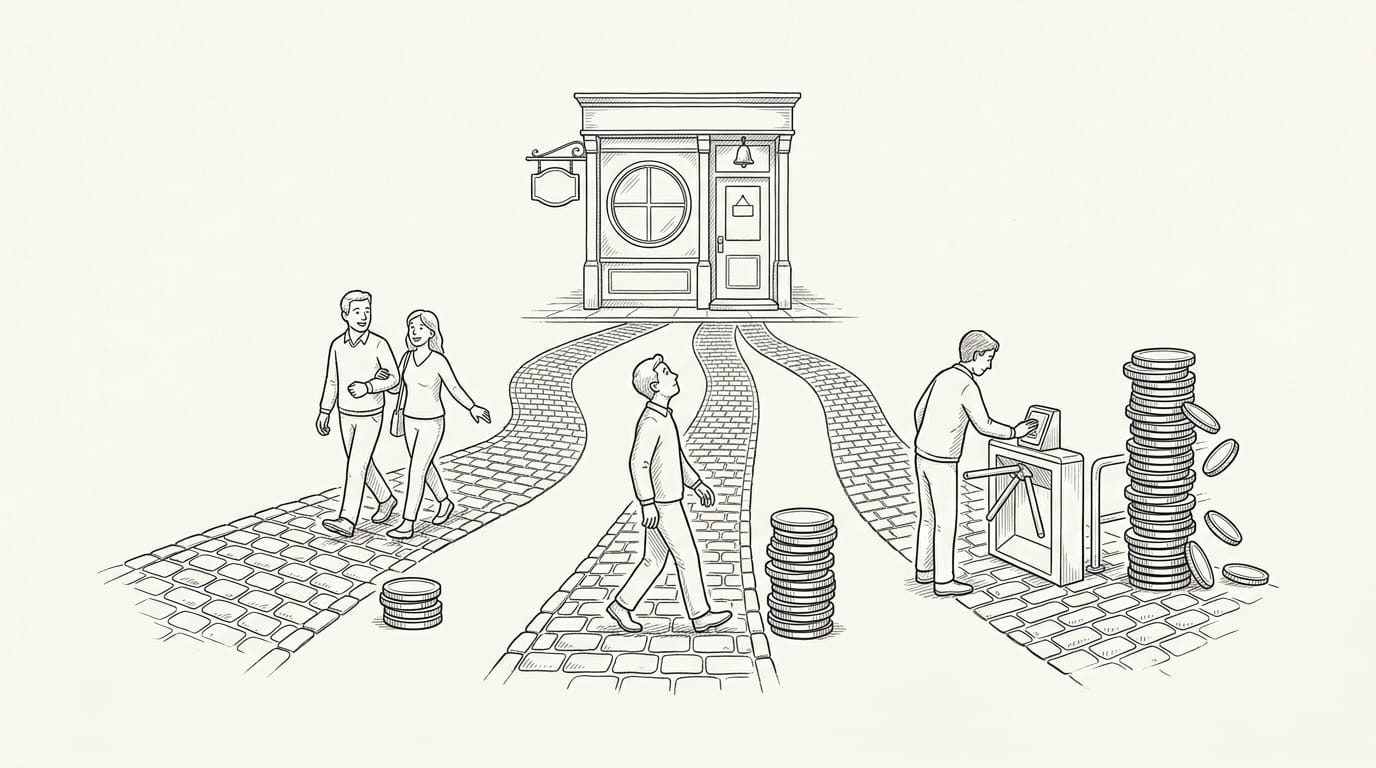
Referrals are usually the cheapest, since happy customers do some of the selling.
Paid pay-per-click (PPC) ads, where you pay for each click, can cost more per customer than referral or organic channels.
A comparative study of paid versus organic growth strategies in direct-to-consumer brands found that organic-dominant brands achieved a 41% lower median customer acquisition cost than paid-dominant brands.
Organic traffic, visitors who find you without paid ads, typically falls in between.
For business-to-business software-as-a-service (B2B SaaS) companies, benchmarks are all over the map. A Future Business Journal analysis of recurring revenue models found that customer acquisition costs vary widely across these companies.
What drives your CAC up or down
Five factors push your CAC up or down:
- Sales cycle length. Longer deals mean more follow-ups and hours per sale.
- Resources and manual effort. A freelance bookkeeper who retypes onboarding emails loses hours a saved template could return.
- Targeting quality. Ads shown to the wrong people burn budget on clicks that never convert.
- Channel mix. Referrals and organic traffic tend to lower your blended CAC, the average across channels.
- Digital maturity. How well your tools connect decides whether you can see which ads produce sales. Otherwise, guessing gets expensive.
Why acquisition costs keep climbing
Acquisition costs keep climbing, largely beyond your control. Ad prices rise as competition grows, and privacy rules limit the targeting data platforms can use.
In business sales, larger buying committees, the groups that weigh in before anyone signs, add meetings before a deal closes. You can’t control the market, but you can know your numbers.
Practical Ways to Lower Your CAC
Your customer acquisition cost (CAC) is what you spend to win each new customer, and we’ll walk through five practical levers that lower it without more ad spend.
Convert more visitors with sharper targeting
Every visitor who leaves without buying raises your CAC, so start by boosting your conversion rate, the share of visitors who act. Precision segmentation splits your audience by need. Tracking where visitors drop out at each stage of your marketing funnel shows what to fix first.
A side hustler selling candles might run one ad for gift buyers and another for people refilling a favorite scent, so each message speaks to its buyer.
Use lead scoring to rank prospects by how likely they are to buy, and test one creative at a time to keep the winner.
A call to action (CTA) is the one thing you ask visitors to do next. A good one is specific and names the benefit, like “Get my free pricing checklist” instead of “Submit.” Examples that lower CAC include “Book a free 15-minute call.”
Clear beats clever, so aim for visitors to act, not just browse.
Lean on referrals and loyalty programs
Referrals are slower than paid ads, but they’re cheaper.
A study on word-of-mouth versus marketing-driven acquisition notes that companies can acquire customers through “costly but fast-acting marketing investments or through slower but cheaper word-of-mouth processes.”
A referral program rewards current customers for bringing in friends, and asking happy clients for a recommendation costs nothing. Loyalty programs reward repeat buyers so they return, which is cheaper than finding someone new.
Keep customers to lower effective CAC
Every customer who leaves means another sale to replace. Lower churn, the share of customers who stop buying, means fewer replacements. Retained customers also refer others, so keeping buyers beats replacing them.
Early lifecycle engagement, like a welcome note or a how-to in the first weeks, keeps new buyers around. Picture a side hustler selling a monthly meal-prep plan.
A text on day three showing how to pick the first week’s menu can keep a subscriber you’d otherwise lose.
Use automation and unified customer data
Automation handles repetitive work like follow-ups, invoices, and reminders, so your hours go to selling. A customer data platform (CDP) pulls each customer’s details from your website, email, and sales tools into one profile.
Multi-touch attribution credits every step in a buyer’s path, not just the last click. Test and learn: change one thing, check the data, repeat.
Outsource sales and team up with partners
Outsourced sales can lower CAC because you pay for selling without carrying a full-time salary.
Partners can help you skip the overhead of an in-house sales operation, and a study on choosing sales channels to scale growth found a clear path to a sales model for expanding into secondary markets while keeping the operational expenditure low.
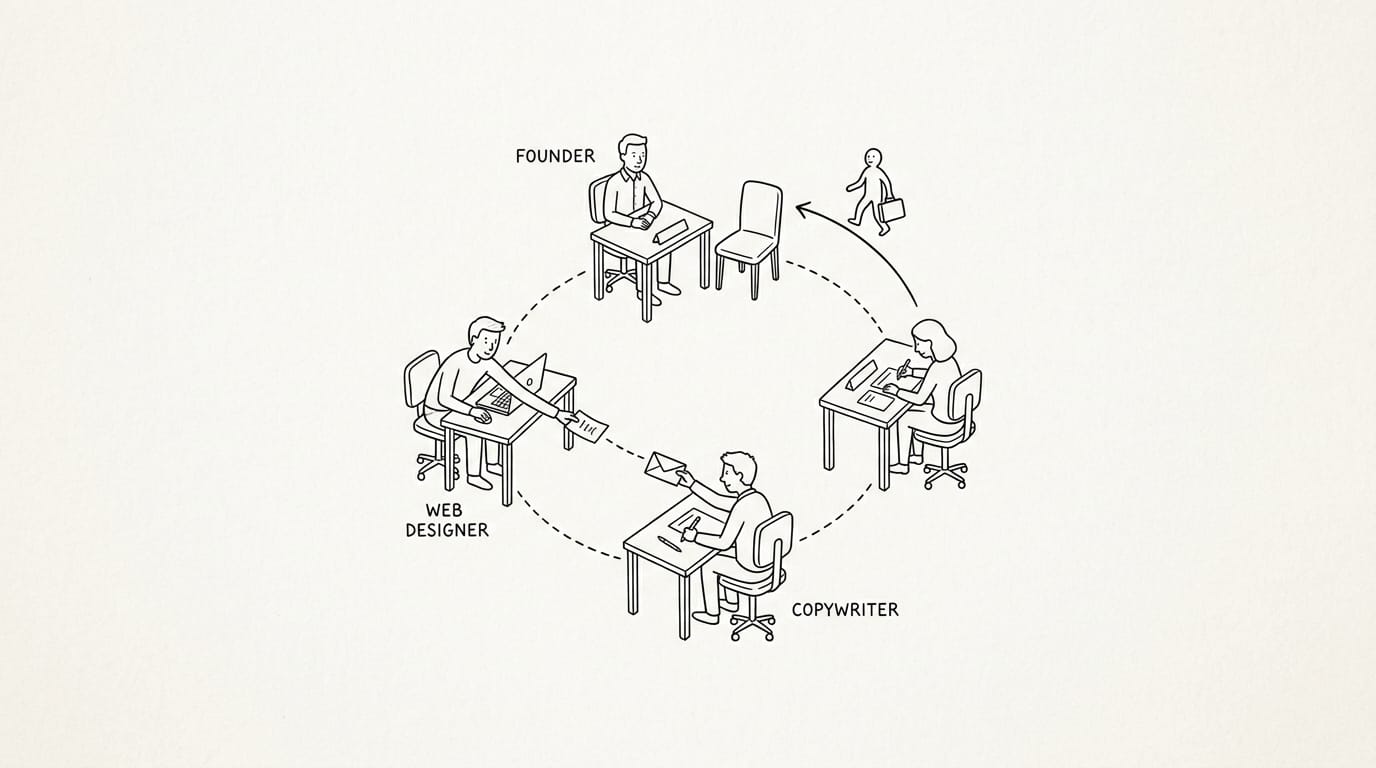
A partner ecosystem works the same way: a web designer and a copywriter refer clients they can’t take on, and neither pays for ads. Partners do the finding for you.
How Industry and Tools Shape Your CAC
Your industry sets the baseline for customer acquisition cost (CAC), and your tools decide whether you can see it.
Why banks and telecoms face high CAC
Banks and telecommunications companies spend heavily to win each customer. Banks pay for advertising, branch staff, and sign-up offers. Telecoms add handset subsidies, selling phones below cost to win contracts, plus commissions for reps.
Churn, the rate at which customers leave, keeps pushing that cost up. Every departure means winning a replacement just to stay where you are. Standing still costs money.
What changes for subscription businesses
With a subscription, you pay to win a customer up front, but revenue trickles in month by month. Two things help you track it:
- Segment and plan-level CAC: Break acquisition cost down by customer type and plan, since an average can hide which plan is working.
- Subscription platform data: Your billing tool records signups, plan choices, and cancellations, so you can calculate CAC per plan.
Software for tracking your CAC
Each one answers a different question:
- CRM (customer relationship management): a record of each customer’s source and what it cost to win them.
- Analytics attribution tools: software that credits each sale to the ad or post that prompted it.
- BI (business intelligence) dashboards: one screen that pulls your numbers together.
- Customer data platforms (CDPs): systems that merge customer data from several sources into one profile.
Take a freelance bookkeeper who starts logging each client’s source. Referrals from a local networking group cost her almost nothing, while her paid ads rarely land clients, so she shifts her hours to the group.
The goal isn’t more data. It’s knowing where customers come from, not just how many arrive.
How vendor platforms fit into CAC work
Vendor platforms are tools you buy from outside companies. A real-time engagement platform sends follow-up messages based on what a customer just did, such as visiting your pricing page.
A CDP used for segmentation sorts customers into groups, such as first-time and repeat buyers, so each gets the right offer.
Sales outsourcing methodology means handing part of the selling to an outside team. That makes acquisition cost easier to read: compare what the outside work costs with the customers it brings in.
A platform won’t lower your CAC on its own.
Telling CAC Apart from Similar Metrics
These terms sound alike, so it’s worth sorting them out before you compare numbers. A call to action (CTA) is the line or button that tells a visitor what to do next, like “Book a call.”
By contrast, customer acquisition cost (CAC) tells you what it cost to win a paying customer.
Where CPA and CPL differ from CAC
- Cost per action (CPA) measures an intermediate action, such as a sign-up or a trial start, not the final sale.
- Cost per lead (CPL) measures what you pay for each lead, meaning a contact who has shown interest.
- Full journey: CAC covers everything from the first ad click to the paying customer.
- A good CPL doesn’t guarantee a good CAC, because leads can be cheap and still never buy.
- Confirm denominators (the bottom number in each ratio) when comparing: check what each figure divides by. If one report divides by clicks and another divides by sales, the same campaign can look like a winner in one and a loser in the other.
Take a candle maker who sells from her spare room. Her ads fill her email list, so her CPL looks great. Then she checks her sales and finds that almost none of those subscribers buy. The lead number looked healthy.
Her CAC told the real story, so she knows her ads need work before she spends more.
CAC only helps if you keep checking it. Work out the number, compare it to what each customer is worth over time, and watch how long it takes to earn back what you spent. Then test one change at a time.
Spending on marketing isn’t the problem. Spending without knowing what each customer costs is. Keep your numbers simple, review them monthly, and let the results decide where your next dollar goes.
Know your number, and every marketing dollar has to earn its place.
References
- Analysis of recurring revenue models in subscription-based software companies | Future Business Journal — link.springer.com (2026)
- Customer Acquisition Cost Optimization: A Comparative Study of Paid Versus Organic Growth Strategies in Direct-to-Consumer Brands — doi.org (2026)
- The Impact of Marketing-Induced Versus Word-of-Mouth Customer Acquisition on Customer Equity Growth — doi.org (2008)
- Choosing sales channels to scale growth in a SaaS organization : a look at an enterprise mobility management software sales company in growth mode — theseus.fi (2019)
Questions
What is the best CAC?
There is no single best customer acquisition cost (CAC); it depends on your business, margins, and customer lifetime value. A useful benchmark is a lifetime-value-to-CAC ratio of about 3:1, while your maximum CAC is the most you can spend and still make a profit.
What are 7 types of digital marketing?
Seven common types of digital marketing are search engine optimization (SEO), content marketing, social media marketing, email marketing, pay-per-click advertising, affiliate marketing, and influencer marketing. Businesses often combine several types to reach and convert customers.
How is CAC defined?
Customer acquisition cost (CAC) is the average amount spent on marketing and sales to win one new paying customer. Calculate it by dividing acquisition spending for a set period by the number of first-time customers gained in that period.
What is an example of a CTA?
“Book a free 15-minute call” is an example of a call to action (CTA). It tells visitors exactly what to do next.
What does a CAC cost?
CAC is the total qualifying marketing and sales costs divided by the number of new customers acquired in the same period. Its amount varies by business; for example, spending $600 to gain 30 new customers gives a CAC of $20 per customer.
What does "call to action" mean in marketing?
A call to action (CTA) is a prompt that tells someone what step to take next, such as clicking a button, signing up, or booking a call. In marketing, CTAs guide people toward a desired action.
What makes a good CTA?
A good CTA is clear, specific, and focused on a useful benefit. For example, “Get my free pricing checklist” is more informative than a generic button such as “Submit.”
Sources
- Analysis of recurring revenue models in subscription-based software companies | Future Business Journal | Springer Nature Link, link.springer.com,
- Customer Acquisition Cost Optimization: A Comparative Study of Paid Versus Organic Growth Strategies in Direct-to-Consumer Brands, doi.org,
- The Impact of Marketing-Induced Versus Word-of-Mouth Customer Acquisition on Customer Equity Growth, doi.org,
- Choosing sales channels to scale growth in a SaaS organization : a look at an enterprise mobility management software sales company in growth mode, theseus.fi,