4-2
Marketing Funnel Explained: Stages, Models, and Metrics
Marketing funnel maps the path from first notice to repeat purchase. Build a lean version on a small budget, using stages and metrics to improve results.
- Written by

- Published
- Updated
- Reading time
- 15 min read
- Sources
- 6 cited
A marketing funnel maps how people move from first discovering a business to considering a purchase, buying, and returning or recommending it. Guide each stage with useful, relevant messages, make the next step easy, and track where people drop off so you can improve the weakest point. Start with one audience, one channel, and one offer, then refine based on results; a simple funnel you maintain is more useful than a complex one you never finish.
In this guide
Think about how you’d choose a new lunch spot. You hear a coworker rave about it, skim the menu online, compare it to two other places, and finally walk in. Each step narrows the crowd.
A marketing funnel is that same path, mapped from the moment strangers first notice your business to the moment they buy and come back for more.
This guide covers the stages, models, tactics, and metrics that show whether your funnel works, and how it differs from a sales funnel. Then we’ll build a lean version you can run on a small budget and a few hours a week.
The Basics of a Marketing Funnel
How do strangers become customers? The funnel gives you a map of that path.
How does a customer journey funnel work?
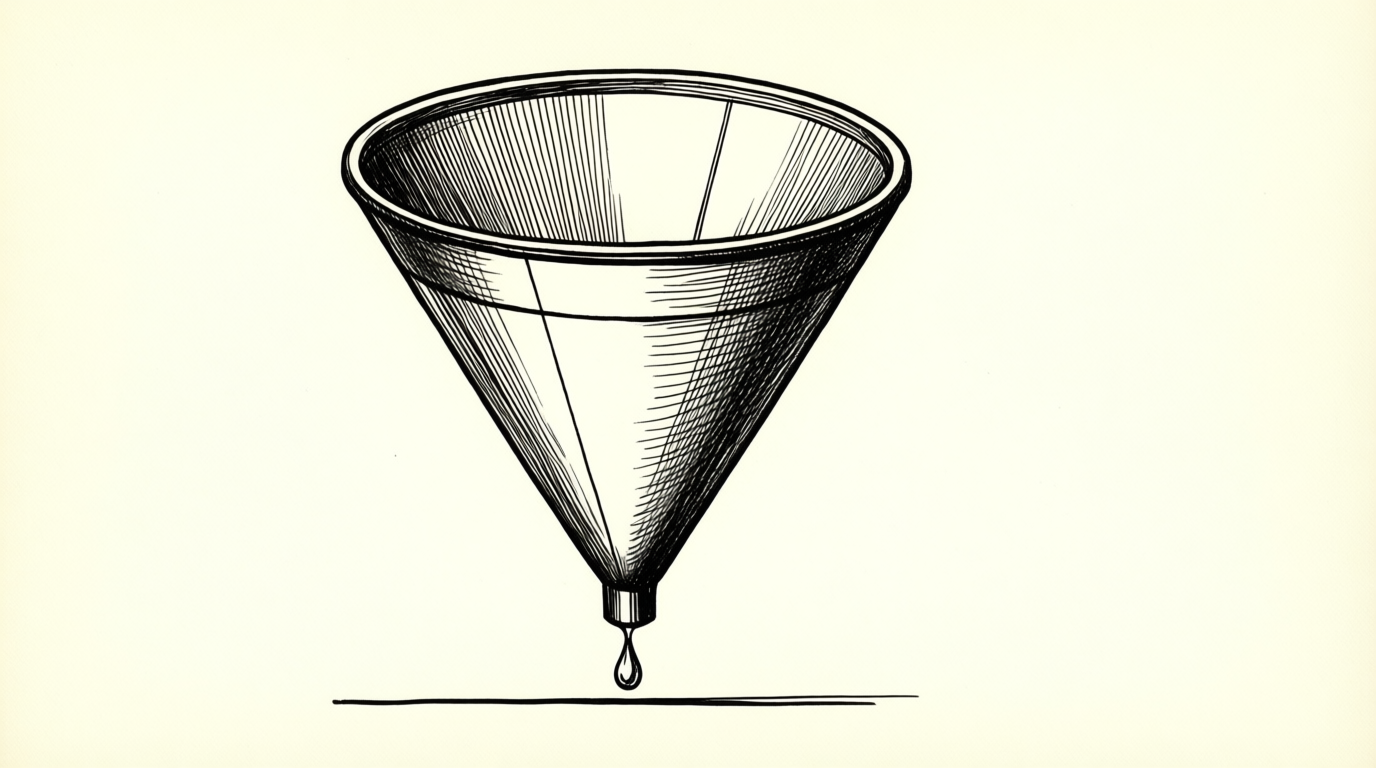
A customer journey funnel is a visual model of the path from first noticing you to buying and beyond, drawn wide at the top and narrow at the bottom.
Prospects narrow at each stage: plenty notice you, fewer click through, and fewer still buy. That narrowing is normal and shows where people drop out. Each stage needs its own messages, from a quick hook to a reassuring guarantee at checkout.
Why funnels are worth building
Funnels earn their keep in five ways:
- Simplifies the journey. Clear stages replace a tangled path.
- Reveals drop-off points. You see exactly where people leave.
- Tailors messaging to each stage. Each stage gets the right words.
- Repeatable, measurable tactics. Run the same steps and compare.
- A feedback loop for refinement. Results show what to change.
Take a candle maker whose visitors add candles to their carts but rarely check out. Her funnel points to checkout, so she tests a flat shipping rate and keeps her ad money. She doesn’t need more visitors.
Where the funnel idea came from
A historical review of advertising effects credits St. Elmo Lewis with a four-step model. In 1898 he argued that sales depend on attention, interest, and desire. Around 1900 he added action, creating AIDA (attention, interest, desire, action).
John Dewey later introduced the stages of the buyer decision process in 1910, and they’ve since been expanded.
The roots are analog, but the same stages now play out online.
Shoppers hop between stages. A reader might vanish for weeks, then buy after a friend’s recommendation. Treat the funnel as a map, not a track.
Stages, Models and Types of Funnels
Funnels come in several shapes, and a few aren’t straight lines at all. We’ll walk through the main ones.
Three stages from TOFU to BOFU
The simplest is the three-stage funnel, built on awareness, consideration, and conversion. Its top and bottom are often labeled top of funnel (TOFU) and bottom of funnel (BOFU).
Researchers Jansen and Schuster (2011), as cited in an automotive marketing study, call it the most popular conversion funnel.
Picture a candle seller at a weekend market. Plenty of people walk past (awareness), a few read the label (consideration), and fewer still buy (conversion). The top is the broadest group, and each stage narrows from there.
Longer funnel models like AIDA
AIDA, short for awareness, interest, desire, and action, is one longer model. Business-to-business (B2B) models often run to six stages. Granular funnels add loyalty and advocacy stages.
Loyalty comes after the sale, when you turn one-time buyers into repeat buyers, and advocacy is when they refer others. Take a freelance bookkeeper whose client renews each year and then refers a friend. One sale has become two.
Funnels built for specific goals
Some funnels are built for one job:
- Inbound funnel: draws in people who find your content on their own.
- Content funnel: moves readers from articles and videos toward a purchase.
- Lead generation (lead gen) funnel: captures contact details from people who may buy later.
- Ecommerce funnel: maps a shopper’s path from product page to checkout.
- Retention and referral funnels: keep customers buying and get them referring friends.
- Account-based marketing (ABM) funnel: targets specific companies with tailored messages.
Non-linear paths and what replaces funnels
Real buying doesn’t always move in a straight line. With non-linear brand integration, your brand shows up across channels, and customers can enter at any point.
The flywheel replaces the funnel: a loop instead of a line, where each happy customer adds momentum to the next round. Cyclical post-purchase nurturing keeps that loop turning after the sale.
Is the funnel dead? Not quite. It’s still a useful model, but it’s no longer the whole map.
Gen Z broke the funnel by squeezing its stages together. A recent Forbes article argues that Gen Z’s behavior is collapsing the traditional funnel, so discovery, validation, and purchase happen nearly simultaneously.
Stages still exist. They just happen at once.
Early-funnel Tactics to Get Noticed
Before you spend money or hours on promotion, know who you’re talking to. Each tactic below can start small.
Finding out who your audience really is
Start with an ideal customer persona, a short profile of the one person most likely to buy. Picture a home baker selling sourdough who decides her customer is a busy parent, so she knows which groups to join. Map out three things:
- Who they are and their daily routine.
- What problem they’re trying to solve.
- Where they look for answers.
Quality beats quantity here. Aim for the right audience, not the biggest one.
Teaching with blogs, guides and webinars
A blog answers the questions your persona types into search. An ebook is a longer guide you give away, and a webinar is a live or recorded session.
Group your best pieces into a resource hub on one topic. Title them with the words your persona searches for, the heart of SEO (search engine optimization, or getting your pages to rank).
An infographic makes a dense comparison easy to share. A landing page, built around one offer, turns visitors into people you can follow up with. Interactive quizzes, like “Which pricing model fits your side hustle?”, give people a result worth sharing.
Putting paid ads on social and search
Paid ads rent attention, while SEO earns it over time. Paid social ads run in feeds like Facebook and Instagram, and paid search ads show when someone types a keyword. SEM (search engine marketing) is paid search, and SEO is the unpaid side.
Ads in Instagram Stories and Reels work best when they’re short and state the offer early. Take a candle maker who tests two scents in short ads, learning which sells before she orders a big batch.
Partnering with influencers and the press
Micro-influencers have a modest, engaged following in one niche, and nano-influencers have an even smaller, often local one.
Brand ambassadors are fans who promote you regularly, often for perks like a discount.
PR (public relations) wins coverage in local and trade press when you offer a story, not a sales pitch.
Podcasts and contributed articles (pieces you write for another publication) borrow an audience a host already trusts. Pitch the story, not the sale.
Winning over People Weighing Their Options
Most visitors aren’t ready to buy when they first arrive. They’re still comparing, and these tools keep them close until they decide.
Lead magnets that capture emails
A lead magnet is a free offer valuable enough that people trade their email address for it. Make it solve a small problem, not showcase your product.
Exit-intent pop-ups make one last offer as visitors head out.
A landing page is a single page built around one offer, with an opt-in form that collects the email.
Two formats work well: free guides that teach one task, and free trials that let people test the real thing.
Following up with email on autopilot
An email sequence is a set of automatic messages sent after signup. Marketing automation is the software that times each one to what the subscriber does.
Segmented email lists sort subscribers by interest so each message fits.
Keep contact frequency and timing predictable: steady beats frantic, and a burst followed by silence teaches readers to tune out.
Pick a free email tool that can run sequences and segment lists, then upgrade once your list outgrows it.
Consider a freelance photographer whose short sequence walks new subscribers toward booking a session. The bookings arrive while she’s at her day job.
Content that earns trust with buyers
Buyers want proof before they commit:
- Case studies show a real customer’s result in their own words.
- White papers are longer, research-style pieces on a single problem.
- Testimonials should be specific: ‘it gives me my Friday afternoons back’ beats ‘Great product!’
- Thought leadership shares your view on a problem buyers care about.
- Product comparisons are honest, including the cases where you’re not the best fit.
Keep your tone authentic. Jargon makes readers feel like outsiders, and outsiders don’t buy. Talk about what it does, not how it’s built. Plain beats polished.
Ways to retarget, score and personalize
Retargeting shows ads to visitors who left without buying. Lead scoring adds points for actions like opening emails or viewing your pricing page.
Scoring shows who’s interested. Lead qualification checks who’s able to buy, through a few questions about budget and timing, before you spend hours on a lead.
Personalized content uses what you know, like a subscriber’s name or the product they viewed, so messages feel written for one person.
Turning Interest into Sales at the Bottom
Shoppers here already know what you sell. They just need a reason to say yes now, without pressure.
Offers and perks that close the deal
These tools make the next step feel safer:
- Limited-time offers. A real deadline gives people a reason to decide today.
- Free trials and demos. Buyers get to try before they pay.
- Guarantees and value stacking. A money-back promise lowers the risk. Stacking bonus extras makes the total value outweigh the price.
- Clear pricing comparisons. Show what your price covers next to the alternatives.
- Tripwire upsell offers. A low-cost first purchase that’s easy to say yes to can lead to a bigger order later.
A woman who sells leather wallets on the side adds free engraving during one posted holiday week. Buyers decide then instead of bookmarking the listing.
Using social proof to answer objections
Shoppers rarely voice doubts. They just hesitate. Social proof, evidence that others already bought and were happy, answers them first.
- Testimonials and reviews. Feature the ones that address a specific worry, like sizing.
- Case study and comparison pages. Show a real result, or line your offer up against what you’re replacing.
- Learn sales rep objections. Note the questions you hear most and answer them on your site, even if you’re the only rep.
- Responsive customer service. A quick reply often saves a sale that a slow one would lose.
Win back shoppers who abandoned their carts
Often a cart is lost to friction, not refusal, so make finishing easy first. Retargeting ads remind past visitors what they left behind. Abandoned cart emails send a short, friendly note with a link back to the cart.
Streamlined checkout cuts extra fields and shows shipping costs up front. Paid ads at the purchase stage reach shoppers already searching for your product.
Every extra step is a chance to quit.
Using discounts and soft selling wisely
A discount can close a sale, but it can also teach buyers to wait. Save it as a closing push for a specific group, like first-time buyers, not as your everyday price.
A soft sell informs and reassures. Urgency pushes for a decision now. Soft selling builds trust, while urgency spends it if you lean on it.
Skip outright price cuts, which signal that your product is worth less. Label any sale as a short event instead, so it stays a choice.
Keeping Buyers Coming Back After Purchase
Your first sale is rarely the finish line. Here’s how to keep buyers coming back.
Why repeat buyers spend more over time
According to research covered by eCommerce News, returning customers generate more revenue per order: their median cart is 80.41 euros, versus 59.90 euros for one-time buyers.
That’s why it pays to focus on customer lifetime value, the total a buyer spends with you over time.
Ongoing email keeps you top of mind. A home baker who emails past buyers when her holiday cookie boxes go back on sale earns reorders without new ads. Make it useful, not pushy.
Rewarding loyalty and encouraging referrals
A candle maker who asks buyers for photos of their candles at home shares the best ones, so new shoppers see a real living room, not a stock image.
Four ways to reward and recruit repeat buyers:
- Loyalty programs. A perk after a set number of orders rewards loyal buyers.
- Referral incentives. Give both the buyer and their friend a small reward.
- Reviews and user-generated content. Ask for reviews and photos customers take of your product.
- Customers as advocates. Happy buyers become advocates who recommend you to friends.
Welcoming new buyers and gathering feedback
If your product lives in an app, interactive in-app onboarding (a short guided walkthrough) helps new users reach their first win. Send a thank-you email with order details and how to get help. Keep it simple.
Book short calls with recent buyers and ask what made them choose you. You’re listening for problems, not just praise. A quick post-purchase survey gathers similar input from more buyers.
A freelance web designer who hears that her handoff notes confused a client rewrites her template, so every future client gets clearer instructions.

Measuring and Improving Funnel Results
Launching a funnel is half the job. Knowing whether it pays is the rest.
Which numbers matter at each stage
According to a preprint study on funnel engagement, impressions, leads, and conversions show how a funnel performs:
- Top of funnel (TOFU): impressions, click-through rate (CTR), and entry sources (where visitors arrive).
- Middle of funnel (MOFU): leads, bounce rate, and scroll depth.
- Bottom of funnel (BOFU): conversion rate and return on ad spend (ROAS), the revenue each ad dollar earns.
Exit rates show where visitors leave.
Tracking conversions, costs and returns
Your conversion rate is conversions divided by visitors, times 100, so 10 sales from 500 visitors is 2 percent.
Cost per acquisition (CPA) is spend divided by new customers, so $200 in ads for 8 customers is $25 each.
Customer lifetime value (CLV) is what one customer spends with you over time, your ceiling for CPA.
Return on investment (ROI) is gain minus cost, divided by cost. Lead velocity tracks how fast qualified leads grow monthly.
Before spending on ads, check your unit economics, the profit on each sale after direct costs. If CLV doesn’t comfortably beat CPA, more spend only buys losses faster.
Figuring out which channels earn credit
Last-click attribution credits only the final touchpoint and ignores the blog post that started the journey.
Consider a side hustler selling candles at markets. Her analytics credit Google ads with most sales, so she plans to double them. A one-question post-purchase survey shows most buyers first found her at a market stall, so she moves the money there.
Multi-touch attribution spreads credit across every touchpoint but needs more data than most lean funnels have, so start simple. Judge each channel on its own cost and sales so one strong performer doesn’t hide a weak one.
Testing what works and where people drop
A/B split testing shows two versions of a page or email to halves of your audience. Change one element at a time.
For drop-off points, check exit rates page by page. A leaky pricing page is worth fixing before you touch the ad budget.
For content gaps, list the questions buyers ask before paying and answer any that your content misses.
Use data-driven refinement: make one change, measure it, keep what works.
Low traffic slows testing, so we’d suggest comparing against your own past numbers, not industry averages, and watching trends over several weeks.
Building Your Marketing Funnel Step by Step
Building a funnel is less about tools and more about sequence.
Going from goals to ongoing tweaks
- Define goals and audience. Get specific: ‘parents who need a weekly meal plan’ beats ‘busy people.’
- Map customer journey stages. Sketch how a stranger notices you, looks closer, then buys.
- Create stage-specific content. Give each stage one asset, like a video for strangers.
- Capture and nurture leads. Collect contact details from interested visitors (your leads), then send helpful follow-ups.
- Iterate and refine. Check which stage loses people, change one thing at a time, and repeat.
Here’s a made-up example. Maya, a weekend candle seller, spends $100 a month on ads. Those ads bring 100 visitors, 10 join her email list, and 2 buy at $30 each. That’s $60 in revenue against $100 in ads, so her weak link is turning leads into buyers.
Lifting that to 4 buyers doubles her revenue to $120.
Tailoring the funnel to your business
If your budget is tight, save paid ads until you know what converts. Brand awareness (people recognizing your name) takes longer than a direct sale.
Average order value (what a typical customer spends per purchase) sets the timeline: a $15 item may close in one visit, while a $1,500 service may take weeks.
Funnel hacking means studying a competitor’s funnel, then adapting what fits. Build on what you already have, like a blog or email list.
Start with a minimum viable funnel (the smallest test of your idea): one channel, one free offer, one follow-up email. One channel that works beats five that don’t.
Mistakes to avoid and rules to follow
- Neglecting the middle of the funnel. Chasing visitors and sales skips nurturing.
- No personalization or retargeting. Tailor follow-ups, and retarget (re-reach) visitors who didn’t buy.
- Poor lead qualification. Ask a question or two to separate real buyers from browsers.
- Data protection and anti-spam. Email only opted-in people and follow privacy laws. Permission beats volume.
Where AI helps with targeting and testing
Artificial intelligence (AI) tools spot patterns in your data, so testing gets faster.
- Precise targeting. Find audiences that look like your past buyers.
- Lead prioritization. Rank new sign-ups by how likely they are to buy.
- Automated testing. Rotate headlines or images and shift spend toward the winner.
The tool sorts. You still decide what your customer wants.
Marketing and Sales Funnels, B2B and B2C
Marketing and sales funnels look alike on a slide, but they do different jobs. Here’s where one hands off to the other.
How the sales funnel differs from marketing
The sales funnel is the path a prospect takes from first hearing about you to a purchase. That’s what “funnel” means in sales: many people enter at the top, and fewer reach the bottom.
The marketing funnel sits upstream, turning strangers into leads, people who’ve shared a name or an email to show interest. Once a lead is ready to talk, marketing hands off to sales. The marketing funnel tracks leads; the sales funnel tracks purchases.
At the bottom, the two teams need each other. Sales shares which questions came up on calls, and marketing uses those answers in its next messages.
Take a side-hustler selling handmade candles. Her social posts are her marketing funnel. When a follower messages about gift orders, that’s a lead, and the chat that turns it into an order is the sales funnel. One order pays for her next batch of wax.
Where B2B and B2C funnels diverge
A business-to-business (B2B) sale goes to other companies, while a business-to-consumer (B2C) sale goes to individual buyers.
B2B funnels run longer, with several people weighing in and sales reps guiding the buyer through each step. B2C funnels move faster and lean on emotion. A shopper likes how something feels and buys, sometimes in one visit. Timing is the real split.
Calibrate your funnel to your customers, not to a template. A bookkeeper selling monthly service to shop owners needs room for a call and a proposal. A soap maker selling online may need only a photo and a checkout button.
A marketing funnel works best when it feels like a conversation, not a sales pitch. Attract people with something useful, help them weigh their options, make buying easy, and give them a reason to come back.
Watch the few numbers that matter, and let them show you where to adjust.
You don’t need a big budget or a full team to get there. Begin with one channel and one offer, then improve each stage as the numbers show where people drop off. A lean funnel you actually maintain beats a perfect one you never finish.
References
- From Impressions to Performance: Unpacking the Economic Value of Digital Marketing Funnel Engagement — doi.org (2026)
- Chapter 10 — openbooks.uct.ac.za
- Ainda AIDA? - Uma revisão histórico-crítica da hierarquia dos efeitos publicitários — doi.org (2017)
- Multilevel marketing: optimizing marketing effectiveness for high-involvement goods in the automotive industry — doi.org (2020)
- Less than 15% of customers place a second online order — ecommercenews.eu (2025)
- How Gen Z’s Consumer Behavior Collapsed The Marketing Funnel — forbes.com (2026)
Questions
What is funnel in terms of sales?
A sales funnel is the path a prospect takes from first hearing about a business to making a purchase. Many prospects enter at the top, but fewer complete the journey and reach the sale.
What is a customer journey funnel and how does it work?
A customer journey funnel maps the path from first noticing a business through consideration and purchase, often continuing into repeat buying or referrals. It narrows as some people drop out at each stage, helping businesses see where to improve and tailor messages to what customers need next.
How did Gen Z break the marketing funnel?
Gen Z has compressed the traditional stages: discovery, validation, and purchase can happen nearly simultaneously rather than in a slow, linear sequence. The stages still exist, but consumers may move among them quickly and across multiple channels.
Is funnel marketing outdated?
No. A funnel remains a useful way to map stages and identify where people drop off, but it is not a complete picture of modern buying behavior. Customers often move nonlinearly, so approaches such as a flywheel can complement the funnel by emphasizing ongoing customer relationships and referrals.
Sources
- Ainda AIDA? - Uma revisão histórico-crítica da hierarquia dos efeitos publicitários, doi.org,
- Chapter 10, openbooks.uct.ac.za
- Multilevel marketing: optimizing marketing effectiveness for high-involvement goods in the automotive industry, doi.org,
- Less than 15% of customers place a second online order, ecommercenews.eu,
- How Gen Z’s Consumer Behavior Collapsed The Marketing Funnel, forbes.com,
- From Impressions to Performance: Unpacking the Economic Value of Digital Marketing Funnel Engagement, doi.org,