4-5
Marketing Research Explained: Methods and Real Examples
Marketing research helps you test decisions before spending. See its three main types, project steps, and how major brands used research to shape choices.
- Written by

- Published
- Updated
- Reading time
- 13 min read
- Sources
- 8 cited
Marketing research is the planned collection, analysis, and interpretation of information about customers, competitors, and the market. It starts with a specific business decision, then uses suitable methods such as surveys, interviews, existing reports, sales data, or online feedback to find patterns and test assumptions. In practice, even a few focused questions can help you choose products, prices, and messages with less guesswork, and regular small tests keep decisions aligned with changing customer needs.

In this guide
Think about testing a new recipe before a dinner party. You’d ask a friend what they like and maybe taste a small batch first.
Marketing research does the same job for a business: it gathers information about customers, competitors, and the market so you can decide with evidence, not guesswork.
This guide covers what marketing research is, its main methods and types, how a project unfolds, and real examples from well-known brands. We’ll also get practical about cost, timing, and how a solo owner can run it cheaply.
What Marketing Research Is and Covers
Ever wondered why some products sell while others gather dust? Marketing research shows you what customers want before you bet your money on a guess. Here’s what we’ll cover.
How research replaces guesswork with evidence
Marketing research is the systematic collection, analysis, and interpretation of information about customers and their needs. Research turns raw answers into data you can draw insights from. Think of a side hustler who bakes dog treats on weekends.
She’s sure her customers want grain-free options, but she’s only guessing. A short survey of past buyers can confirm or overturn that hunch, and the answer decides which recipe she bakes next month. Guessing feels free. It rarely is.
The key features of marketing research are:
- Systematic: it follows a planned method, not random impressions.
- Need-focused: it starts with what consumers need and want.
- Insight-driven: it produces findings you can act on, not just numbers.
How market research differs from marketing research
People often use market research and marketing research interchangeably, and the overlap is real. The difference is the question each one answers. Market research describes what the market looks like today.
Marketing research shows how to reach the customers in it.
How research data describes, explains, and predicts
Research data does three jobs. It’s descriptive when it shows what’s happening, such as how many customers buy and when. It’s diagnostic when it explains why, and predictive when it points to what’s likely next. Every project moves through four stages:
- Planning: define the question you need answered.
- Collecting: gather the information that answers it.
- Analyzing: look for patterns and what’s driving them.
- Communicating: share findings in a form someone can act on.
Skip planning, and you’ll collect plenty of answers to the wrong question.
How different teams view research
Teams read the same research differently. Sales teams look for which customers are close to buying and what’s holding the rest back. Marketing teams focus on which message reaches the right people.
Product development teams ask which features customers actually need.
In the boardroom, research is how leaders make big calls on evidence rather than instinct. Seen this way, research is a key to success: when every team works from the same facts, decisions line up.
If you’re a team of one, you wear all these hats at once. Check the evidence, then decide.
Why Marketing Research Matters
Marketing research can sound like big-company work. Yet every price, ad, and product rests on assumptions about customers, and research tests them before they cost you money.
What research does for your business
Done well, research helps you:
- Make informed decisions. Choose based on what customers have told you, not what you hope is true.
- Reduce investment risk. Spotting a weak idea in a survey costs far less than spotting it in unsold inventory.
- Forecast demand. Estimate how many people want your offer before you order stock.
- Sharpen positioning. Learn the words customers use, so your description sounds like theirs.
- Benchmark against competitors. Compare what rivals charge and promise, so you know where you stand.
A side hustler selling handmade leather wallets on weekends asks recent buyers which color they reached for first. The answers point to one shade, so she skips the pile of unsold stock in the other.
The goal isn’t more data. It’s better decisions.

Three goals every study should serve
Every study should serve three goals:
- Administrative (internal operations). It helps you run the business smoothly, from scheduling to inventory.
- Social (customer satisfaction). It shows whether customers feel heard and likely to return.
- Economic (market demand). It shows whether enough people will pay your price.
Skip one, and you’re guessing.
How each department uses research
Solo owners wear all of these hats:
- Sales and lead generation. Research shows where prospects find you and what makes them buy. It also helps you gauge customer lifetime value, the total profit one customer brings over the relationship.
- Brand positioning and campaigns. It tests which message or offer lands before you fund a full campaign.
- Product and business development. It shows which features people want and which just add clutter.
- Technology-driven research innovation. Online surveys and website analytics gather feedback faster. The question stays the same, but what changes is how fast you get the answer.
How associations use research to serve members
Research helps associations in three ways:
- Understand members, donors, and sponsors. Feedback shows what each group needs, so you can keep them.
- Work efficiently with small staffs. Short, focused studies give useful answers without a full research department.
- Improve programs and services. Feedback shows which offerings members use and which they ignore.
Fewer, sharper questions beat a longer survey every time.
The Key Areas and Parts of Research
Research sprawls fast, so focus on the key areas, building blocks, and guiding questions.
What research should focus on
- Competition research: who sells to your customers, at what prices, and how well.
- Product research: whether your offer solves a real problem and which features matter.
- Audience research: who buys, why, and what they’re trying to get done.
- Communication channel research: where your customers spend time and how they’d rather hear from sellers.
Take a side hustler who sells leather wallets on weekends. Her research shows few rivals offer engraving, and her gift shoppers are in a hurry. So she adds engraving as a paid option, matching what buyers actually asked for.
You’re learning what buyers want, not what you assume they want.
Building blocks of a solid study
- Market segmentation: splitting a broad market into smaller groups with shared needs.
- Research design and sampling: choosing how you’ll gather information and who you’ll ask.
- Competitive and consumer behavior analysis: how rivals position themselves and how buyers choose.
- Market sizing and forecasting: estimating how many customers exist and how much you could win.
- Reporting and presentation: summarizing findings in plain language with a clear next step.
On sampling, five friends who like your work make a fan club, not a sample. Ask people who could actually buy.
Key questions to guide your research
Answer these before you collect any data.
- Who are your target audiences? Name specific groups, like weekend gift shoppers.
- Which concerns affect each audience? Price, trust, shipping, and convenience weigh differently for each group.
- Which programs provide the most value? Find which efforts, like a market booth or email list, bring in buyers worth their cost.
What Are the Three Main Types of Marketing Research?
Marketing research comes in three main types: research you collect yourself, research others have already published, and what people are already saying online.
Collecting new data yourself
This is primary research, information you gather firsthand through:
- Surveys: written questions sent to a group.
- Interviews: one-on-one talks that uncover motives.
- Focus groups: guided discussions with several people at once.
- Ethnographic observation: watching people in their real setting, to see what they do, not just what they say.
It’s precise but slower and costlier. Conventional Primary Research Techniques notes these methods take more time and resources than existing reports and names cost as their main drawback.
So how much does marketing research cost? Primary work sits at the costly end, but the cheapest option is free customer interviews before launch. Think of a freelance bookkeeper testing a monthly cleanup service for small landlords.
A few free calls show most would rather pay quarterly, so she prices her plan that way.
Using existing reports and studies
Existing reports and studies are the budget option. They come from:
- public sources (such as government data)
- commercial sources (paid research firms)
- educational sources (university studies)
They’re faster and cheaper but less tailored: a study covers the whole market, not your one product. Use them for context, then fill the gaps yourself.
When to use stories versus numbers
Use stories to learn why people buy, and numbers to learn how many feel the same way. Interviews and focus groups reveal in-depth attitudes and motivations, while surveys and polls supply large-scale numerical data.
Scores like Net Promoter Score (NPS, which asks how likely customers are to recommend you) and customer satisfaction score (CSAT) turn feelings into numbers you can track.
The strongest answers combine them: a survey shows how many buyers are unhappy, and a few interviews show why. Do both.
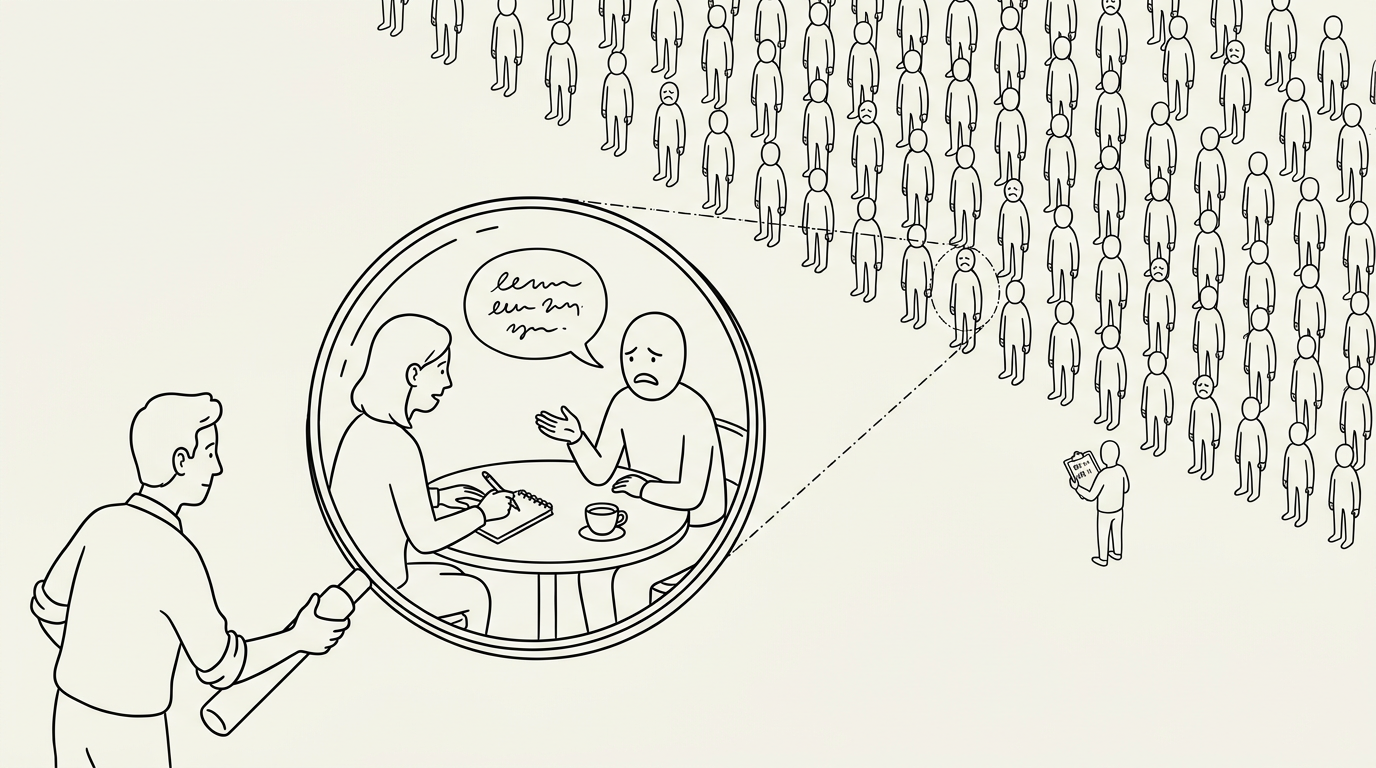
Tracking what people say online
- Aggregate public conversations: gather posts, reviews, and forum threads about your category.
- Sentiment analysis: software using natural language processing (NLP) to sort text as positive, negative, or neutral.
- Track competitor mentions: see what buyers praise or complain about in rival brands.
- Candid customer opinions: people often speak more freely in an unprompted review than in a survey.
Think of a solo candle maker who sees rival reviews calling scents ‘too strong.’ That’s a free signal, so she tests a milder blend first.
Other ways to test and learn
- A/B testing: show two versions of a page, email, or price to different visitors and see which performs better.
- CATI (computer-assisted telephone interviewing): a declining method, though a study in the Journal of Survey Statistics and Methodology notes telephone surveys have long been popular and still get used.
- Association management system (AMS) data: software tracking a trade group’s members and dues. If your buyers belong to it, its records can show you who they are.
- Concept testing: show a sketch or mock-up to potential buyers before you build.
How a Research Project Unfolds
Each stage sets up the next, so here’s the path from first question to follow-up.
Set goals and pin down the problem
Good goals name a decision, not a topic: “Should you raise your price?” works, but “learn about my market” doesn’t. Define your target audience as the people whose answers matter most, then turn each unknown into a testable question.
A home baker weighing custom cakes might ask, “Will past birthday customers pay more for a custom design?” She can test it with a short survey of those exact people, so she knows whether custom orders are worth her weekends.
Plan your method, timeline, and sample
Methodology is how you’ll gather evidence, like a survey or interviews. So how long does market research take? It varies.
According to the Wiley International Encyclopedia of Marketing, a project’s timeline depends on its methodology, sample size, and data-collection and analysis needs. Sketch those choices on a calendar first.
Sample size is how many people you hear from, but who you ask matters more than how many.
Probability sampling gives everyone in your target group a known chance of selection, such as a random pick from your customer list. Non-probability sampling relies on convenience, like whoever stops at your market table.
That’s useful for a first read, but treat those answers as clues, not proof.
Collect, check, and analyze the data
Check every response for duplicates, half-finished surveys, and copying errors.
Operational data records what happened, like sales and refunds. Experience data captures what people think, through surveys and interviews. Operational data shows what customers did, while experience data shows why.
Statistical analysis counts and compares, like how many customers reordered. Thematic analysis sorts open-ended comments into recurring themes.
One angry review is a story; the same complaint across interviews and refund notes is a pattern. Trends only show up when you compare the same measure over time.
Watch for these traps:
- Friendly-audience bias. Friends tend to answer kinder than strangers.
- Leading questions. “Wouldn’t you love a faster option?” hands people your answer.
- Confirmation bias. You notice the feedback that fits your plan and skip the rest.
- Overreading small samples. A few responses can mislead you.
Share findings and act on them
Write a short executive summary that answers your original goal, then list the two or three recommendations it supports. Turn each finding into a decision: keep the price, test a new one, or note what’s still unknown.
Review the results with your team, even if that’s one partner or a bookkeeper, since a second reader spots gaps you’ve stopped seeing. Finally, thank your respondents and tell them what changed because of their answers.
Keep testing and tracking over time
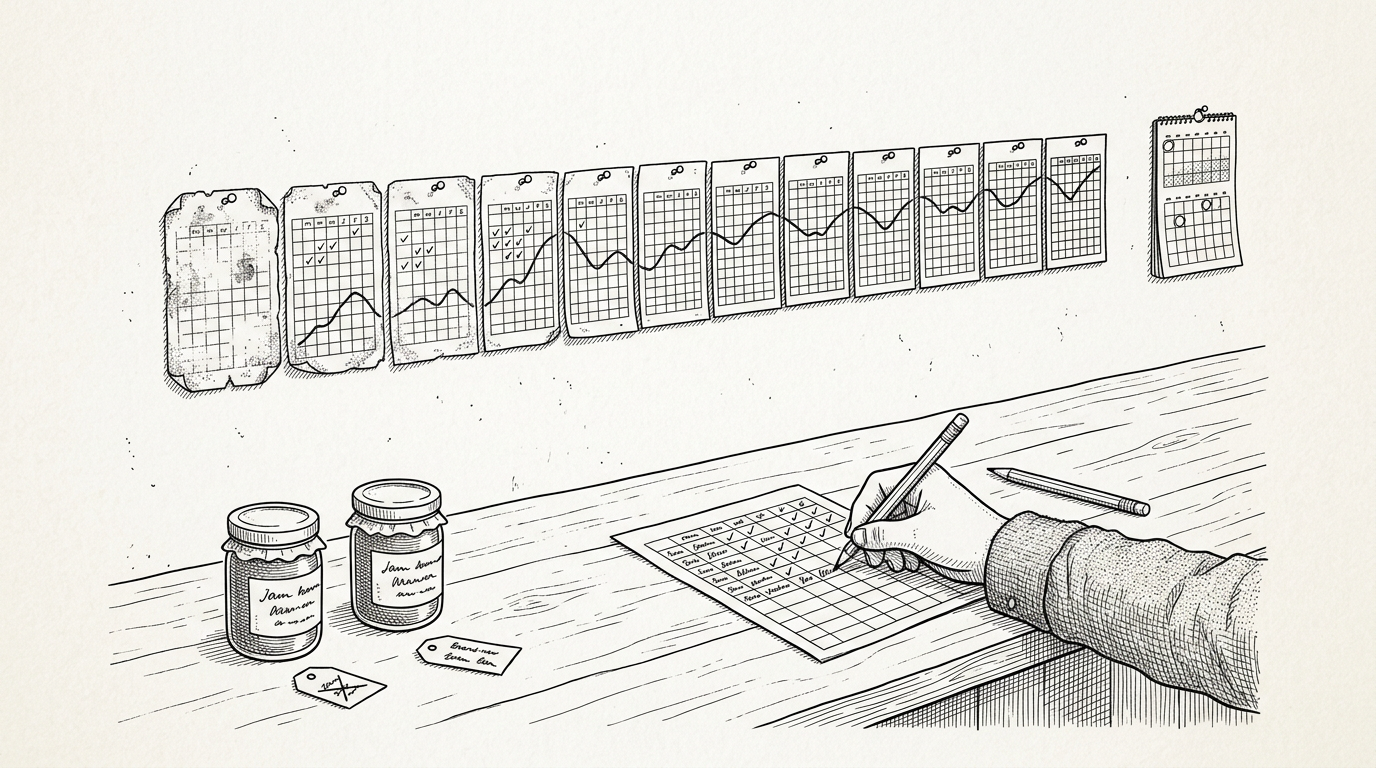
Research doesn’t end at launch. Keep small tests running, like a new price on one product, and repeat key questions every few months. Markets shift. Last year’s answers can quietly go stale.
Ongoing tracking works best as a habit, not a one-time study: a simple sheet of sales, reviews, and repeat orders, updated monthly.
Habits and Tools That Make Research Work
Good research depends as much on habits as on software. Pick your method by budget and question first, then use the habits and tools below to keep your results sound.
Habits that keep research sound
- Mix qualitative and quantitative. Interviews and open-ended comments (qualitative data) reveal why people buy. Counted answers (quantitative data) show how many agree.
- Use multiple data sources. Survey answers, sales records, and social posts each miss something, so check one against the others.
- Maintain data quality. Date your spreadsheets, note each number’s source, and remove duplicate responses. A figure without a date or source is just a guess.
- Ethics, consent, and privacy. Tell people what you’re collecting and why, and get their okay before recording a conversation. Ask first, share less.
- Keep watching competitors. Check rivals’ prices, offers, and reviews on a regular schedule. A snapshot taken months ago can’t show what changed last week.
Software that helps you research
- SentiOne social listening: tracks what people say about your business, your competitors, and your category online.
- SurveyMonkey templates and services: start from a ready-made survey instead of a blank page, or use their services if you’d rather not build it yourself.
- Momentive AMS reporting: organizes your results into a summary you can review without building it from scratch.
- Free tools: Google Trends shows when people search for a topic, not what they think of it, so pair it with interviews. Free forms cost nothing to use. Check current pricing on any paid tool before you commit.
Consider a side hustler selling handmade wallets. She checks Google Trends for gift-season spikes, then surveys past buyers about why they chose her. That research shapes her listing, so she’s live before the holiday rush.
Real Examples from Well-known Brands
Even big brands build on research, and these methods scale down for a side hustle.
How big brands put research to work
A FlexMR case study shows Specsavers using quantitative research, or number-based data, to inform a campaign and its naming.
A study of Nike’s customer satisfaction reports that Nike has used post-purchase surveys, sent after a sale, to collect feedback.
Procter & Gamble (P&G) has used focus groups (guided group discussions) to gather consumer feedback, according to Listening begins at home. That research also paired them with one-on-one interviews.
According to a study of its marketing model, Coca-Cola has done competitor analysis as part of its marketing research, comparing its progress with rivals.
According to a 2021 study by Celina Navarro and Belén Monclús, Netflix has used social media monitoring to understand audience conversations and interests.
HubSpot’s A/B testing shows two versions of an email or ad to different people and keeps the stronger one. A photographer can test two subject lines this way and keep the one with more opens.
Research behind entry and repositioning moves
Market entry research comes first. Ennera’s move into the UK market raises a question every brand faces: will local buyers want this, and who already serves them?
Concept testing shows an idea to likely buyers before you build it. A side hustler selling candles might ask a few regulars which scents they’d buy before ordering wax in bulk. Cheap to ask, costly to guess.
Before you reposition, check brand perception, the impression customers already hold. A freelance bookkeeper who sees herself as a planning partner might find clients only call at tax time. Ask how they describe you, not what you hope they’ll say.
Marketing research boils down to one habit: checking with real customers and real numbers before you spend money, time, or a launch date.
Whether you survey buyers, interview a few people, or compare competitor prices, the goal is the same: swap hunches for evidence you can act on.
You don’t need a big budget to start. A short survey and a few honest conversations can answer your most pressing questions, and you can repeat them as your business changes. Small and regular beats big and rare.
References
- Going Online With a Telephone Employee Survey: Effects On Coverage, Nonresponse, and Total Selection Bias | Journal of Survey Statistics and Methodology — academic.oup.com (2026)
- Understanding Nike’s customer satisfaction with delivery performance — hdl.handle.net (2022)
- The curation of European Netflix catalogues on social media: The key role of transnational and local cultural traits — journals.sagepub.com (2021)
- Analysis of Coca-Cola Company’s Marketing Model — joebm.com
- Wiley International Encyclopedia of Marketing — onlinelibrary.wiley.com
- Listening begins at home. — pubmed.ncbi.nlm.nih.gov (2003)
- Conventional Primary Research Techniques — doi.org (1999)
- Specsavers Brings Customer Insights into Centralised Hub — resources.flexmr.net
Questions
What is the market research process?
The market research process typically has four stages: plan the research question, collect relevant information, analyze it for patterns, and communicate findings that support a decision. A sound process also defines the target audience, chooses an appropriate method and sample, and checks data quality before acting on results.
What is market research GCSE?
Market research GCSE usually refers to the market research topic studied in GCSE Business. Students learn how businesses gather and use information about customers, competitors, and markets, including primary and secondary research methods such as surveys, interviews, and existing reports.
What are the techniques of marketing research?
Marketing research techniques include surveys, interviews, focus groups, observation, analysis of existing reports, social listening, competitor analysis, concept testing, and A/B testing. Choose techniques according to the question: conversations can uncover why people act, while surveys and other numerical methods can show how many share a view.
What are the three main types of marketing research?
The three main types are primary research, secondary research, and online listening or social media research. Primary research gathers new information directly, secondary research uses existing studies and reports, and online listening examines public posts, reviews, and discussions.
What are the key features of marketing research?
Marketing research is systematic, focused on customer needs, and designed to produce actionable insights. It collects and interprets information about customers and markets to support evidence-based decisions rather than guesswork.
How much does marketing research cost?
Marketing research can cost nothing if you use free customer interviews, online forms, public data, or existing reports. Primary research generally costs more because it takes time and resources; the price depends on the method, sample, and whether you do the work yourself or hire a provider.
How to become a marketing researcher?
To become a marketing researcher, build skills in research design, surveys and interviews, sampling, data analysis, and clear report writing. Study marketing, business, statistics, or a related field, then gain experience through internships, research assistant roles, or practical projects; employers may also value proficiency with survey and analytics tools.
How long does market research take?
Market research can take anywhere from a few days to several months, depending on the method, sample size, and time needed to collect and analyze data. A short survey or set of interviews may be quick, while a large study or ongoing tracking project takes longer.
Sources
- Going Online With a Telephone Employee Survey: Effects On Coverage, Nonresponse, and Total Selection Bias | Journal of Survey Statistics and Methodology |, academic.oup.com,
- Specsavers Brings Customer Insights into Centralised Hub, resources.flexmr.net
- Understanding Nike's customer satisfaction with delivery performance, hdl.handle.net,
- Listening begins at home., pubmed.ncbi.nlm.nih.gov,
- Analysis of Coca-Cola Company's Marketing Model, joebm.com
- The curation of European Netflix catalogues on social media: The key role of transnational and local cultural traits - Celina Navarro, Belén Monclús, 2021, journals.sagepub.com,
- Conventional Primary Research Techniques, doi.org,
- Wiley International Encyclopedia of Marketing, onlinelibrary.wiley.com