8-5
Market Research to Start a Business: Complete Guide
Market research to start a business tests demand before you risk your savings. Use cheap steps to size up rivals and judge whether to move forward.
- Written by

- Published
- Updated
- Reading time
- 12 min read
Market research for starting a business means finding out who might buy your offer, what they need, what they already use, and what they would pay. Start with a clear question, use low-cost reports, reviews, interviews, surveys, and small tests, then compare what people say with what they actually do and with your costs. The evidence helps you decide whether to proceed, adjust the offer, or stop before risking savings, and keeps your business plan grounded in real demand.

In this guide
Think about the last time you bought something new. You probably checked reviews, asked a friend, and wondered whether anyone else would actually want it. Starting a business works the same way, only the stakes are your savings and your paycheck.
Market research is simply finding out whether people want what you plan to sell, who they are, and what they’d pay. Done cheaply and in the right order, it tells you whether to keep going before you quit your job.
Here, we’ll cover the steps, low-cost methods, and how to judge the results.
Market Research to Start a Business Matters
Before you spend money or evenings on an idea, you need to know whether anyone wants it. That’s the job of market research.
What it covers and who uses it
Market research gathers data on customers, competitors, and trends. It maps your industry, your niche (the narrow slice you’d serve), and your target market (the people most likely to buy).
The goal is facts over assumptions: it’s less about what you hope is true and more about what your buyers actually do.
Think of a candle seller who assumes everyone wants her scents. A few conversations might reveal her buyers want gifts, and that changes what she makes. It’s not only for startups, either. A freelancer weighing a new service can ask the same questions.
How research cuts risk and finds gaps
Research pays off in practical ways:
- Avoiding costly mistakes. Testing demand beats learning there’s none after you’ve bought inventory.
- Spotting market gaps. Look for needs that current options serve poorly or not at all.
- Understanding customer needs. Their own words often reveal what they’d pay to fix.
- Catching early trends. A shift you notice early gives you a head start.
- Sharpening marketing and positioning. Customers’ own words make your listings clearer.
Guessing feels free. It isn’t.
Keep researching as the market shifts
Research isn’t a one-time task. Set a recurring check-in, such as once a quarter, to update your numbers and assumptions. When customers or competitors shift, adjust your offer rather than hoping it passes.
A freelance bookkeeper who keeps hearing about a newer invoicing tool can add setup help and meet that demand early.
Kinds of Market Research You Can Use
Market research comes in a few types, and each one answers a different question.
Firsthand research versus existing reports
Primary research means collecting new information yourself:
- surveys
- interviews
- focus groups (guided talks where a small group reacts to your idea)
The answers come straight from your actual audience.
Secondary research uses information someone else already gathered, such as industry reports or government data. It’s usually quicker and cheaper, but it describes the market in general, not your version of it.
Combine both for the strongest picture: the report shows what is happening, and your conversations reveal why people buy.
Traditional methods versus low-budget options
Large companies often use statistical sampling (surveying a carefully chosen slice of a population so the results reflect the whole) and focus groups. Both can be excellent, but they’re often too costly for a small business.
You don’t need a research firm. Try these instead:
- Quick polls in your network about which version people would buy.
- Prototype tests, where a few people try a rough version while you watch.
- Chats with people you know about what frustrates them now.
Take a freelance bookkeeper who wants to serve small restaurants. She calls a few owners she knows and asks what keeps them up at night. When the same headache comes up twice, her first offer solves that problem. Cheap doesn’t mean careless.
Formal methods earn their place as you grow. Once you have paying customers, a paid survey can test a new product line with more confidence. Treat them as a later step, not a first one.

Follow the Research Steps in Order
Work through these steps in order, so each answer sets up the next before you spend money or time.
What are the 7 basic research questions?
Answer these first, in order:
- Identify the problem or question. Name the one thing your idea solves.
- Set a preliminary budget. Decide what you can spend before you’ve confirmed anything.
- Define objectives and needed information. Write down what you need to learn.
- Set an evening-hours research budget. Decide how many evening hours a week you can give it.
Every step below builds on these answers.
Pinning down who your customers are
Get specific about your buyers first. Start with the basics: demographics (age, income, household size), location, and interests.
Then practice market segmentation: splitting a broad group into smaller groups that share a need. Next, build personas, short profiles of a typical customer in each segment.
Finally, talk to real people. Surveys and interviews are less about what people say and more about what they’ll actually pay. Think of a home baker who asks neighbors what they’d pay for fresh sourdough.
She learns her price is too high for most of them, so she adjusts before buying flour in bulk.
Looking into your industry and product idea
Read trade publications and industry reports for trends and pricing norms in your field. Use tools like Google Trends to check whether searches for your product are rising or falling.
Study similar offerings: what competitors charge and what customers complain about. Then total your operating and marketing costs, including materials, software, ads, and your own time. Ignore costs and you’re just guessing.
Making sense of what you found
Start broad, then narrow: look at the overall market first, then your segment, then your specific product. If costs or demand came in differently than planned, adjust your budget and goals now. Fill open questions with more research instead of assuming.
Highlight your opportunities and risks, then make your call: go, pivot, or stop.
- Go. The evidence supports your plan as written.
- Pivot. Demand exists, but your product, price, or customer needs to change.
- Stop. The numbers won’t work, and it’s better to learn that now than after you’ve quit your job.
Sizing up Rivals and Your Strategy
Your customers already have options, so you need to know them before you set a price. Here’s how to study rivals, then size your market.
Reading competitors’ prices, messages and strengths
Start with strengths and weaknesses: what customers praise and complain about in rivals’ reviews. Compare their pricing, menu, and messaging too.
A side hustler selling custom wedding invitations might find every shop nearby leads with price, while the best-reviewed one sells its paper. She then has to decide whether to compete on price or quality.
Content popularity tools show which posts draw the most engagement, and joining their email list reveals their offers. Treat findings as a clue, not a verdict: rivals show their best face, and a busy competitor doesn’t prove there’s room for you.
Confirm with real customers before you bet your savings.
Using SWOT and sizing the market
SWOT analysis (strengths, weaknesses, opportunities, and threats) sorts what you know into four boxes. For a wider lens, the 5 C’s of marketing analysis are:
- company
- competitors
- customers
- collaborators (partners and suppliers)
- context (the wider market)
In market sizing, TAM (total addressable market) is everyone who could ever buy from you, SAM (serviceable available market) is the slice you can reach, and SOM (serviceable obtainable market) is the share you can realistically win.
Turn those layers into revenue potential by multiplying likely buyers by yearly spend, then trimming to what you can actually serve. A side hustler planning meal-prep boxes might find the numbers don’t cover her costs.
She’d rather find that gap before she quits.
The 1% rule in market sizing says that if a market is huge, you only need 1% of it to succeed. It sounds reassuring but is usually a red flag: the question is who will pay you, not how big the market is.

Cheap Ways Small Businesses Can Research
Your future customers already complain and ask questions in public, and you can read it for free.
Finding customer problems in online forums
Start with pain points, the frustrations people describe in their own words. Quora shows which questions draw the most answers, and Reddit lets you sort a niche’s top posts for complaints that repeat.
In Facebook groups, read quietly for a few weeks, then recruit survey participants there, following each group’s rules.
What reviews reveal about customer needs
Read the Amazon reviews of three to five competing books and note the exact words readers use, since those phrases belong in your marketing. Negative reviews reveal unmet needs, the gaps you could fill.
Look for what readers wish existed, not just what already sells.
Ask people with surveys and one-on-one talks
A post-purchase survey goes to people who just bought, while a non-purchase survey reaches people who looked and left, and often teaches you more. Automate survey triggers so each one goes out on its own after a purchase or a pricing-page visit.
Add a willingness to pay question asking what a fair price would be, then check those answers against what people actually do.
One-on-one customer interviews go deeper than any survey, and even 10 help because patterns surface fast. In startup research, the 50/100/500 rule is a rough rule of thumb with three checkpoints: 50, 100, and 500 people you’ve heard from.
The bigger the sample, the more weight you can give what you’re seeing.
Interview people before you quit your job. Think of a bookkeeper planning a tax-prep service for freelancers. She books ten short calls on her lunch breaks and learns clients dread missing deadlines more than they mind paying for software.
Her paycheck still covers the bills, so a weak idea costs her an afternoon, not her rent.
Tracking what customers actually do online
Tracking reveals what people do, not just what they say. Google Analytics shows where visitors arrive and which pages they read before leaving, and email engagement tracking shows which messages get opened and clicked.
Marketing automation tools can connect those actions so follow-ups respond to real behavior. If a page draws visitors but nobody clicks signup, the offer isn’t landing. Behavior tells the truth.
Software and AI for Faster Research
Artificial intelligence (AI) and survey tools can cut the grunt work out of research, but only if you know what each one is doing for you. Here’s how we’d put them to work.
AI that analyzes data in real time
AI tools can spot patterns in the comments, reviews, and search trends around your idea as they come in. That’s real-time data analysis: the findings update as new information arrives.
A candle maker who posts three scent options might see one drawing most of the replies, so she knows which to test first.
An AI business plan generator drafts a plan from a few answers you type in, like your product, your price, and who you think will buy. It’s only as good as those answers. Feed it guesses and you’ll get polished guesses back. Polish isn’t proof.
The bigger win is time. These tools handle the first pass, so your evenings go to checking what’s true instead of compiling it.
Survey tools and marketing automation software
Online survey platforms let you ask strangers questions and sort the answers without a pile of paper forms.
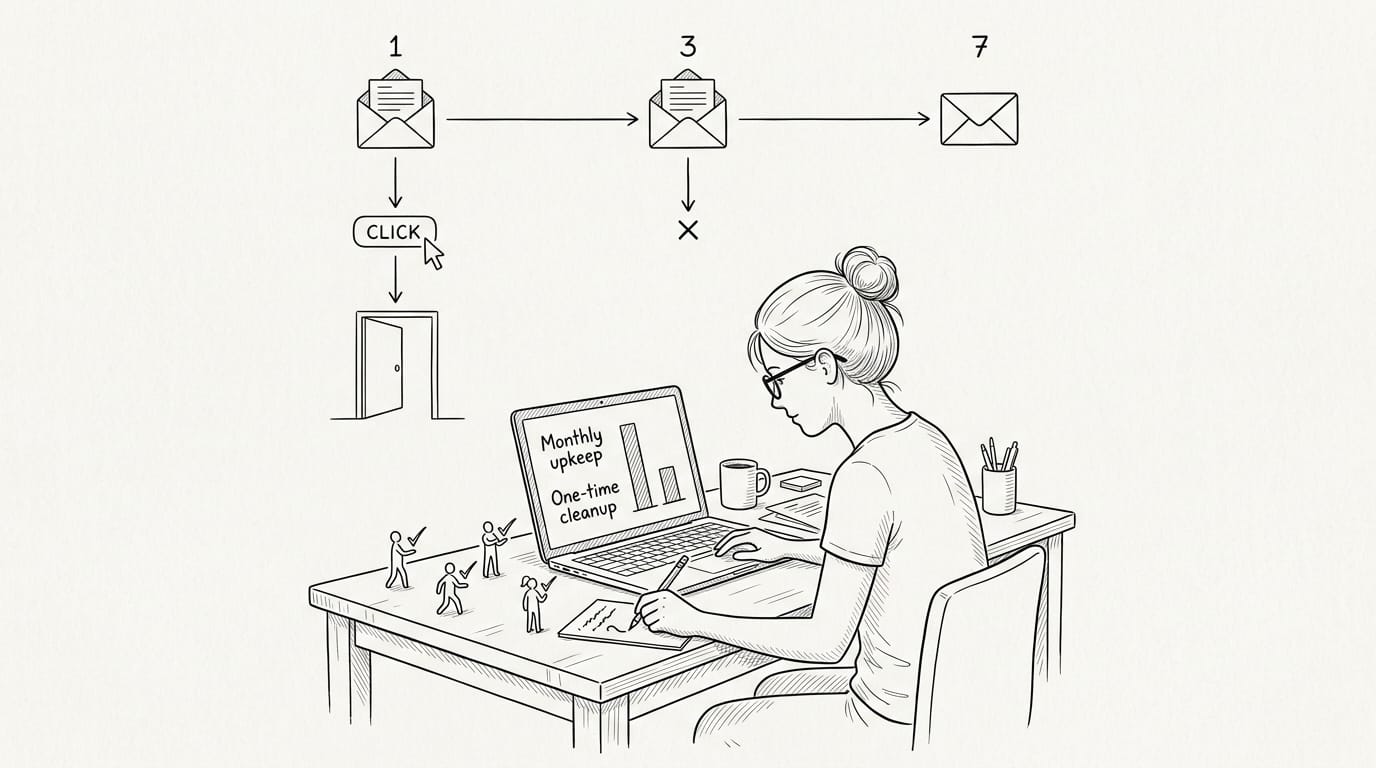
A freelance bookkeeper might ask her network whether they’d pay for monthly upkeep or a one-time cleanup, and one quick answer shows which offer to build first.
Primary research is information you gather yourself, straight from the people you want to sell to. Survey tools give you control over the questions, who sees them, and what the answers mean.
Software speeds up the collecting, but you still decide what to ask. That part’s on you.
Marketing automation software sends follow-up emails on a schedule and tracks who clicks. If a landlord’s free repair checklist gets opened but never clicked through, the offer needs work, not the list.
Putting Your Research into a Business Plan
Research only pays off when it shapes what you do next. A business plan is where your findings become decisions.
What a business plan does for you
It does four jobs:
- A roadmap. It turns scattered notes into one clear path.
- A requirement for investors and lenders. Anyone putting money in will want it in writing.
- A guide for decisions and your team. Check each choice against it before committing.
- Proof of viability. It shows, on paper, whether the idea holds together.
Consider a home baker who sells custom cakes on weekends. Her research shows most orders come from birthdays, so her plan centers on them. A plan is less about predicting the future and more about preparing for it. Without one, you’re guessing.
How your findings shape the plan
Your findings shape each part:
- Demand and pricing. What customers say they’ll pay sets your price and sales target.
- Target market and location. Your research shows who buys and where, whether locally or online.
- Labor and financial needs. Expected demand helps you estimate the hours the work takes and the money you’ll need.
- Market entry and marketing. The channels your customers already use show where to launch first.
- Historic product performance. If you’ve sold a product before, its real results are your best guide.
Sections every plan should include
A solid plan includes these sections:
- Executive summary. A one-page overview of the idea, the market, and what you need.
- Market analysis. Your research organized: who buys, how big the opportunity is, and who competes.
- Strategy and financial projections. How you’ll run the business, plus expected earnings, spending, and break-even point.
- Marketing strategy and plan. How you’ll reach customers, through which channels, and at what cost.
Your research is the foundation.
Real Examples and Quick Answers
Let’s see research at work in three businesses, then we’ll tackle common questions.
See the research in three examples
Think of someone planning a coffee shop on a street they walk daily. Before signing a lease, they stand on the corner at morning rush and count who passes and who stops in.
If a café across the road already serves that crowd, they learn it before spending savings.
A side hustler planning a real estate business for first-time buyers doesn’t have to guess which neighborhoods need help. They ask local lenders which buyers get turned away, and why. Those answers point to a niche they can serve.
Consider someone running a movie and dinner night at a local restaurant. She emails her list to ask which films and nights people would actually attend. The question isn’t whether people like the idea.
It’s which nights they’d show up for. Empty seats cost money.
Common questions about research, answered
Market research is also called marketing research, and the two names describe the same work: gathering facts about customers and competitors before you commit money.
It also links to consumer behavior, the study of why people buy. A customer’s habits, budget, and frustrations show whether your idea solves a problem they’ll pay to fix.
The first step is to define the question you need answered, such as whether people nearby would pay for a weekly meal-prep service. Write it down before surveying anyone.
The goal is to lower your risk before you commit. It’s less about proving you’re right and more about finding out where you’re wrong while it’s cheap. Better to hear it now than after you’ve quit your job.
Good market research doesn’t promise a guaranteed winner. It replaces hunches with evidence you can check, one small step at a time. Follow the steps in order, keep the costs low, and let the results tell you what to do next.
Your idea either finds buyers at a price that works or it doesn’t. Either answer is useful, and it’s far cheaper to learn that over a few weekends than over a few years of savings.
Your first paying customer is the best market research you’ll ever get.
Questions
What is the 50/100/500 rule startup?
The 50/100/500 rule is a rough startup market-research rule of thumb based on hearing from 50, 100, and 500 people. As the number of people you hear from grows, you can put more weight on recurring patterns, but the rule does not guarantee that demand exists or that the sample represents your market.
What is the 1% rule in business?
The 1% rule in business market sizing suggests that capturing just 1% of a large market could be enough for success. It can be misleading because a large market does not show who will actually buy from you, at what price, or whether you can reach and serve them profitably.
What are the 7 basic questions in market research?
Seven useful market-research questions are: What problem or opportunity are you investigating? Who are the potential customers? What do they need and how do they currently solve the problem? How many potential buyers are there and where are they? Who are the competitors and what do they offer? What price will customers pay? How will you reach buyers, and what evidence would support changing or stopping the idea?
What are the 5 C's of marketing analysis?
The 5 C’s of marketing analysis are company, customers, competitors, collaborators, and context. They help assess your business and capabilities, the people you serve, rival offerings, partners or suppliers, and wider market conditions.
How to research a business market?
Start by defining the question you need answered and the customers you want to understand. Review existing reports and competitor prices and reviews, then gather firsthand evidence through interviews, surveys, polls, or prototype tests. Compare what people say with what they actually do, estimate costs and likely revenue, and use the findings to proceed, adjust, or stop.
What business can make $10,000 a month?
Businesses such as consulting, bookkeeping, specialized freelancing, software, and certain online or local services can potentially reach $10,000 in monthly revenue. Results depend on demand, pricing, costs, skills, and the ability to find and retain customers; revenue is not the same as profit. Research buyers and test a small offer before investing heavily.
What qualifications do I need to be a market researcher?
There is no single required qualification to become a market researcher. Employers often value skills in research methods, survey design, interviewing, statistics, data analysis, and clear communication; relevant degrees may include marketing, business, economics, psychology, or sociology. Practical experience with research projects and tools can also help, especially for freelance or entry-level work.