4-4
Lifecycle Marketing Explained: Stages and Strategies
Lifecycle marketing maps messages to each customer stage. See how simple email flows welcome, re-engage, and retain buyers, plus what to measure.
- Written by
- Published
- Updated
- Reading time
- 14 min read
- Sources
- 3 cited
Lifecycle marketing is the practice of tailoring messages to each customer’s stage, from first awareness and signup through purchase, repeat buying, loyalty, or re-engagement. It uses customer data and behaviors to send timely, relevant messages across suitable channels, then measures results and adjusts what is not working. In practice, a simple welcome flow, a check-in for quiet customers, and a thank-you for repeat buyers can strengthen relationships without a large team or budget.
In this guide
Think about a gym membership. A welcome email greets you on day one. If you stop showing up, a message asks what happened. Months in, a nudge suggests a new class. Each message fits where you are in the relationship.
That’s the heart of lifecycle marketing: planning messages around the stages a customer moves through, from first hearing about you to becoming a loyal repeat buyer. Instead of one promotion for everyone, you meet each person where they are.
We’ll cover the stages, strategies, tools, and measurement, then show how a solo owner can run it with a few simple email flows.
Lifecycle Marketing Explained and Why It Matters
Lifecycle marketing keeps customers engaged after the first sale, and we’ll show you how.
What is the lifecycle marketing framework?
It’s a plan for sending each customer the right message based on their history. It entails four core ideas:
- Data-driven personalized engagement. Use past orders and other data to tailor each message.
- Whole customer relationship. The sale is the start, not the finish line.
- Acquisition through advocacy. Happy customers bring in new ones through referrals and word of mouth.
- Behavioral triggers and automation. An action like a first order sends the next message automatically.
A side hustler who sells candles sends a thank-you note after a first order, then a reminder six weeks later. The buyer reorders with no new ad spend.
How it differs from other marketing approaches
- Versus traditional marketing. Traditional campaigns blast one message to a broad crowd. Lifecycle is less about what you say and more about who hears it and when.
- Versus sales funnel. A sales funnel ends at the purchase. Lifecycle keeps going after the sale.
- Versus CRM. A customer relationship management (CRM) system stores customer data. Lifecycle marketing puts it to work.
- Versus customer journey. The journey is the path a buyer takes. Lifecycle marketing is the messages you send along it.
- Versus retention and automation. Retention is one goal of lifecycle marketing, and automation is one of its tools.
How it helps the business grow
- Higher customer lifetime value. It’s what a customer is worth over time. Carnegie, Wilcox, and Zhu (2008) say the aim is developing customers to raise that value.
- Lower acquisition cost. A paper, From Clicks to Customers, found organizations running integrated funnel management saw a 24% improvement in customer acquisition cost (CAC).
- Reduced churn. Churn is the rate at which customers leave. The same paper reported a 35% increase in customer retention rates.
- Better conversion rates. Conversion rate is the share who take the step you want. Timely messages feel like help, not a pitch.
- Improved customer experience. Messages that reflect what customers care about feel attentive, not random.
Where the approach came from
The roots run back to the AIDA model (attention, interest, desire, action), and the term was popularized around 2000 to 2001. Over time, the focus shifted from acquisition to retention: from finding buyers to keeping them.
The Stages a Customer Moves Through
Customers don’t all need the same message at the same moment. Here’s how their journey breaks down.
Getting noticed and capturing leads
Before anyone buys, you need a way to reach them again. That’s lead capture: collecting an email from someone interested.
Paid ads, content, and search engine optimization (SEO, making pages easy to find) bring visitors in, but that’s rented attention. You want to own the contact.
Asking directly works too. A question like ‘What are you shopping for?’ gathers zero-party data, information customers share on purpose. It shows what people want, not just what they clicked.
Trade a lead magnet, like a useful checklist, for an email address. Send visitors to a landing page with one offer and one signup form.
Helping new users reach their aha moment
The aha moment is when a new customer first feels your product’s value. Get people there fast, because those who never arrive rarely stay.
Start with a welcome campaign, the short series sent right after signup. Use guided walkthroughs to show only the steps that get people there. Then track day 1 retention, meaning how many new users return the next day.
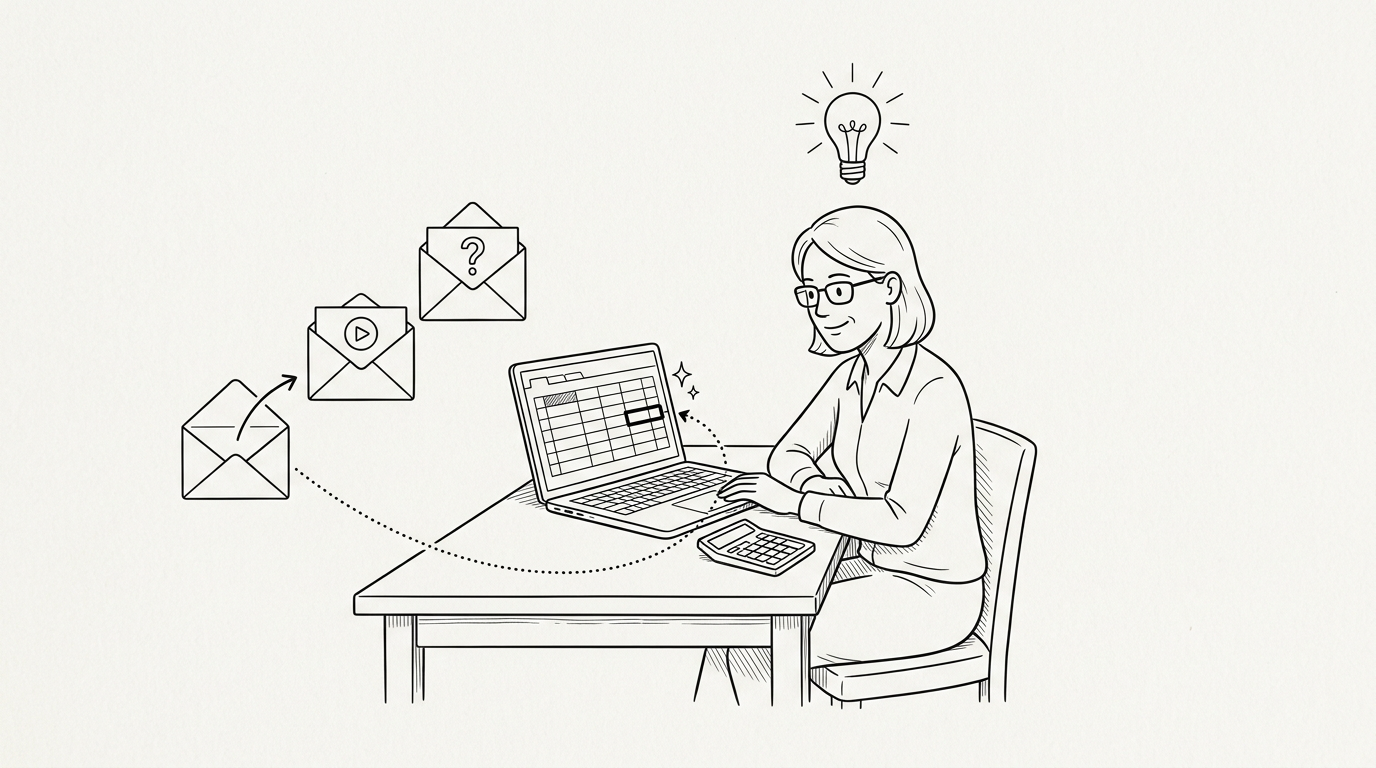
Begin with a three-email welcome flow:
- Thank them and point to one next step.
- Show how to reach the aha moment with a short video.
- Ask what they hope to get done, and offer help.
A bookkeeper selling a budget template links the first email to the one tab to fill in. Within a day, the buyer has a spending total, and that quick win gets them to open the next email.
Keeping customers coming back
Habit formation happens when your product or emails become routine. Build it on purpose with a predictable rhythm, like a weekly tip.
A behavior-based nudge responds to what someone did or didn’t do, like a reminder about an item they viewed. Tips and timely reminders keep you in view.
Churn is the rate at which customers stop buying or cancel. Watch early signals, like fewer logins, and reach out before they leave. The focus shifts from getting customers to keeping them.
Earning repeat purchases and bigger orders
A repeat purchase happens when someone buys again without a fresh discount pulling them in. Trust does the heavy lifting.
Cross-selling suggests a related product, while upselling offers a larger version. For subscription renewals, remind people before the date so staying is easy.
Every message needs one clear call to action, the single thing you want the reader to do next.
Turning loyal customers into advocates
A loyalty program rewards repeat buying with points, perks, or early access. A referral program rewards both the referrer and the new customer. Ask for referrals after a great experience, not before the first order.
Measure satisfaction with Net Promoter Score (NPS), which asks how likely someone is to recommend you, from zero to ten. Top scorers can join VIP (very important person) tiers, special groups for your most engaged customers.
User-generated content is anything customers create about you, like photos or reviews. Ask permission before reusing it.
Winning back customers who went quiet
An inactive user campaign targets people who’ve gone quiet for a window you choose. Send a short, friendly note, not a blast.
A re-onboarding email walks someone back to the aha moment with one specific step. Ask why they left rather than guilting them into returning.
A win-back incentive, like a discount, can help, but use it sparingly.
Predictive disengagement detection spots warning signs early, like shrinking open rates. A wallet maker can do a rough version by sorting customers by last purchase date.
What Are the Main Marketing Strategies?
Lifecycle marketing comes down to one question: what should a customer hear next? Ask five marketers for their main strategies and you’ll get five answers, so there’s no official top five. These six cover the ground:
| Strategy | Best for |
|---|---|
| Event-driven messaging | Timely follow-ups |
| Personalized recommendations | Repeat sales |
| Churn prevention | Keeping customers |
| Cross-channel coordination | Right message, right channel |
| Streaks and rewards | Building habits |
| Targeted offers and clean lists | Protecting margin |
Sending messages based on what users do
Event-driven messaging sends a message because someone acted. Think of a home baker: a visitor starts a custom cake order, stops halfway, and gets a note offering help finishing it.
Abandoned onboarding recovery picks up where a signup left off, and cart abandonment reminders show shoppers the exact items they left.
Replacing static schedules swaps set-and-forget sends for flows that follow the customer. What someone does matters more than the date. Timing is the lever.
Tailoring recommendations to each person
Next-best-action decisioning picks the most useful message for each person instead of one offer for everyone. Product and content recommendations work like a streaming service suggesting your next show.
Web personalization shows returning visitors what they browsed last time. Personalize at scale means building a few templates with changing fields, not writing many hand-written messages.
Catching churn before customers leave
Churn is when customers stop buying or using what you sell. Early disengagement signals, like unopened emails or a skipped reorder, give you time to act.
A value-led nudge reminds people what they’re getting or missing. A bookkeeper whose monthly client has stopped logging in might send one receipt-saving tip with no sales pitch attached.
At-risk customer identification flags anyone who crosses a line you set. Watch signals together, not one at a time.
Coordinating messages across every channel
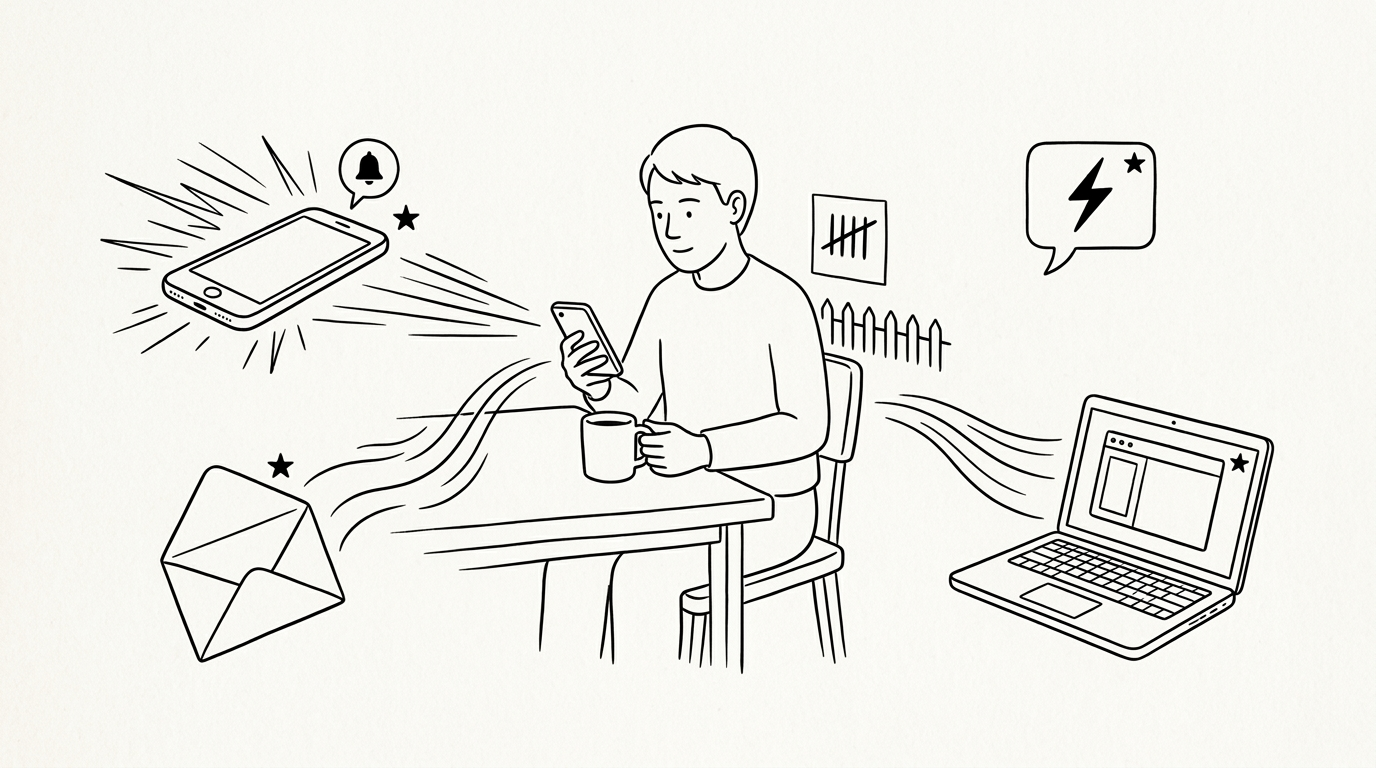
Four channels, four jobs:
- Push: short alerts on a phone app
- Email: longer messages read at leisure
- SMS (short message service, or plain text messages): fast, so save it for urgent notes
- In-app: messages shown inside your product
Channel chosen by urgency means matching the channel to how time-sensitive a message is. A delivery problem might justify a text; a monthly tip fits email.
Frequency caps limit how many messages one person gets in a set period, so you don’t wear anyone out.
Consistent cross-channel experience means your channels tell the same story.
Is email still worth it in 2026? For a solo owner, yes, mainly because you control the list. Platforms can change their rules, but your subscriber list stays yours. Check it against your own opens and sales.
Using streaks, badges, and rewards
Streaks reward consecutive days or weeks of activity. Milestone badges mark a point reached, like a tea seller who sends a badge with a customer’s fifth monthly box, a small win that makes reordering feel routine.
Loyalty tiers unlock perks as customers buy more, but each step should feel earned, not handed out.
Referral programs reward customers for bringing in someone new, so set the reward at a level your margin can afford.
Keeping offers targeted and lists clean
Targeted incentives go to people who need a nudge, like lapsed customers, not someone who ordered yesterday. Discount suppression keeps recent full-price buyers out of discount emails so they don’t learn to wait for sales.
A sunset flow gives subscribers who’ve stopped opening a last chance to stay, then removes those who don’t.
A re-permission email asks subscribers to confirm they still want your messages. A smaller list of engaged people tells you more than a big one that never opens.
Putting the Data and Tech in Place
Lifecycle marketing works only when the right information reaches the right message on time.
What steps make up a lifecycle plan?
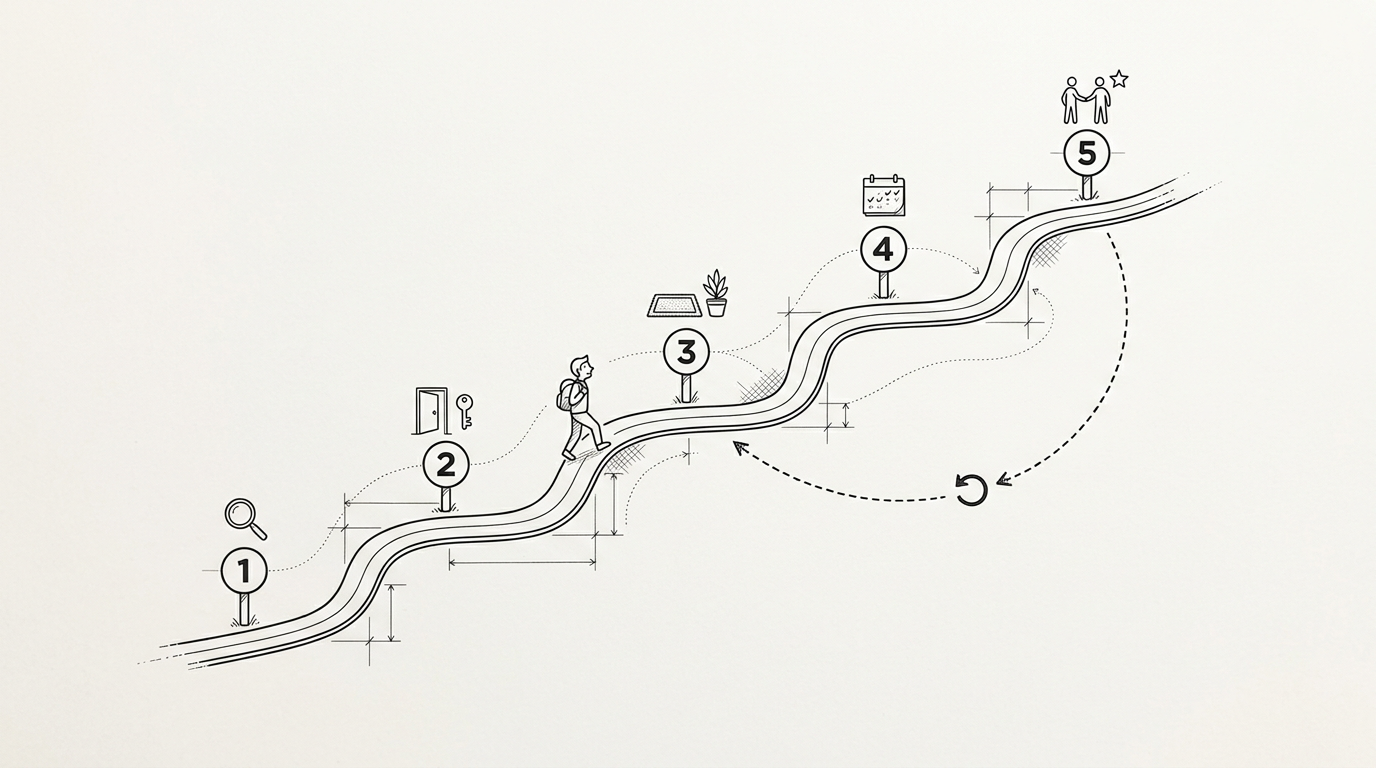
Lifecycle planning has five steps:
- Audit funnel drop-offs. Find where people drop off between visit and sale.
- Unify first-party data. Gather what customers give you directly.
- Map core journeys. Write out the main paths customers take with you.
- Add messaging guardrails. Set limits on how often you contact people.
- Test and iterate. Change one thing at a time and keep what works.
If you searched for the 7 steps of a marketing plan, this isn’t that list. These five cover the lifecycle side. A solo owner can start with the audit and one clean customer list.
Unifying customer data with a CDP
Think of a home baker who takes orders through a website, a booking app, and Instagram. Her customers sit in three lists, so some get two reminders and others none.
A customer data platform (CDP) merges those sources into one profile per person, creating a single customer view.
Identity resolution matches records, so Dana M. on the order form and Dana Miller in her inbox count as one person. Now she sends one reminder, not two.
Breaking data silos is the goal. Build on first-party data (what customers give you directly) and zero-party data (what they tell you on purpose).
Matching data speed to each use case
Latency is the delay before your system knows something happened. A batch sync moves data on a schedule, so a noon order might wait until morning. That’s the batch sync latency gap: fine for some messages, frustrating for others.
Event-processing speed is how fast your platform handles an order or an abandoned cart. Trigger reliability is whether that event fires its message every time.
Match latency to the use case. A pickup reminder can wait for a nightly batch, but an order confirmation should go out right away. Timing is part of the message.
Choosing the right tools and platforms
Braze, Klaviyo, and Iterable are names you’ll see often, but bigger isn’t always better. Check vendor platform capabilities first: can it trigger messages from events and match identities?
Then test marketer-friendly interfaces, since a flow that needs a developer slows every change.
If you already use an email or CRM platform (customer relationship management), start there. A free-tier email tool lets you prove your flows before you pay. Choose for how you work, not the longest feature list.
Common mistakes that hold programs back
- Data silos. Information sits in separate tools, so no one sees the full picture.
- Channel fragmentation. Email, text, and ads run on separate schedules, so messages collide.
- Limited personalization. Everyone gets the same message, whatever they’ve done.
- Scalability issues. A setup that works today can buckle as your list grows.
- Neglecting later stages. Effort goes to the first sale while past customers go quiet.
Tracking Results and Improving over Time
Sending the flows is the easy part. Here’s how we tell what’s working and what needs fixing.
Metrics to track at each stage
Track these five at each stage:
- Setup completion rate: the share of new subscribers who finish their first step.
- Retention and DAU/MAU: how long people stay, plus daily active users (DAU) divided by monthly active users (MAU).
- Repeat purchase rate: the share of customers who buy again.
- Win-back conversion: the share of lapsed customers who return.
- Referrals and satisfaction: how often customers recommend you and how happy they are.
A candle maker with strong setup but few reorders can rewrite just her second message.
Revenue metrics that show business value
Revenue shows whether a program pays, not just whether it gets attention. Four to watch:
- Lifetime value (LTV): total revenue per customer, compared with customer acquisition cost (CAC) for your LTV:CAC ratio.
- CAC payback window: how long a customer’s earnings take to cover what you spent to win them.
- Average order value (AOV) and average revenue per user (ARPU): what a typical purchase and customer are worth.
- Net revenue retention: revenue kept from existing customers after upgrades, downgrades, and cancellations.
Measuring what your messages really cause
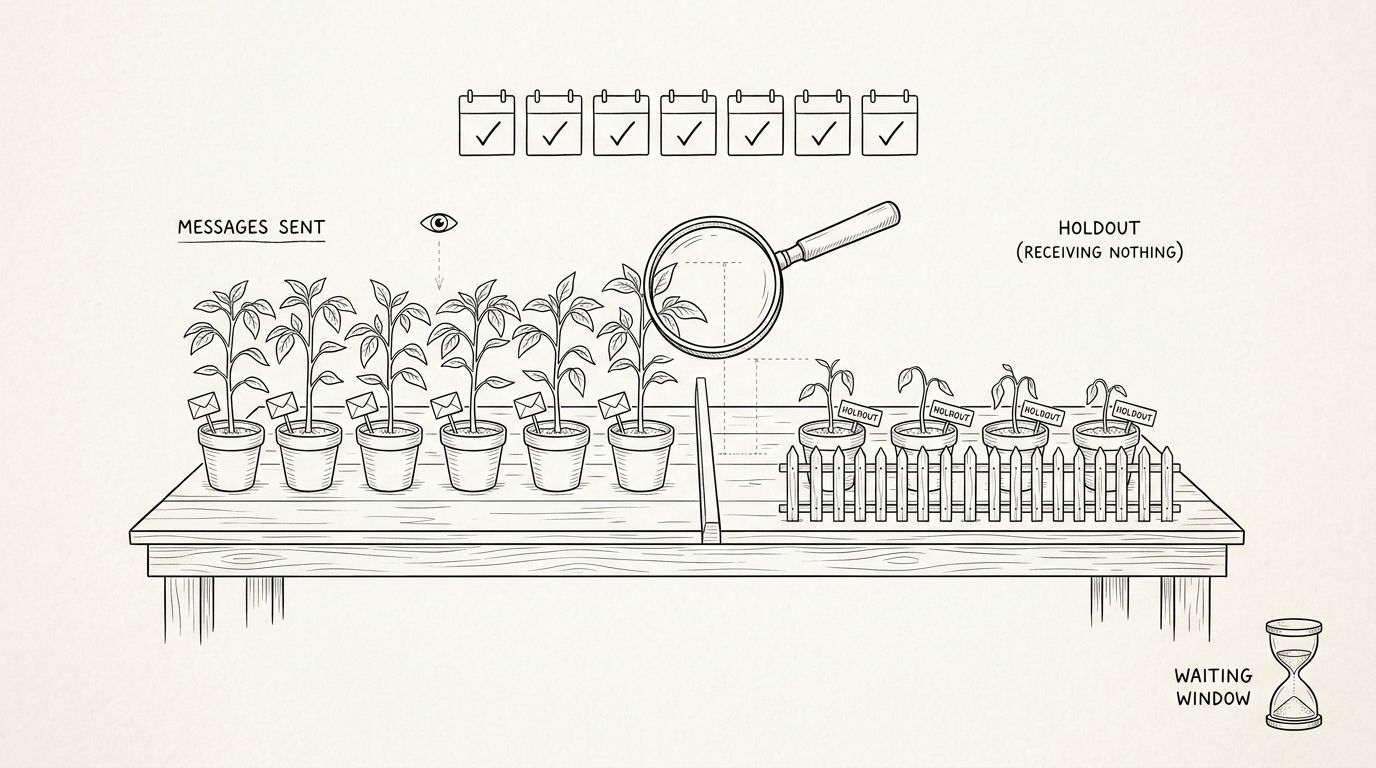
A control group gets no message, so you can compare it with people who do. A holdout is a group you deliberately keep back to serve as that control. Size it small enough that it won’t cost much, but big enough to show a difference.
Opens and clicks aren’t enough. They show attention, not cause, so only a holdout can prove a message produced the sale.
Small lists are noisy. A spike in one week may be chance, so look for patterns across several weeks.
Time to ROI (return on investment) is how long a flow takes to pay back its cost. Judge each flow only after that window closes.
Running tests and acting on feedback
Four habits close the loop:
- A/B testing: split one message into two versions, changing one thing at a time.
- Regular data analysis: review your numbers on a fixed schedule.
- Customer feedback: ask customers why, with a single question after purchase.
- Focus on key metrics: track two or three that matter at your stage.
Test one thing, measure it honestly, and keep what works.
How Real Brands Put This into Practice
Big brands have refined these moves for years, and you can scale most of them down to a one-person business.
Lessons from apps, fintech, and streaming
Apps and fintech lean hard on timing. Chime’s signup recovery emails catch people who stopped partway through opening an account. Robinhood’s know your customer (KYC) nudges prompt new users to finish the identity check before they trade.
Netflix’s recommendation rows suggest what’s next, while Uber Eats splits its messages by channel so each one travels the route that fits. Strava’s trophy case celebrates milestones, giving members a reason to keep logging workouts.
What shopping and food apps get right
Nike’s abandoned cart email reminds shoppers about what they left behind, and Dollar Shave Club’s cross-sell offers a complementary product after a first order.
Zomato sends meal-time notifications when people are deciding what to eat, and Super Kicks uses an exit-intent offer, a pop-up that appears as a visitor moves to leave the page.
Consider a side hustler selling handmade soap online. When a first customer buys one bar, a follow-up email two weeks later offering a matching lotion can turn that one-time buyer into a repeat order.
Classic brands worth learning from
Established brands have the deepest playbooks. Amazon’s recommendations surface items other shoppers bought alongside what you’re viewing. Zappos’s customer service shows that what happens after the sale matters as much as the sale itself.
Sephora’s Beauty Insider loyalty program rewards members for coming back, and HubSpot and Grammarly rely on nurturing sequences, educational emails that guide free users and trial users toward a paid plan. Patience pays.
Lifecycle marketing is about keeping customers, not just winning them.
Building a Career in Lifecycle Marketing
Wondering if you can break in without the usual background? You can.
Skills you need, degree or not
Most of what you need is transferable. Think of a former restaurant manager who schedules shifts and tracks food costs. She already plans and measures.
You’ll also need working knowledge of customer relationship management (CRM) software and enough analytics to read opens, clicks, and repeat purchases.
Learn the basics of the General Data Protection Regulation (GDPR), the EU’s privacy law, and the CAN-SPAM Act, the US rules for commercial email.
No degree is required, so your work has to make the case.
Getting your first role and moving up
Build a portfolio of mock campaigns: sample automated email series for a real or imaginary product.
Next, reframe your resume. Change ‘sent the club newsletter’ to ‘managed a recurring email program and tracked replies.’
One path runs from coordinator, who builds campaigns, to Head of Lifecycle, who decides which ones get built.
Join lifecycle and email communities and ask people in the field for short chats.
Plan on roughly 6 months to 2 years for that climb. Steady progress beats a rushed title.
Daily work and what you can earn
Much of your day goes to quality assurance (QA): checking links, names, and send timing before launch. Picture a solo bookkeeper sending a reminder with the wrong client’s name. That’s what QA catches.
You’ll also do cross-functional collaboration, working across teams with designers, sales, and support.
Salaries start near $85K and pay varies by role and experience. According to a study of sales career paths in the Journal of the Academy of Marketing Science, firms value sales managers’ experience more than salespeople’s. Experience carries weight.
Lifecycle marketing comes down to one idea: the right message at the right moment. Map the stages, choose a few strategies that fit your business, and let your tools handle the repetitive work.
You don’t need a big team or budget to begin. A welcome flow, a check-in for customers who’ve gone quiet, and a thank-you for repeat buyers can carry real weight. Then track what happens and adjust.
Every customer relationship has a beginning and a future. Give each stage the attention it deserves, and your best customers will keep coming back.
References
- FROM CLICKS TO CUSTOMERS: MANAGING THE FULL FUNNEL FOR SUSTAINABLE GROWTH — zenodo.org (2025)
- How do firms value sales career paths? | Journal of the Academy of Marketing Science — link.springer.com (2023)
- Customer Lifetime Value as the 21st Century Marketing … — cebr.vse.cz
Questions
What is the lifecycle marketing framework and what does it entail?
The lifecycle marketing framework plans messages around a customer’s relationship with a business, from first contact through repeat purchases and advocacy. It entails using customer data to personalize engagement, treating the relationship as ongoing, encouraging referrals, and triggering automated messages based on behavior.
What are the 7 steps of a marketing plan?
A common seven-step marketing plan is: define your mission and objectives, analyze the market and competitors, identify your target audience, set measurable goals, choose marketing strategies and tactics, establish a budget and timeline, and measure results and refine the plan.
What are the 5 main marketing strategies?
There is no single official list of five main marketing strategies. Common approaches include content marketing, social media marketing, email marketing, search engine optimization, and paid advertising; businesses often combine them to reach and engage different audiences.
Is email marketing still worth it in 2026?
Yes. Email marketing remains worthwhile in 2026 because you control your subscriber list, unlike audiences on platforms whose rules can change. Judge its value using your own engagement and sales results, and send relevant messages at a reasonable frequency.