6-2
How to price a product: cost, margin and what buyers pay
Set a first price that covers every cost of a sale, card fees and your time included, and sits where buyers will pay, with worked examples and the markup trap.
- Written by

- Published
- Reading time
- 9 min read
- Sources
- 3 cited
- Time needed
- An afternoon
- What it costs
- Nothing
- Difficulty
- Tools required
- Your costs per sale, competitors’ prices, a spreadsheet Toolbox
Price from both ends: add up the full cost of one sale, including fees, a share of the monthly costs and your time, then find what customers already pay for the alternatives, and set the first price where the two meet. If your full cost is above what buyers will pay, no discount fixes it; change the product, the customer or the way you make it.
In this guide
To price a product, work from both ends. Add up the full cost of one sale (materials, packaging, shipping, card or platform fees, a share of your monthly costs and the hours it takes you), find what customers already pay for the alternatives, and set the first price where the two meet, usually toward the upper half of what buyers pay rather than the bottom. If the full cost comes out above what buyers will pay, the product doesn’t run at any price you can charge, and a discount only makes it worse. The rest of this guide works one example through each step.
Price from both ends
Most pricing mistakes come from using one end only. Cost-plus pricing (add up your costs, add a percentage) ignores what buyers will pay. Copying a competitor’s price ignores your costs, which may be nothing like theirs. Working from both ends shows whether there’s a gap between what a sale costs you and what customers pay, and where in it to stand. It’s the check the Price part of the Idea Inspection runs: where did the price come from, and what does one sale pay you per hour?
The example throughout, with figures made up to show the sums: a potter selling hand-thrown mugs online at $45 each, shipping included.
Add up the full cost of one sale
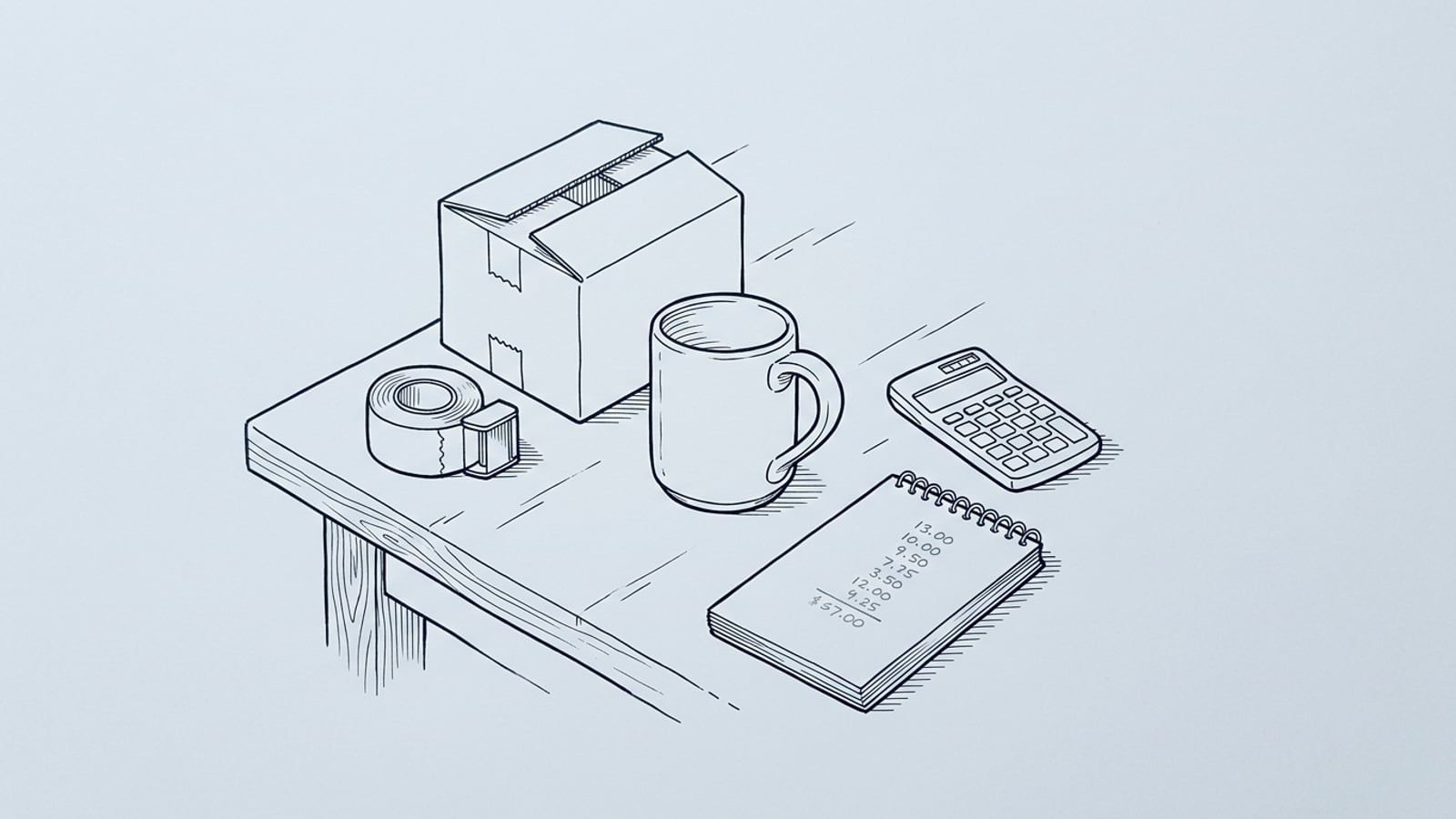
List everything that goes out each time one mug sells. For a product, that’s usually:
- materials (here, clay, glaze and the firing);
- packaging: box, padding, tape, label;
- shipping, if the price includes it;
- payment fees, which are a percentage of the price plus a fixed amount;
- marketplace fees, if you sell on one: listing, transaction and processing fees, sometimes advertising.
For the example mug:
| Cost per sale | Example amount |
|---|---|
| Clay and glaze | $3.50 |
| Kiln firing (a share of the electricity) | $0.90 |
| Box, padding and tape | $2.00 |
| Shipping label | $6.99 |
| Card fee: 2.9% + 30¢ on $45 | $1.61 |
| Total per sale | $15.00 |
The card fee is Stripe’s standard rate for a domestic card payment online, as of October 2026; other providers charge different rates, and the Toolbox sets them side by side. Because the fee is a percentage of the price, work it out again whenever the price changes. If you sell on a marketplace instead of your own site, its fees belong in this table too, and they can come to more than the card fee: Etsy vs Shopify works one sale through each platform’s fees.
Add a share of the fixed costs
Then there are the costs that come around every month whether you sell or not: the website, software, a share of the studio, insurance. Divide the monthly total by the sales you realistically expect in a month to get a share per sale. If the potter’s fixed costs are $150 a month and she expects to sell 30 mugs, each mug carries $5.
Sell fewer and each mug carries more, which is why a price has to be checked against the break-even point: the number of sales a month that covers the fixed costs at all.
Count your time
So far the mug costs $15 to sell plus $5 of overhead: $20. At $45, that leaves $25. Whether $25 is any good depends on how long a mug takes.
Time a whole sale, not just the making: throwing, trimming, glazing, the photos, the messages, the packing and the trip to drop it off. Say it comes to two hours a mug. Then $25 for two hours is $12.50 an hour, before tax. Leave out the overhead and it’s $15 an hour, the figure the Idea Inspection’s per-hour question works out.
Now pick the hourly rate you’d accept from a job and put your time into the cost like any other part:
| Cost per mug | At 2 hours a mug | At 1 hour a mug (made in batches) |
|---|---|---|
| Per-sale costs | $15.00 | $15.00 |
| Share of fixed costs | $5.00 | $5.00 |
| Your time at $25 an hour | $50.00 | $25.00 |
| Full cost | $70.00 | $45.00 |
At two hours a mug, the full cost is $70 and a $45 price doesn’t cover it. The price goes up, the hours come down, or the potter is paying herself $12.50 an hour and should at least know it. Batching the work (throwing twenty at a time, packing once a week) is the usual way the hours come down; halving them makes $45 cover everything.
The rate is before tax, and the self-employed pay self-employment tax on top of income tax; an accountant can tell you how much of each sale to set aside.
Margin vs markup: the mistake that costs you
Two words get mixed up in pricing, and the mix-up shrinks what every sale leaves.
- Markup is what you add, as a percentage of the cost: (price − cost) ÷ cost.
- Margin is what you keep, as a percentage of the price: (price − cost) ÷ price.
They use the same two numbers but divide by different ones, so a 50% markup is not a 50% margin:
| Markup on cost | Price on a $20 cost | Margin on the price |
|---|---|---|
| 25% | $25.00 | 20% |
| 50% | $30.00 | 33% |
| 100% | $40.00 | 50% |
| 200% | $60.00 | 67% |
| 300% | $80.00 | 75% |
The mistake runs like this: you decide you need a 50% margin, add 50% to the cost, and end up with 33%. To set a price for a given margin, divide the cost by one minus the margin. Virginia Cooperative Extension’s pricing guide for direct sellers gives the same formula: price = cost ÷ (100% − the gross margin you want). For a 50% margin on a $20 cost, that’s $20 ÷ 0.5 = $40.
Discounts show why it matters. At $30 on a $20 cost, each sale leaves $10. Take 20% off and the price is $24, leaving $4: a fifth off the price has taken three-fifths of what the sale left. The thinner the margin, the less room a sale, a wholesale order or a rise in costs has to work with.
A high margin isn’t automatically enough, either. The potter’s mug, at $45 on $15 of per-sale costs, has a 200% markup and a 67% margin, and at two hours a mug it still doesn’t pay her $25 an hour. The margin is only what’s left to pay for the fixed costs, your time and any profit, so judge it against those, not against a number from someone else’s trade.
Find what customers pay now
The other end is what buyers already pay to get the same job done, and that takes in more than your direct competitors. For a mug, the alternatives include:
- other handmade mugs, on marketplaces, at craft fairs and in local shops;
- factory-made mugs, which set the floor for anything to drink from;
- other gifts at a similar price, if most of your mugs are bought as presents.
Look up 10 to 20 comparable listings and note the price, what’s included (shipping, gift wrap) and what sets the pricier ones apart. Ask the people you’ve talked to what they last paid for something like it. The SBA’s market research guidance puts the same question to every new business: what do potential customers pay for the alternatives?
Write down a range, not one number. In the example, say comparable handmade mugs sell for $32 to $58 with shipping. That’s the band the price has to sit in, and anything above the top of it needs a reason buyers can see.
Set the first price
Put the two ends side by side. There are three cases.
- Your full cost sits comfortably inside the band. Price inside it too, toward the top if your product stands up next to the pricier ones. Don’t undercut by default: a low price leaves less to cover mistakes and slow months, and it’s harder to raise than to lower.
- Your full cost is near the top of the band. Price near the top, make the reason visible (the materials, the finish, a guarantee, faster delivery), and work on the cost: cheaper packaging, batching, fewer steps.
- Your full cost is above what buyers pay. No discount fixes this. If the per-sale costs alone are above the price, selling more only loses money faster. Change the product, the customer or the way it’s made, or drop it.
At two hours a mug, the potter is in the third case: a $70 full cost against a band that tops out at $58. Batching moves her into the first, at $45. So her first price is $48: inside the band, and covering the full cost at one hour a mug with about $3 to spare for breakage and the slow month, after the card fee is worked out again at the new price. If she can’t get the hours down, the honest answer is that the mug pays $12.50 an hour, and she has to decide whether that’s enough.
Keep to one price, or a few clear tiers, written down, and let the buyer see the total with shipping before checkout.
Test it, and know when to raise it
A first price is a guess with arithmetic behind it. Test it before you order a big batch of anything.
- Say it out loud. Quote it to people in your group and watch. If nobody ever says it’s too much, it’s probably too little; if most say no, ask what they’d pay and what they’d give up to get there.
- Ask for money at that price. A pre-sale is the real test of a price, and how to pre-sell a product covers taking orders before you make the batch.
- Check the costs every few months. Fees, shipping and materials change, and every change comes straight out of what a sale leaves you.
Raise the price when the numbers say so:
- you sell out, or you’re booked weeks ahead;
- your costs have gone up;
- what each sale leaves no longer covers your fixed costs and your time at the sales you’re actually making;
- a sale takes longer than you priced it for.
Give regular customers notice, change one price at a time, and watch sales for a few weeks before deciding it was a mistake. For the rest of the numbers that decide whether an idea runs, from break-even to cash flow, see the Money guides.
Questions
What is a good profit margin for a small business product?
There’s no single good number, because it depends on what the margin has to pay for. Work it out backwards: what each sale must leave after its own costs to cover your fixed costs at the sales you can realistically make, pay for your time, and leave room for discounts, breakage and slow months. Be wary of benchmark figures that don’t name a source and a date; your own costs are the ones that count.
What’s the difference between markup and margin?
Both start from the price minus the cost. Markup divides that by the cost and margin divides it by the price, so a 50% markup on a $20 cost gives a $30 price and only a 33% margin. To hit a target margin, divide the cost by one minus the margin: $20 ÷ 0.5 = $40 for a 50% margin.
Should I price lower than my competitors?
Not as a starting point. A small business rarely has the volume to win on price, a low price leaves less to cover your time and your mistakes, and it’s harder to raise a price than to lower one. Price lower only if your costs really are lower and you want the buyers who choose on price; otherwise price inside the range buyers already pay and show what’s different.
How do I include my time in the price?
Time a whole sale, from the first message to the drop-off, pick the hourly rate you’d accept from a job, and add hours times rate to the cost of the sale. If the total comes out above what buyers pay, cut the hours (batching, fewer steps) or change the product rather than quietly working for less. The rate is before tax, and the self-employed pay self-employment tax on top of income tax, so ask an accountant what to set aside.
When should I raise my prices?
When you sell out or are booked weeks ahead, when your costs have gone up, or when what each sale leaves no longer covers your fixed costs and your time. Give regular customers notice, change one price at a time and watch sales for a few weeks. A few people saying it’s too much is normal; most of them saying no is the signal to look again.
Sources
- Selling Directly to Buyers: How to Price Your Products (AAEC-97P), Virginia Cooperative Extension,
- Plan your business: market research, startup costs and break-even, U.S. Small Business Administration
- Pricing and fees, Stripe