8-2
SOP Meaning in Business, Explained in Plain English
SOP meaning in business: see how written steps keep know-how from getting stuck in your head, plus what to document first as you hire and delegate.
- Written by

- Published
- Updated
- Reading time
- 13 min read
- Sources
- 5 cited
In business, SOP means standard operating procedure, a written, step-by-step guide for completing a repeated task consistently. A useful SOP assigns responsibility, includes clear instructions and checks, and stays current in a shared place; choose a checklist, numbered steps, or flowchart to fit the work. Documenting processes reduces guesswork and mistakes, makes training and delegation easier, and helps the business keep running when key people are unavailable.
In this guide
Remember handing a friend your house key and explaining how to water the plants and reset the alarm? Now imagine doing that for every task in a growing business.
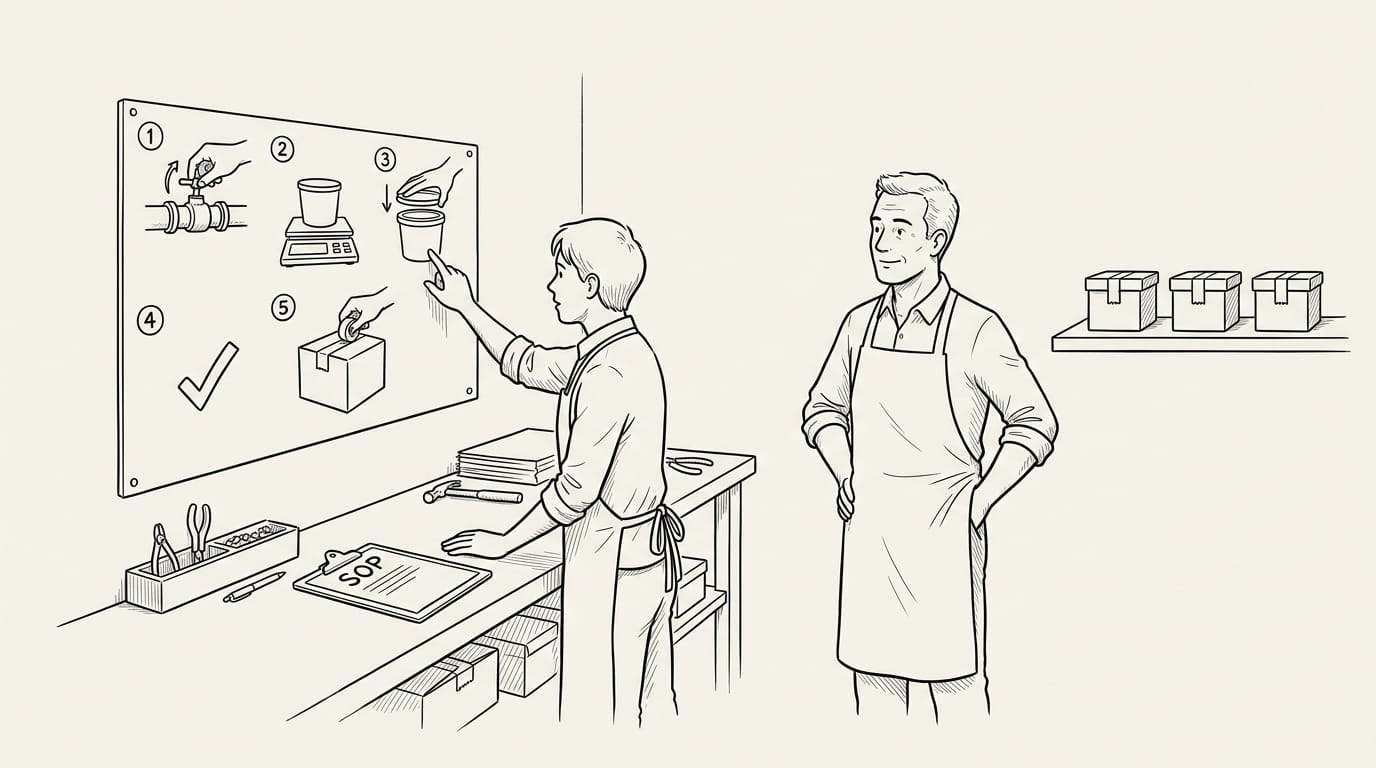
A standard operating procedure (SOP) is a written, step-by-step guide that captures how a task gets done, so the know-how isn’t stuck in your head.
Here, we’ll cover what an SOP means, why it matters, how to write one, and which processes to document first as you hire and delegate.
SOP Meaning in Business, Defined
Before you document your first process, it helps to know exactly what the term means.
What does SOP stand for in business?
In business, SOP stands for standard operating procedure: a playbook of documented step-by-step instructions for repeated tasks. The payoff is uniform execution, so a task gets done the same way every time.
An SOP document is the written file that holds those steps.
In marketing, SOP still stands for the same thing, such as a weekly newsletter routine.
Consider a side hustler who sells candles on weekends. Her one-page SOP for packing orders lets her helper ship every box her way, so her Sunday afternoons are free again.
Don’t mix up an SOP with a key performance indicator (KPI), a number that tracks how well the work is going. The SOP shows how to do the task, and the KPI shows whether it’s working.
Other things SOP can mean
- Food dipped in liquid. A sop is bread or other food soaked in gravy or soup.
- Bribe or concession. It can also be a bribe or a concession to placate someone.
- Weak-willed person. Calling someone a sop means they’re weak-willed.
- Verb: to soak. To sop means to soak something up.
- Soprano. In music, SOP is short for soprano, the highest female singing voice.
Where SOPs show up across teams
- Sales and human resources (HR) handoffs. Clear steps for passing leads to account managers or onboarding hires.
- Expense report submission. Which receipts to attach, which category to pick, and who approves it.
- Customer issue escalation. How a support rep passes a complaint up, and which details come with it.
- Manufacturing and compliance protocols. Required checks and records that keep production consistent and within the rules.
Any task that changes hands is a good candidate. Write it down once.
Why Businesses Rely on SOPs
Once a second person starts doing the work, the owner can’t be the only one who knows how it gets done. A standard operating procedure (SOP) is a written, step-by-step document that fixes that. It’s less about more paperwork and more about fewer guesses.
Keeping quality the same every time
Say you sell custom dog treats on weekends and just hired your first part-time helper. Without a written SOP, the helper guesses at the oven setting and bake time, and the batch comes out soft. A one-page SOP gets the helper to the same result on day one.
According to a journal article on standard operating procedures, SOPs keep activities standardized and consistent, which reduces variability. Less variability means your quality holds steady.
Keeping work going and scaling up
Think of a freelance bookkeeper who runs her practice from a spare room. When she’s sick for a week, her clients’ reconciliations pile up because nobody else knows her routine.
With a written SOP, a trusted helper can keep the work moving while she recovers.
Franchises rely on documented procedures so one location runs like another, and an SOP preserves institutional knowledge that would otherwise walk out the door when a long-time employee leaves.
Clear roles keep the whole team aligned
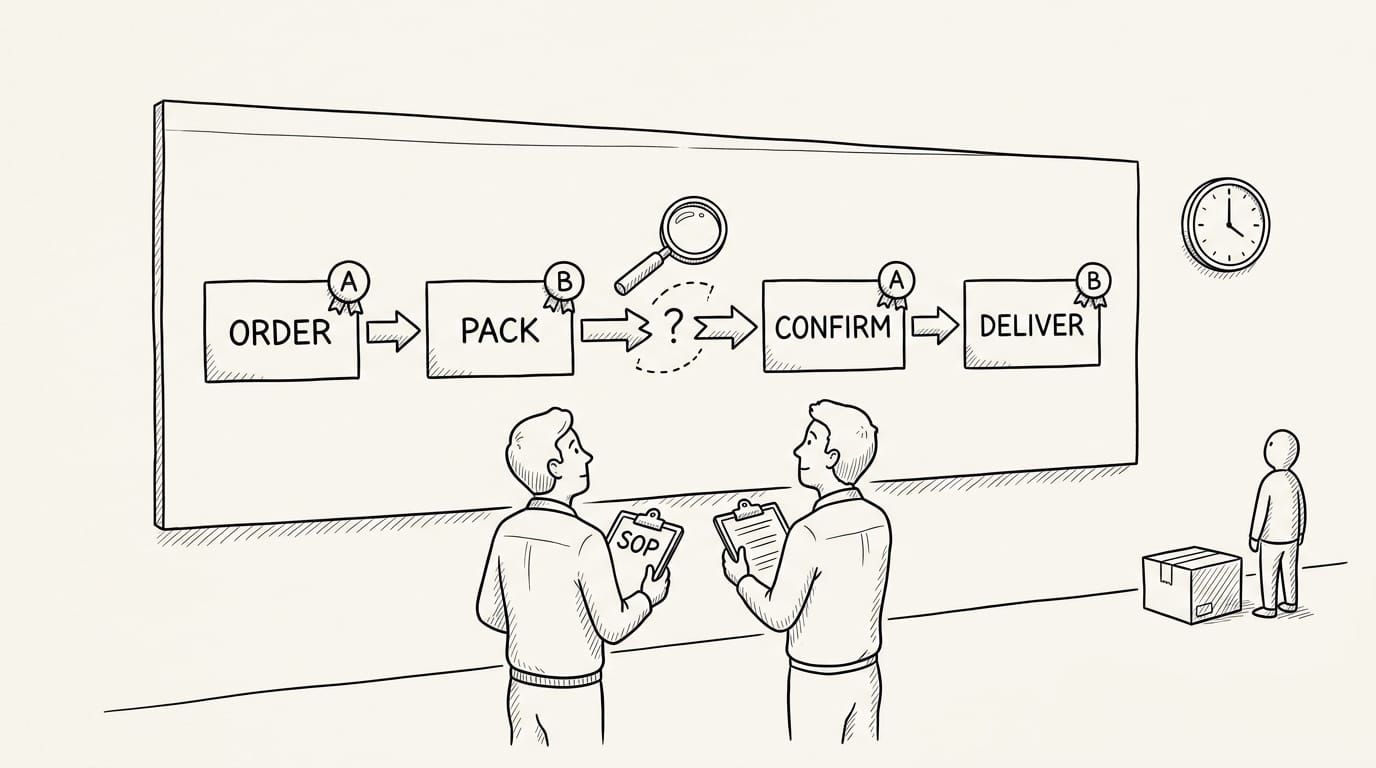
Picture a two-person online shop where each partner assumes the other is sending the shipping confirmation, and a customer waits a week for an update. An SOP names who owns each step, so the question ‘whose job is this?’ always has a written answer.
That shared clarity keeps the team aligned. When something still slips, the question changes from who messed up? to which step broke? That makes errors much easier to spot.
Staying compliant and cutting business risk
A written SOP is also proof you can show. If a customer, insurer, or auditor asks whether you follow a set process, a document plus a record of it being followed answers the question. Proof beats promises.
That documented proof of adherence helps in three areas:
- Legal and financial risk. A clear procedure makes it easier to show you did what you said you’d do.
- Fraud and breach exposure. Written steps and access points make gaps, like cut corners or mishandled data, easier to find.
- Regulated fields. Procedures are vital in healthcare and manufacturing, where skipped steps carry real consequences.
How the SOP market is growing
Demand for SOP management tools is growing as more businesses move their procedures online, and the pandemic sped that shift up.
According to a study on companies’ digitalization during the COVID-19 pandemic, digitalization efforts rose to an unprecedented level during the pandemic compared with the period before.
The same push appeared in a study on technology adoption in municipal home care, where the pandemic forced an accelerated digitalization process. Rising regulatory requirements add to that pull, since a digital record is easier to produce on request.
What You Gain from Using SOPs
Writing a standard operating procedure (SOP) takes effort up front, so it’s fair to ask what you get back.
Getting more done with less effort
Picture a side hustler who sells custom dog collars from her kitchen table. Without a written process, she works out each order from scratch. A one-page SOP answers those questions once, so her evenings go to selling.
- Eliminates guesswork. Each step is spelled out, so nobody has to wonder what “the usual way” means.
- Reduces decision bottlenecks. Routine calls are answered in the document, so work doesn’t wait on the owner.
- Streamlined workflows. Writing steps down exposes extra handoffs and dead ends you can cut.
- Time and cost savings. Less time spent re-explaining tasks means more hours for paying work.
Cutting mistakes and rework
Every redo costs time and materials you didn’t plan for.
- Step-by-step instructions. Each task becomes ordered actions, so nothing gets skipped.
- Fewer mistakes and waste. Writing the right way down leaves less room for error and less material in the trash.
- Less rework. A finished order that gets remade costs you twice. Catch problems early.
What is an SOP for an employee?
An SOP for an employee is a written guide to one role’s steps, so a trained person can pick it up and do the job the same way. It’s less about who does the work and more about how it gets done.
- Faster new-hire ramp-up. New hires can work through the steps on their own. A controlled experiment on explanatory manuals notes that manuals documenting SOPs are commonly used as training materials and references during operation.
- Clear documented reference. The answer to a mid-task question lives on the page, not in someone’s head.
- Easier delegation. A freelance bookkeeper handing invoicing to a part-time helper can do it with one page instead of a long explanation.
How SOPs help teams improve together
- Cross-department cooperation. When each group writes down its handoffs, the next team knows what to expect from the last.
- Baseline for improvement. A written SOP records how things worked before, so you can tell whether a change helped.
- Culture of continuous improvement. When everyone can see the process, people feel free to suggest a better way.
A shared process shifts the talk from who made the error to which step needs fixing.
Why visuals work better than text
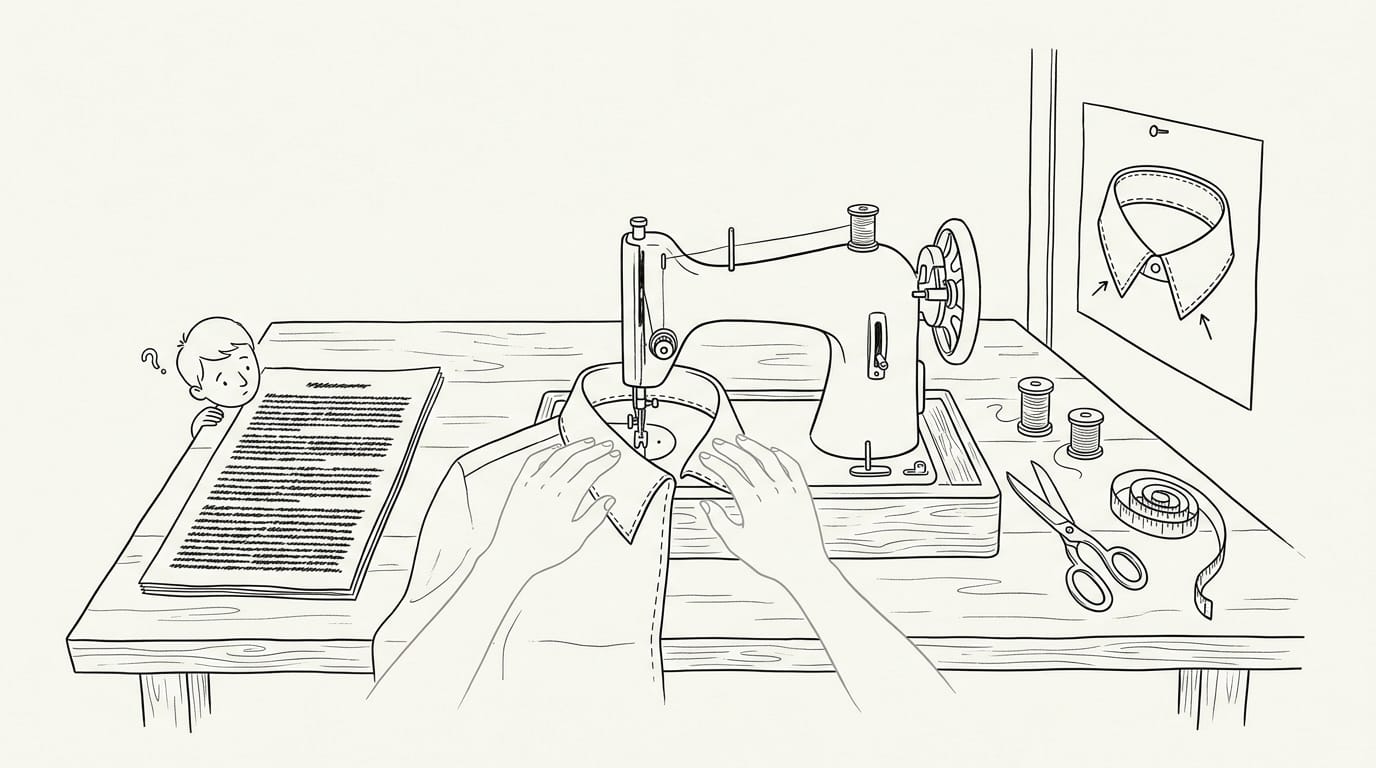
- Visuals beat written instructions. A study on procedural multimedia presentations found that participants processed pictorial and multimedia instructions faster than text, and made fewer errors when carrying out the multimedia ones.
- Faster comprehension. A photo of a finished collar beside the stitching step shows a new helper what right looks like at a glance.
- Reduced cognitive load. Cognitive load is the mental effort of holding information in mind while acting on it. Pictures can ease that load.
Pictures show the step instead of describing it. Seeing beats reading.
What a Strong SOP Includes
A standard operating procedure (SOP) is only as useful as its contents, so here’s what belongs in one.
The basic parts every SOP needs
A policy states what must be true, while a work instruction covers how one task gets done. An SOP walks through the whole process. Every SOP needs four basic parts:
- Clear, specific title. ‘Packing and Shipping Orders’ beats a vague ‘Fulfillment.’
- Purpose statement. One or two sentences on why the procedure exists.
- Defined scope. Where the process starts, where it ends, and what it leaves out.
- Detailed procedure steps. Numbered in order, each one a single action someone can check off.
Consider a candle maker hiring her first packer. Her SOP’s purpose, scope, and steps let him start on day one without her hovering.
Who handles each step and approves it
Every step needs an owner. Once you delegate, unclear ownership is where work slips.
- Who performs each step. Assign a role, like ‘packer,’ not a person, so the SOP outlasts staff changes.
- Approvals and accountability. Mark steps that need a second set of eyes, like refunds over a set amount, and name the approver.
A freelance bookkeeper who hires a part-timer keeps sign-off on client discounts, so the late-night ‘is this okay?’ texts stop.
Tracking dates, revisions, and approval signatures
An SOP changes over time, so you’ll want a paper trail.
- Publication and revision dates. Show when the SOP went live and when it last changed.
- Revision history. A short log of each change, with its date and a one-line reason.
- Approval signatures. Record who signed off, so everyone knows who to ask.
- ISO 8601 dates. Write dates year first, like 2025-03-04, using ISO 8601, the international standard date format. You won’t have to guess whether 03/04 means March or April.
Supporting details, from safety to QA checks
- Required resources and materials. List the tools, supplies, and logins each step needs, so nobody starts without them.
- Compliance and safety considerations. Note the rules and protective gear that apply, such as labeling requirements.
- Related document references. Point to any linked policy or work instruction, by title.
- QA controls and checkpoints. Quality assurance (QA) checks catch errors before customers do. Mark who inspects, what they check, and what happens on failure.
A checkpoint takes a minute. A returned order costs a lot more.
Steps to Write an SOP Well
Writing a good standard operating procedure (SOP) is less about formatting and more about accuracy.
Lay the groundwork before drafting
Identify one specific process, like packing an online order. Then set the objective (what a good result looks like) and the scope (where it starts and stops).
Next, pin down the end user, the person who’ll follow it. They need more detail than you do. Then gather input from experts: the people who do the work daily.
In most companies, the person who knows the process best drafts the SOP, and a process owner (the manager accountable for it) signs off. In a small business, that’s often you.
Start with processes you repeat, ones a new hire needs on day one, and ones where mistakes cost customers. Think of a side hustler who sells candles and hires a teenager for weekend packing. Shipping comes first, since one wrong label means a refund.
Once that SOP exists, she gets her Saturdays back.
Writing clear steps and choosing a format
Use simple, action-oriented language: start each step with a verb, like “Open the order.” Add a photo where a step is easy to misread, and a flowchart where the process branches.
Match the format to the work:
- Checklist: a short routine with no branching
- Numbered steps: a sequence where order matters
- Flowchart: a process with decisions along the way
If the task happens on a computer, record your screen while narrating, then turn it into steps. You’ll catch what you forgot.
Review, test, then roll it out
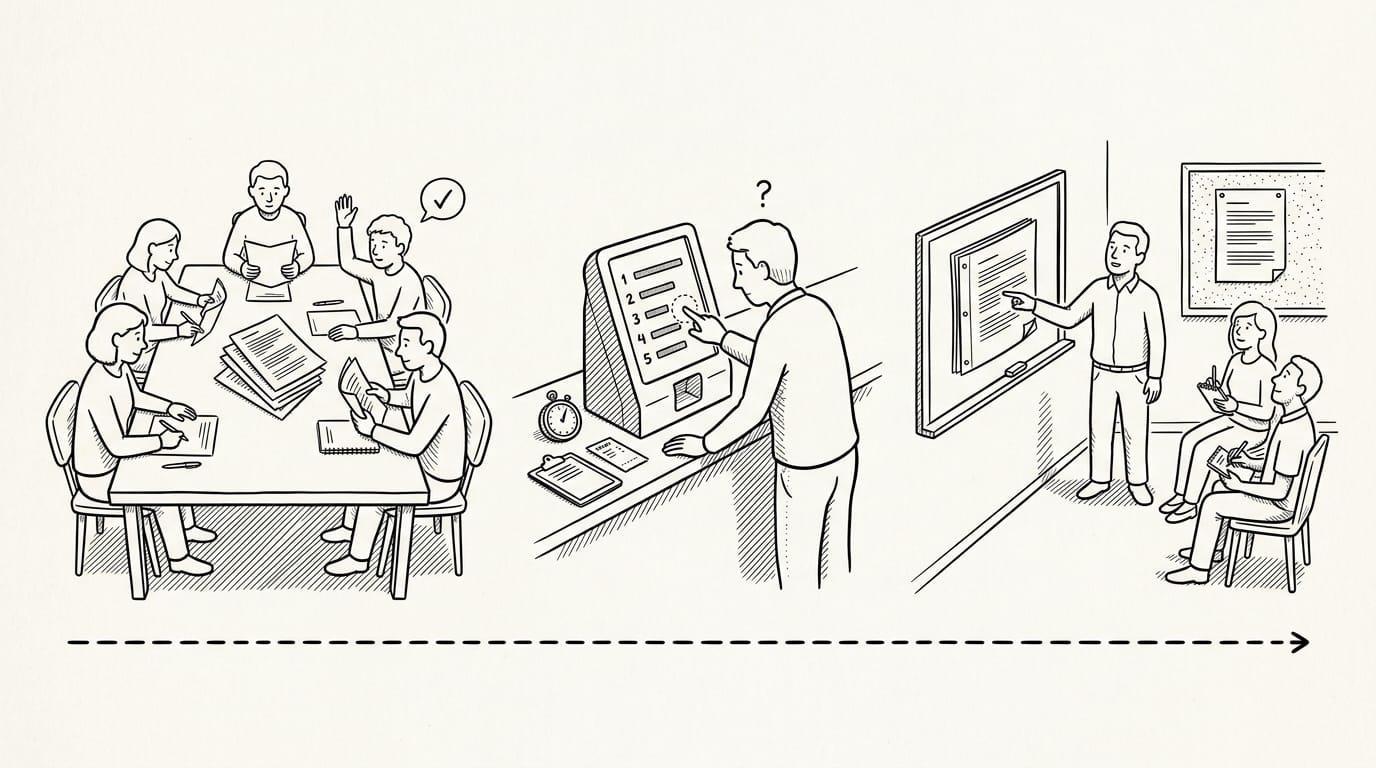
Begin with a stakeholder review: send the draft to everyone it affects. Then test it in a controlled setting, like a test order, and watch where the tester stalls. Once it passes, finalize it and share it with everyone who uses it.
Finally, train staff by walking new people through it.
Keeping the SOP current over time
Set a review interval that fits how fast the process changes. Use version control: give each revision a number and date, and archive old copies so nobody follows last year’s steps. Keep every SOP in central storage, a shared folder everyone can open.
If the packer’s steps live only on your laptop, they’re no help on a busy Saturday.
Formats and Real Examples of SOPs
Once we know what a standard operating procedure (SOP) needs to hold, the next question is how to lay it out.
Popular formats teams use for SOPs
Most teams use one of these:
- Step-by-step lists. Numbered steps for short tasks where order matters.
- Flowcharts. Boxes and arrows that show decisions, like “if it’s over budget, ask the owner.”
- Hierarchical outlines. Nested headings that group steps under bigger stages.
- Checklists. Tick boxes for steps that can’t be skipped.
- Wiki, PDF, or screen recording. A wiki is a shared web page the team can edit. A PDF (portable document format) is a fixed file that looks the same on any device. A screen recording shows each click, which beats words for software.
Pick the one your team will actually open.
SOP examples from everyday work
Expense reports. A freelance designer’s checklist (photograph the receipt, pick a category, tag the client) means she submits everything before the month closes.
Customer complaint escalation. A solo shop owner writes down who answers a complaint first and when it moves up to her. When she’s away, her helper handles the next complaint without calling.
Blog publishing. A side-hustler who runs her candle shop’s blog drafts, edits, checks links, then schedules each post, in that order. Her new part-time writer can publish without asking what’s next.
Vendor approval. Before paying a new supplier, a food truck owner’s SOP requires a price sheet, proof of insurance, and her sign-off. Nobody adds a supplier on a whim, so new charges don’t surprise her on the next invoice.
Start with the tasks you already repeat, not the ones you hope to hand off someday.
Problems to Expect and Tools That Help
Writing your standard operating procedures (SOPs) is only half the job. The rest is getting people to use them.
Common obstacles when rolling out SOPs
- Employee resistance. Long-time staff may see a written procedure as criticism of their skills.
- Insufficient management support. If owners skip the SOPs, nobody else will follow them.
- Keeping documentation current. Writing a procedure is one task. Keeping it accurate is the ongoing one.
- Perceived loss of flexibility. A good SOP fixes only the steps that must stay the same every time.
Picture a candle seller whose friend packs weekend orders. Outdated steps mean repeated questions and mistakes the owner must fix instead of selling.
Getting employees on board with SOPs
- Involve employees in creation. Staff spot broken steps first, and they’ll follow what they helped build.
- Provide comprehensive training. Handing someone a document isn’t the same as teaching the process. Walk through it together and let them practice.
- Single maintained version. Keep one master copy with a named owner. When two versions float around, nobody trusts either one.
Software and tools that manage SOPs
- Document management systems keep every procedure versioned and searchable in one place.
- Workflow automation triggers steps for you, like sending a checklist when a new order arrives.
- Cloud storage access lets anyone reach the master copy from any device.
- Screen-capture SOP tools record your clicks and turn them into step-by-step instructions.
- Augmented reality (AR) and virtual reality (VR) training overlays steps on real equipment or simulates hands-on tasks.
A candle seller probably doesn’t need virtual reality. A shared folder and a screen recording may be enough. Start simple.
An SOP turns what you know into a shared playbook, so your business keeps running whether you’re at your desk, on vacation, or training someone new. Start with the processes that eat up the most time or cause the most mistakes when they’re done wrong.
Then keep each one current as the work changes, and fix it whenever something slips through the cracks. That’s how a business stops depending on you and starts growing without you.
References
- The Measurement of The Relationship Between the Digitalisation of The Companies and Their Response to the COVID-19 Pandemic — doi.org (2025)
- From safety to efficiency: How drivers of technology adoption changed during the COVID-19 pandemic in municipal home care — pmc.ncbi.nlm.nih.gov
- Description: Procedural Multimedia Presentations: The Effects of Working Memory and Task Complexity on Instruction Time and Assembly Accuracy — repositoriosdigitales.sicyt.gob.ar (2026)
- A Controlled Experiment Investigating the Effects of Explanatory Manual on Adherence to Operating Procedures — mdpi.com (2019)
- Standard operating procedures ‐ a novel perspective — doi.org (2001)
Questions
What is SOP and KPI?
SOP stands for standard operating procedure, a written set of steps for completing a recurring task consistently. KPI stands for key performance indicator, a measure used to track how well work or a process is performing. An SOP explains how to do the work; a KPI shows whether it is working.
What is meant by SOP document?
An SOP document is the written file containing step-by-step instructions for a repeated task or process. It commonly includes the purpose, scope, procedure, responsibilities, and revision information.
What is SOP for an employee?
An employee SOP is a written guide to the steps involved in a role or task. It helps employees carry out work consistently, answer routine questions, and learn responsibilities during onboarding.
What does SOP stand for in marketing?
In marketing, SOP stands for standard operating procedure. It documents repeatable activities, such as the steps for preparing and sending a weekly newsletter.
Who writes SOPs in a company?
The person who knows the process best usually drafts the SOP, often with input from the people who perform the work. A process owner, typically the manager accountable for it, reviews and approves the document.
Sources
- From safety to efficiency: How drivers of technology adoption changed during the COVID-19 pandemic in municipal home care - PMC, pmc.ncbi.nlm.nih.gov
- The Measurement of The Relationship Between the Digitalisation of The Companies and Their Response to the COVID-19 Pandemic, doi.org,
- Description: Procedural Multimedia Presentations: The Effects of Working Memory and Task Complexity on Instruction Time and Assembly Accuracy, repositoriosdigitales.sicyt.gob.ar,
- A Controlled Experiment Investigating the Effects of Explanatory Manual on Adherence to Operating Procedures, mdpi.com,
- Standard operating procedures ‐ a novel perspective, doi.org,