7-3
SOP Meaning in Business: A Plain-English Guide
Understand SOP meaning in business, what a strong procedure includes, and how to choose the first few processes worth documenting for repeatable results.
- Written by

- Published
- Updated
- Reading time
- 13 min read
- Sources
- 4 cited
In business, SOP means standard operating procedure: a written, step-by-step guide for completing a recurring task the same way, whoever does it. Strong SOPs clarify the purpose, scope, roles, tools, quality checks, and current instructions, and should be tested, easy to find, and updated when work changes. Start with the few tasks that repeat often or cause costly mistakes, so people can hand off work, avoid guesswork, and keep operations running consistently.
In this guide
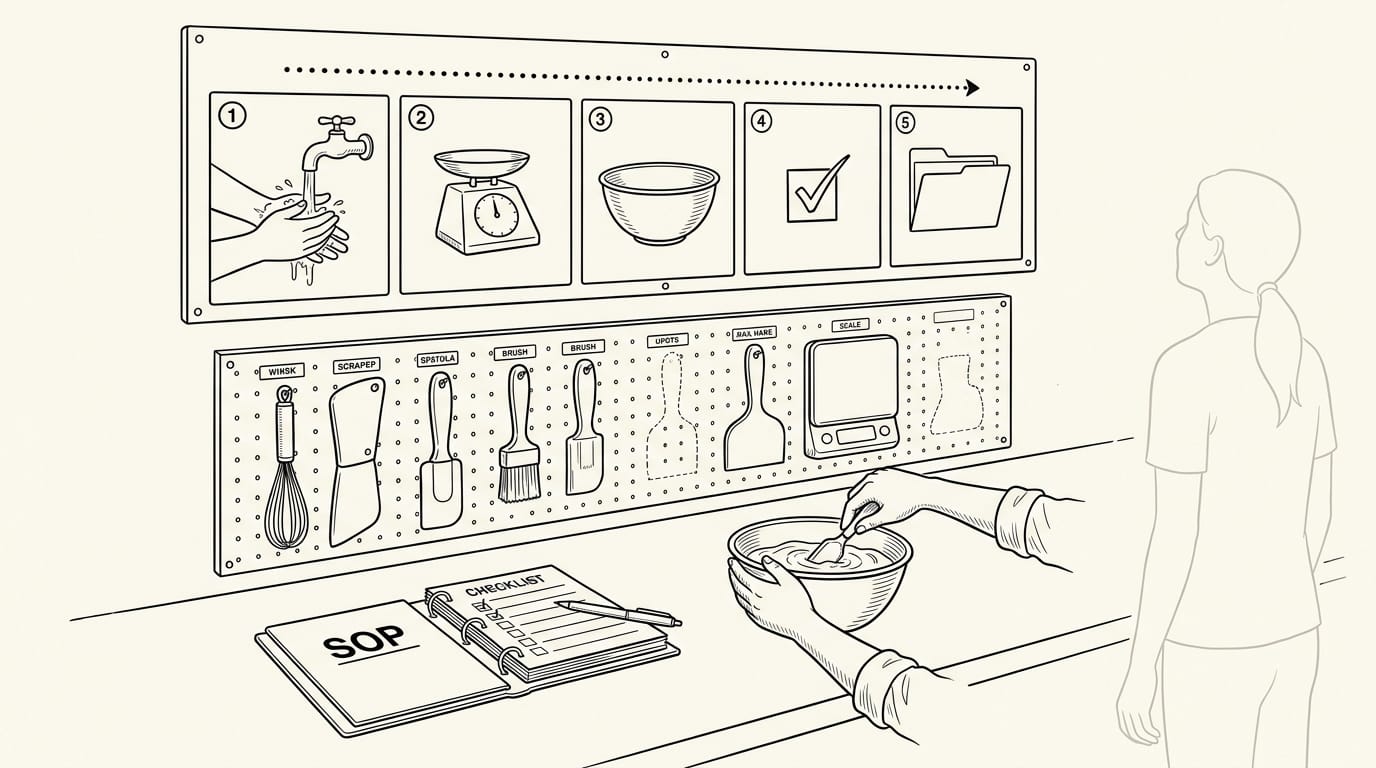
Think about baking a cake from memory versus following a recipe card. The card gets you the same result every time, even on a tired Tuesday night.
That’s the idea behind a standard operating procedure (SOP): a written, step-by-step guide for doing a task the same way, no matter who does it.
In this post, we’ll cover what an SOP means, what a strong one includes, how to format and write one, and the tools that help. Then we’ll show you how to document only the few processes worth writing down first.
SOP Meaning in Business Explained
Here’s the business meaning first, then the other ways the term shows up.
What does SOP stand for?
SOP stands for standard operating procedure, a documented set of step-by-step instructions for a task you want done the same way every time. Think of it as a playbook or roadmap.
The goal is consistent performance: the result depends on how a task gets done, not who happens to be working.
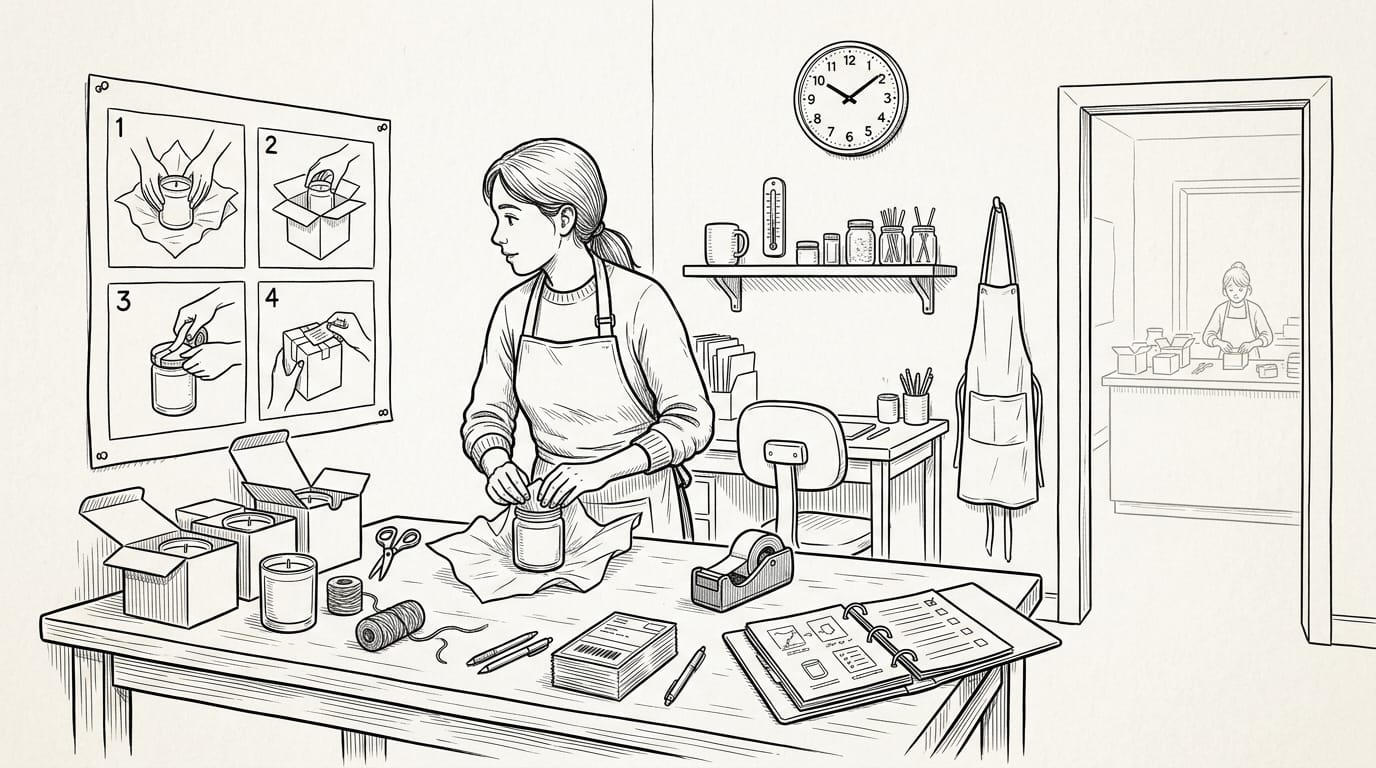
A side hustler who sells candles on weekends keeps a one-page packing checklist: wrap, label, weigh, ship. When her sister covers a busy week, orders still go out right, and nobody’s untangling mistakes on Sunday night. Same steps, same result.
In marketing, SOP stands for the same thing, and it’s usually used for recurring work like campaign approvals or lead follow-up.
Other things SOP can mean
Outside the office, the same letters mean other things:
- Food dipped in liquid. Think bread soaked in gravy or soup.
- Bribe or concession. A bribe, or a small concession offered to quiet someone.
- Weak-willed person. A pushover who gives in too easily.
- Soprano abbreviation. Short for soprano in music.
- Etymology and word forms. SOP is the business term, SOPs is its plural, and lowercase sop is the everyday word.
Real SOP examples from different departments
Departments write them for very different work:
- Expense report submission. Which receipts to keep and when to send them in.
- Customer complaint escalation. Who answers first and when a complaint moves to a manager.
- Blog publishing.
- Drafting
- Editing
- Scheduling
- a final live-post check.
- Vendor approval. How a new supplier gets vetted and who signs off.
- Onboarding and payroll. Setting up a new hire’s accounts and first paycheck.
- Manufacturing and compliance. Production steps and the checks that keep products within standards.
Why Businesses Rely on SOPs
A standard operating procedure (SOP) is a written, step-by-step way to do a task the same way every time. Here’s why businesses lean on them.
Keeping work consistent and mistake free
A home baker who sells birthday cakes writes down the exact frosting amounts. Same cake, every time.
Fewer mistakes mean less rework. Checklists add quality control (checking the results) and quality assurance (checking the process). Written steps also remove bottlenecks by answering routine questions in advance.
What is an SOP for an employee?
For an employee, an SOP is their job playbook: what to do, in what order, and what good looks like. Picture an online seller who hires a part-time packer.
On her first day, she watches a short packing clip and ships an order correctly, without you hovering. That shortens the new-hire learning curve. Veteran staff use the same document as a reference, too.
Visual SOPs, which use photos, diagrams, or short videos, aid comprehension.
Staying compliant and limiting risk
If a client or auditor asks whether work was done the approved way, the steps and sign-off are your documented proof of adherence. That supports regulatory and legal protection when a rule or contract requires a set method.
A second check, like two people counting the cash drawer, makes fraud and mistakes harder to slip through. In healthcare and manufacturing, a skipped step can hurt someone, so written procedures matter.
Saving time and keeping operations running
Re-explaining a task costs minutes every time. A written SOP makes that explanation reusable, so the time savings add up. Business continuity means work keeps going when someone is sick or away.
When a candle seller falls ill, her sister follows the packing SOP and Monday’s orders still ship. That’s less about starting the work and more about keeping it running. A written SOP also helps you:
- Scale across locations. A second stall can match the first without you standing there.
- Retain knowledge. Skills stay in the business when a person leaves.
- Control costs. Extra tape and unneeded checks become easy to spot.
Clear roles and teams working together
When each step has a named owner, it’s clear who does what and who follows up. Handoffs between sales, production, and shipping stay clean when everyone uses the same steps.
You can’t improve a process you haven’t written down, so the SOP becomes your baseline. An SOP describes how work gets done, while a key performance indicator (KPI) measures how well it’s going.
Think of the SOP as the recipe and the KPI as the taste test.
Once you track a KPI against those steps, a change either moves the number or it doesn’t. You decide with evidence, not gut feel.
The numbers behind SOP adoption and growth
According to a market report from Emergen Research, the SOP management solution market was valued at 1.2 billion dollars in 2024 and is projected to reach 3.8 billion dollars by 2034, a compound annual growth rate (CAGR) of 12.1%.
During the first phase of the coronavirus (COVID-19) pandemic, healthcare organizations rapidly adopted digital solutions, according to the editors of Medical Science Monitor.
In a community service study by Tenriawaru, employees’ average procedural understanding score rose from 2.94 to 4.75 after their procedures became video instructions.
You’ll see claims that SOPs cut compliance risk by a precise percentage. We don’t have a verified figure for that, so treat exact numbers with caution. Always check the source.
What a Strong SOP Document Includes
A standard operating procedure (SOP) is a set of written instructions for a recurring task, and an SOP document is the file that holds them in one place.
Naming it, stating its purpose and scope
Start with a clear, specific title, such as “Packing and Shipping Orders” rather than “Operations.” Then add a purpose statement of a sentence or two. It’s less about what the task is and more about why it matters.
Finally, set the scope boundaries: where the procedure starts, where it ends, and what it leaves out.
Who handles each step and approves it
For each step, name who performs it. A one-person business may list just one name, and that’s still useful. Next, record who approves the work and who answers for mistakes.
Then add a RACI matrix (Responsible, Accountable, Consulted, Informed), a grid that marks each person’s role on each step:
- Responsible: does the work.
- Accountable: owns the result and signs off.
- Consulted: gives input beforehand.
- Informed: hears the outcome afterward.
Step-by-step instructions and the tools needed
Good step-by-step instructions tell a newcomer how to do the task, not just that it needs doing. List the required tools and materials up front so nobody goes hunting for tape.
Add troubleshooting guidance for known snags, and list any reference documents and standards the work depends on.
Think of a side hustler who sells candles from her spare room. Her steps read like this:
- Print the label.
- Check the address against the order.
- Tape the box and set it by the door.
When she hires her teenage son for weekend rushes, he can pack orders from those steps alone, and she gets her Saturday back.
Tracking dates, revisions and quality checks
Every SOP needs a publication date and a revision date, so you’ll always know which version is current. Keep a revision history that logs each change, who made it, and the signature of whoever approved it.
Then add quality control checkpoints, the moments someone checks the work before it moves on. Write every date in ISO 8601 format, the international date standard from the International Organization for Standardization.
That means year, month, then day, as YYYY-MM-DD. It avoids confusion between day-first and month-first readers. Pick one format and stick to it.
Ways to Format an SOP
A standard operating procedure (SOP) can take many shapes, so pick the one that fits the job. Don’t confuse it with a policy (the rule and its reason) or a work instruction (one task in close detail), since an SOP covers the whole process.
Common layouts, from checklists to videos
Each layout suits a different kind of task:
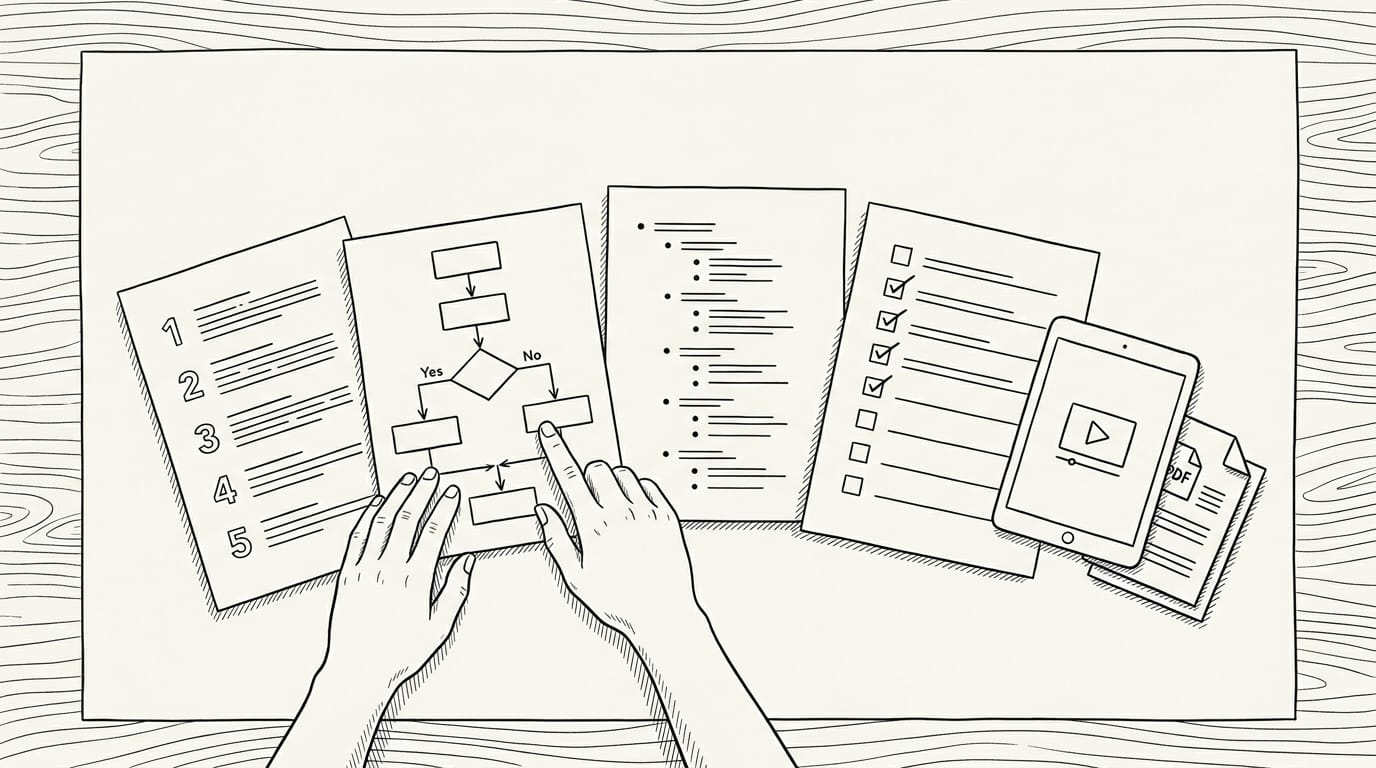
- Step-by-step lists. Numbered steps in the order you do them. The default for most routine work.
- Flowcharts. Boxes and arrows that show decisions, such as whether an order needs gift wrap.
- Hierarchical outlines. Main steps with sub-steps nested beneath them.
- Checklists. Tick-off items you confirm before, during, or after a task.
- Wiki pages, portable document format (PDF) files, and screen recordings. Shared documents and videos, best when seeing a task done beats reading about it.
A flowchart shows which path to take, while a step list shows what to do on it.
Picking a format that fits the task
Match the format to the task, the reader, and your tools:
- Match task complexity. A simple job may need only a checklist, while a branching one may need a flowchart.
- Match audience preferences. If your part-time packer learns faster from photos, a screen recording beats a wall of text.
- Match your team’s existing tools. If everything lives in a shared drive, write the SOP there.
- Combine formats for complex tasks. A checklist for the overall flow plus a flowchart for the decisions often beats either alone.
Take a side hustler who bakes dog treats for a local pet shop. Her packing checklist hangs inside the pantry door, and the damaged-batch flowchart sits in a shared folder. Each format does one job. A tired Sunday night won’t mean a missed step.
Writing an SOP, Step by Step
Once you know what a standard operating procedure (SOP) is, the real work is writing one people will actually follow.
Plan the SOP before writing a word
Start by naming one specific process: “packing a web order” fits on one page, but “running the business” doesn’t. Next, identify the end user, the person who’ll follow it, since that sets how much detail you need.
Then define the objectives and scope: what the SOP should achieve and where the process starts and stops.
Finally, start with the highest-repeat, costliest tasks. Think of a candle seller who packs every order herself. One clear SOP for packing returns the most time for the least writing. Write for the work that repeats, not the work that rarely happens.
Who should help write an SOP?
Who writes SOPs in a company? Usually the person who owns the process drafts it, with input from the people who know the work. Three sources help most:
- Consult subject matter experts. Ask people who know a process deeply, like your accountant for month-end bookkeeping.
- Job shadowing and observation. Watching someone work reveals the gap between the official process and the real one.
- Involve process performers. The people doing the task daily catch the steps you’ve stopped noticing.
If it’s only you, record yourself working through the task and build from that footage.
Draft in plain words with helpful visuals
Write each step as a short action that starts with a verb, so “Open the order sheet” beats “The order sheet should be opened by whoever is on shift.” Short steps get followed. Long paragraphs get skimmed.
Add screenshots wherever a step involves a screen or a label, since an arrow pointing at the right button does in seconds what three sentences can’t.
Don’t assume the reader knows where the login is or what “done” looks like. Write for the newcomer, not the veteran.
Review, test and roll out the SOP
Start with a stakeholder review: have everyone the process touches read the draft. Then test it in a controlled setting, such as a practice run at home, where someone follows it without your help.
Finalize and distribute it in one shared, easy-to-find place, and retire old copies so no one works from a stale version. Finally, provide training by walking the new person through it before they work alone.
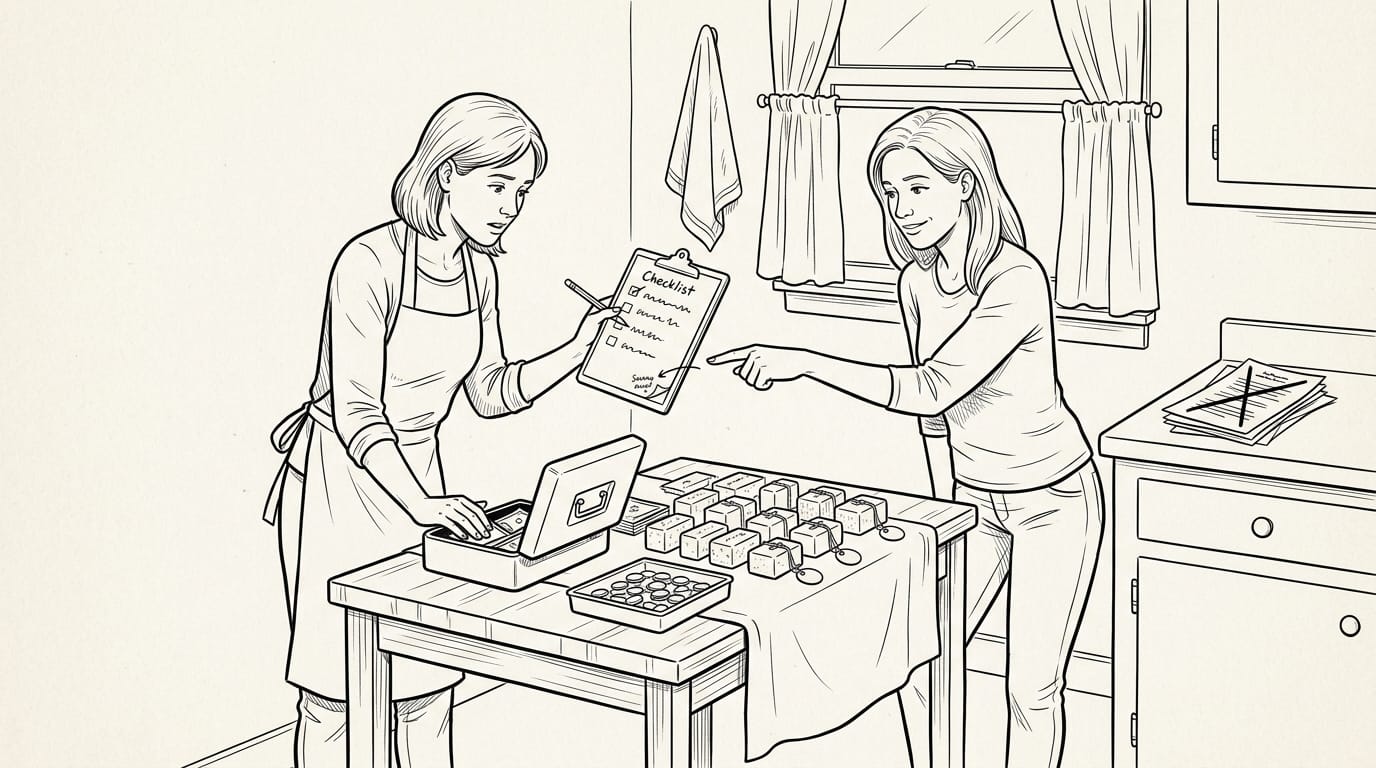
Consider a side hustler who sells handmade soap at weekend markets and brings on a helper for busy seasons. She has the helper set up the table at home using only the SOP, and that practice run reveals a step about the cash box she’d never written down.
She fixes it before the helper ever works a real market alone.
Keeping the SOP current over time
Keep it current by setting a regular review schedule, such as every quarter, and tracking revisions with a version number, a date, and a note on what changed.
Update it whenever a tool, supplier, or regulation changes, because a wrong step is worse than no step at all.
A current SOP is one you can trust, and that trust lets you hand off work without hovering.
Common Hurdles and the Tools That Help
Even a well-written standard operating procedure (SOP) can fail if people resist it, can’t find it, or don’t trust it. Knowing the roadblocks helps you clear them.
Why teams push back on new SOPs
Pushback usually comes from four places:
- Employee resistance to change. Long-time staff may see a written procedure as criticism.
- Insufficient management support. If the owner skips the SOP, nobody else will follow it.
- Keeping documents current. People trust anything written down, so stale steps cause real mistakes.
- Perceived loss of flexibility. Staff worry a written process will box them in.
Take a home baker who hands her first helper a written closing checklist. The helper hears distrust and ignores it, so the kitchen closes a different way every night. Trust comes first.
Ways to get past those hurdles
Most of these hurdles shrink with a smarter rollout:
- Involve employees in development. Let the people doing the work shape the steps.
- Comprehensive training and support. Walk everyone through it and stay available.
- Single maintained version. One master copy, one named owner.
- Map, standardize, automate processes. Map each step as it really happens, standardize it, then automate what repeats.
Aim for buy-in rather than compliance. People follow a process they helped build.
Keeping SOPs easy to find and reach
An SOP nobody can find might as well not exist. A centralized, searchable platform puts every procedure in one place.
Keep it in an easy-to-find location, and make sure cloud access works from anywhere, so a freelancer checking invoicing steps from a client’s office sees the same current version.
Tools that store, automate and track SOPs
Here’s what each one does:
- Document management systems. Store, version, and organize procedures so the newest copy opens.
- Workflow automation. Send reminders and trigger next steps so tasks move without chasing.
- Browser-based documentation tools. Write and share SOPs from a web browser, with nothing to install.
- AR and VR training. Augmented reality (AR) overlays steps on equipment, and virtual reality (VR) lets people rehearse tasks.
- Automated compliance tracking. Flags procedures due for review and training not yet completed.
- Software cost comparison by team size. Weigh each plan’s cost against how many people will actually log in.
Pick the tool that fits your current team, not the one you hope to have.
Quick Answers to Common SOP Questions
Before you write a single procedure, it helps to get the basics straight. Here are the answers people look for first.
Why do SOPs matter?
Standard operating procedure (SOP) is the full name behind the acronym. It’s a written, step-by-step guide for how a recurring task gets done.
In business, an SOP is less about what the work is and more about how it gets done, every time, in the same order.
Who writes them? Usually the person who does the work, or the owner who knows it best. In a one-person business, that’s you. In a bigger team, a manager or lead employee often drafts the document, and the people doing the task check it for accuracy.
Why do they matter? They make handoffs smoother. Picture a side hustler who runs a candle shop from her spare room.
Her packing routine lives entirely in her head, so when a friend covers her weekend orders, a string of texts follows about where the labels are.
A one-page SOP with the steps, the supplies, and a photo of the finished box would answer those questions before anyone asks them. Nobody has to guess.
Engagement is the less obvious payoff. A study of standard operating procedures in logistics at a business-to-business online seller notes that clearly defined rules can encourage employees to feel more engaged, valued, and appreciated.
That work ties the effect to clear expectations and defined work processes, so even a two-person team has a reason to write things down.
An SOP is a record of how you already do your most important work, written down so it holds up when you’re busy, sick, or hiring for the first time. Don’t start with a binder full of documents.
Pick the one or two processes that eat the most time or cause the most mistakes, and write those first.
Keep each one short and update it when the process changes. A few clear pages beat a full manual nobody opens. Write down the few steps that matter most, and the rest of your business gets easier to run.
References
- Digitalisasi SOP Berbasis Video Instruksional untuk Meningkatkan Pemahaman Prosedural Karyawan CV Mockerz Apparel Industries | Tenriawaru — ojs.unm.ac.id (2026)
- “The Impact of Standard Operating Procedures on Employee Productivity and Satisfaction in Logistics Operations of a B2B E-commerce Company” — doi.org (2025)
- Medical Science Monitor | Editorial: Global Initiatives Support the Use and Regulation of Digital Health Technology During the COVID-19 Pandemic — medscimonit.com
- SOP Management Solution Market Future Outlook & Competitive Landscape Report [2024–2034] — emergenresearch.com
Questions
What is SOP and KPI?
An SOP, or standard operating procedure, explains how to perform a recurring task consistently. A KPI, or key performance indicator, measures how well a process or goal is performing.
What is meant by SOP document?
An SOP document is a file containing written, step-by-step instructions for completing a task consistently. It may also include the purpose and scope, assigned roles, tools, quality checks, and revision history.
What is SOP for an employee?
For an employee, an SOP is a job playbook that explains what to do, in what order, and what a satisfactory result looks like. It helps employees learn tasks and gives experienced staff a reliable reference.
What does SOP stand for in marketing?
In marketing, SOP stands for standard operating procedure. It describes consistent steps for recurring work, such as approving campaigns or following up with leads.
Who writes SOPs in a company?
Usually, the person who owns the process drafts the SOP, with input from subject matter experts and the employees who perform the work. A manager or team lead may coordinate the writing and approval, while process performers review it for accuracy.
Sources
- SOP Management Solution Market Future Outlook & Competitive Landscape Report [2024–2034], emergenresearch.com
- Digitalisasi SOP Berbasis Video Instruksional untuk Meningkatkan Pemahaman Prosedural Karyawan CV Mockerz Apparel Industries | Tenriawaru | Jurnal Kebajikan, ojs.unm.ac.id,
- Medical Science Monitor | Editorial: Global Initiatives Support the Use and Regulation of Digital Health Technology During the COVID-19 Pandemic - Article, medscimonit.com
- “The Impact of Standard Operating Procedures on Employee Productivity and Satisfaction in Logistics Operations of a B2B E-commerce Company”, doi.org,