6-8
Business Financial Management: A Complete Guide
Business financial management shows whether a business can pay, with pricing, margins, break-even points, and cash flow to guide decisions.
- Written by

- Published
- Updated
- Reading time
- 13 min read
- Sources
- 2 cited
Business financial management is the work of tracking, planning, and using a business’s money to make sound decisions. It means keeping business and personal finances separate, budgeting and forecasting, reviewing accurate records, and checking cash flow, costs, margins, and break-even points regularly. These habits help owners catch problems early, pay bills and taxes on time, set prices with confidence, and decide when the business can safely invest or grow.

In this guide
Picture a kitchen table covered in receipts, a side hustle you hope will one day cover the rent, and no clear sense of whether it’s actually paying. That’s the gap business financial management fills.
Business financial management is the work of tracking, planning, and using your money so you can make smart decisions about your business.
It covers the core parts, the systems that keep records straight, the habits that keep things healthy, and the mistakes small owners tend to make.
In this article, we’ll also get practical with the numbers that make or break an idea: pricing, margins, break-even, and cash flow.
Why Business Financial Management Matters
A good product can’t save a business that loses track of its money, so here’s what managing it involves.
How to understand business finance?
Business financial management means tracking what your business earns and spends, then using those numbers to make better calls. It’s less about bookkeeping and more about decisions. You plan, organize, direct, and control the funds.
Start by monitoring money in and out, then run a regular business health check-up. Then focus on efficiency and profitability.
The payoff from managing money well
Good money habits help you spot red flags early, like sales slipping while costs creep up. They also drive growth and productivity by showing which work earns and which only keeps you busy, and clean records reduce accounting errors.
Consider a side hustler selling candles on weekends. Tracking supplies shows her that premium wax is eating her margin, so she switches blends and keeps the savings.
These habits boost profitability and firm value, meaning what your business is worth to an investor or buyer, and they support economic stability.
Goals for steady cash and long-term growth
These goals matter most:
- Liquidity and cash flow stability. Have enough cash on hand to cover bills as they come due. Profit doesn’t pay Friday’s rent.
- Maximize profit, minimize costs. Keep more of each sale by cutting costs that add nothing.
- Regulatory compliance. Follow the tax, licensing, and reporting rules that apply to you.
- Long-term stability and growth. Build something that lasts, not just survives the quarter.
- Adequate funds and shareholder returns. Keep enough to run and grow, then decide what shareholders, the people who own shares, take home. For a solo side hustle, that’s you.
Real decisions owners face every year
These calls put the numbers to work:
- Facility expansion. A bakery moving into a bigger kitchen needs the extra orders to cover the higher rent.
- Restaurant chain budgeting. Each new location needs its build-out, staff, and stock funded before opening day.
- Fleet lease versus buy. A delivery business weighs monthly lease payments against buying its vans outright.
- Startup office location. A new company weighs rent against commute times and hiring pool.
- Bookstore going online. Before launching, the owner needs to price in shipping and platform fees, since both shrink margin on every sale.
The Main Parts and Types to Know
Business financial management means planning, tracking, and deciding with your money. Its parts range from pre-launch planning to weekly cash checks.
Plan ahead with forecasts and clear goals
Start with long-term financial goals, like a monthly profit that covers rent. A forecast projects sales, costs, and cash: a best guess you can test, not a promise. Scenario analysis runs it three ways: best, likely, and slow.
A candle maker who keeps $15 from each $25 candle after $10 in materials has a 60 percent margin. That’s her unit economics: what one sale leaves after its direct costs.
With $300 a month in fixed costs (costs that don’t change with sales), her break-even point is 20 candles, since $300 divided by $15 is 20. Every candle after that is profit.
Capital requirement estimation totals what you need before the first sale. Financial policies are written rules, like never paying personal bills from the business account.

Comparing budgets against actual results
A budget is your plan in numbers, with a detailed version for each location or sales channel. The gap between that plan and actual results is the budget variance. The budget shows what you expected; the variance shows what happened.
Corrective action is your response, like repricing or switching suppliers. Catch gaps early, not at year-end.
Spotting risks and keeping funds under control
Name the risks first: a supplier raises prices, a big client leaves, a machine breaks. Risk management means reducing each one.
Insurance covers losses you can’t absorb alone, and internal controls are simple habits, like keeping business and personal accounts apart. Asset security and use means knowing what you own and where it sits.
Contingency plans answer ‘what if?’ before it happens, so write them down now.
Decisions on investing, financing, and profit sharing
Good decisions run on timely, accurate data: this month’s numbers, not last year’s guesses. Investment decisions ask whether a machine will return more than it costs, and financing decisions ask where the money comes from.
Dividend and profit allocation splits profit between reinvesting and paying yourself. Lease versus purchase analysis compares renting gear with buying it.
A wedding photographer who leases a camera keeps monthly costs low, but buying costs more up front and may pay off over years.
Balancing debt and equity to judge investments
Every business is funded by a mix of debt (borrowed money you repay with interest) and equity (owners’ money that shares in the upside).
Debt-equity analysis weighs that debt versus equity mix, since heavy debt means fixed payments keep coming due in a slow month. To judge a specific investment, these measures help:
- Return on investment (ROI): profit divided by cost, as a percentage.
- Net present value (NPV): the value today of an investment’s future cash, minus its upfront cost.
- Discounted cash flow (DCF): the method behind NPV, which values future money below money in hand.
- Internal rate of return (IRR): the annual rate an investment earns, for comparing options.
A $1,000 printer that adds $500 in profit has an ROI of 50 percent.
Tracking short-term cash, reports, and benchmarks
Working capital is your short-term cushion: current assets (cash, customer payments, inventory) minus current liabilities (bills due within a year).
Liquidity ratios check whether you can pay near-term bills, and the simplest, the current ratio, divides current assets by current liabilities. Receivables management means invoicing promptly and chasing late payers.
The income statement (a profit and loss report) and a few key performance indicators (KPIs), like repeat customers, round out your tracking. Benchmarking against your industry helps only when the comparison is fair.
Profit can look fine on paper while cash runs dry, so check cash weekly.
Setting up the Basic Money Systems
Before you put more time or money into your idea, set up the systems we’d use to see whether it’s working.
Core reports every owner should keep
Cash flow is the money that actually moves in and out of your business, and when. It’s less about what you earned and more about when cash lands. A freelance photographer books a wedding in March but isn’t paid until May.
Her books count the job as earned, yet her checking account can’t cover rent. Cash pays rent.
- Balance sheet: what the business owns and owes on a given date.
- Income statement: profit or loss over a month, quarter, or year.
- Accounting ledger: the running record of every transaction.
- Cash flow forecast and statement: the forecast projects cash in and out, and the statement records what actually happened.
- Personal financial statement: your own assets and debts, showing how much risk you can carry.
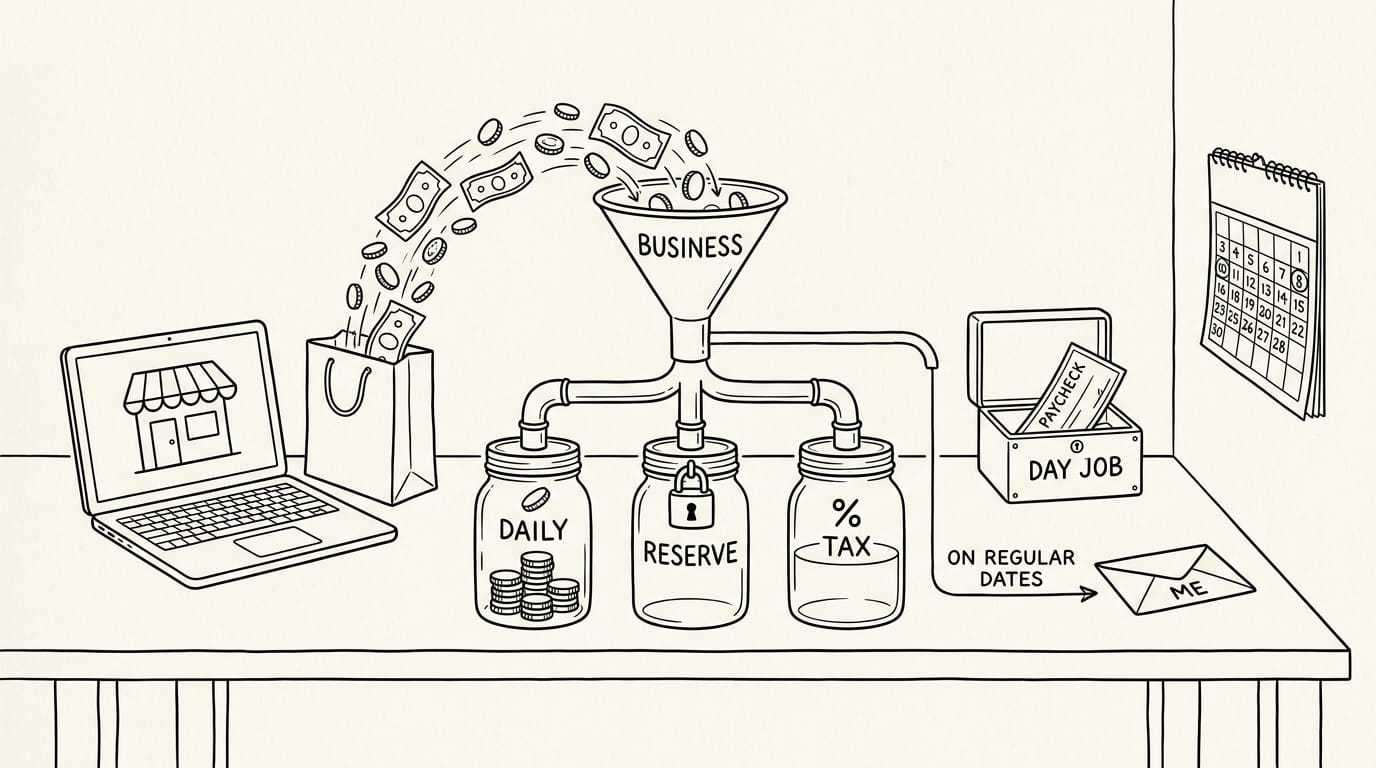
Keep business money in its own accounts
- Dedicated business checking and savings: one account for daily money, one for reserves you don’t touch.
- Route all income and expenses: every sale lands there, and every business bill is paid from it.
- Set aside tax savings: move a share of each payment into savings as it arrives, so taxes don’t catch you off guard.
- Separate side income from day-job pay: keep your paycheck out so you can see whether the idea pays for itself.
Paying yourself works best on a schedule, not whenever the balance looks big enough. Regular transfers from the business to your personal account keep the numbers readable, and your accountant can explain how they’re taxed.
Software that handles invoices, payroll, and reconciliation
A dog-walking side hustler who used to chase payments by text now sends invoices with automatic reminders, so clients pay sooner.
- Accounting software: records transactions and builds your reports for you.
- Automated invoicing and reminders: invoices go out and follow-ups reach unpaid clients without you chasing.
- Automated payroll: calculates pay and the taxes withheld from each paycheck, once you hire anyone.
- Bank reconciliation: checking that each ledger entry matches your bank statement, so errors surface early.
Hiring accounting help, early or as needed
- Hire a certified public accountant (CPA) or bookkeeper early: the CPA handles taxes and planning, and the bookkeeper keeps your ledger current.
- Outsource bookkeeping: hand routine entries to an outside bookkeeper so you can focus on customers.
- Fractional chief financial officer (CFO) for projects: a part-time finance leader you bring in for a one-time job, like building a pricing model.
- Ongoing accountant guidance: regular check-ins to review your reports and flag problems early.
Everyday Habits That Keep Finances Healthy
These habits keep your side hustle’s money steady, and most take minutes a week.
What makes a good money management strategy?
A good money management strategy starts with a written financial plan: what you earn, what the business costs to run, and where you want it in a year.
Stick to a budget with a limit for each category. Put money back into the company where it earns its keep, rather than spending every dollar as it arrives.
Plan three to ten years ahead, so one tempting short-term deal can’t pull you off course.
Watch cash flow and chase late invoices
Cash flow is the money actually moving in and out of your account, so monitor it closely. It’s less about what you bill and more about when it lands.
Take a freelance designer who invoices at month’s end and then forgets about it. Two clients fall weeks behind, and her software renewal still comes due. A reminder on the day each bill goes overdue would have kept her cash on schedule.
To stay ahead of late payers:
- Billing for late payers. Invoice the day work wraps up, with a clear due date.
- Overdue review. Each week, decide who gets a follow-up.
- Cash check. Confirm the money has landed before you spend it.
Borrowing wisely and paying taxes on time
Borrowing is a tool, not a rescue, so borrow only for something that will pay back more than it costs.
- Loan. A lump sum repaid on a fixed schedule.
- Credit line. A set amount you draw on and repay as needed, which suits uneven cash flow.
Schedule quarterly or monthly tax payments and set aside a share of each payment you receive, so a big bill never catches you short.
Build routines and learn the core numbers
Three routines keep the numbers in front of you:
- Weekly money meeting. A short sit-down to review cash and upcoming bills.
- Daily cash snapshot. Your balance and what’s due in the next few days.
- Monthly checklist. Review the budget, tax set-asides, and next month’s bills.
Margin is what you keep from each sale after direct costs, and break-even is the number of sales that cover your costs. Sales show what came in, but margin shows what you keep. Know your numbers.
Money Mistakes Small Owners Tend to Make
A few common habits quietly drain side hustles. Here’s what to watch for.
Mixing personal money with business cash
When business money mixes with your paycheck, it’s hard to see what’s working. Picture a weekend baker who buys flour on her grocery debit card. At tax time, she can’t tell which purchases were for the bakery.
A separate business bank account puts every sale and expense in one place.
Leaning on credit cards adds risk, since interest can erase a sale’s profit. Pay balances in full. And watch for unnecessary purchases: ask whether each one earns money or just feels like progress.
Skipping emergency funds, insurance, and tax reserves
Side income feels like bonus money, so these safeguards are easy to skip.
- Emergency fund. A slow month or a broken oven shouldn’t force you to borrow. Keep a cushion that covers your basic costs.
- Business insurance. One injured customer or stolen tool can wipe out what you’ve built.
- Tax reserve. Owners often underestimate what they owe. Take a dog walker who spends every payment on groceries: in April, the tax bill arrives with nothing set aside. Move a slice of each payment into savings the day it lands.

Going without a budget or clear reports
A budget is a plan for money in and out, so bills stop feeling like surprises. Bookkeeping feels tedious, so receipts pile up in a shoebox and there’s no clear report. The real question isn’t how much you sold. It’s how much you kept.
Avoiding the numbers is the costliest habit: when they go unread until a bill or tax notice forces a look, there’s no time to fix anything. Pick one day a month to review sales and expenses. Looking early beats panicking late.
Rules to Follow on Taxes and Reporting
Taxes are easy to push to the back of your mind, but they belong in your numbers from the first sale. Here’s what we need to track and why each piece matters for your margin.
Tax filings, sales tax, and GAAP standards
Think of a side hustler who sells handmade candles online and at weekend markets. Collecting sales tax isn’t the same as earning it. That money was never hers, so she keeps it in a separate account.
Then tax time doesn’t eat into the profit she planned on.
Each piece has its own rules:
- Provincial and federal taxes. Your business income can be taxed at both the provincial and federal levels, so check which ones apply where you live before you treat your profit as final.
- Sales tax remittance. Remittance means sending the sales tax you’ve collected to the government on schedule. Keep it set aside so it’s ready when it’s due.
- GAAP and IFRS. Generally Accepted Accounting Principles (GAAP) and International Financial Reporting Standards (IFRS) are the rulebooks for preparing financial statements. They keep your records consistent and comparable. Ask a professional which one applies to you.
- Corporate tax returns. If you’ve incorporated, your business files its own return, separate from your personal one. Keep the two apart from day one.
Track it as you go. Rebuilding a year of sales at the last minute is far harder.
Careers and Training in Financial Management
Financial management skills open doors well beyond the finance department, and the field is still hiring. Here’s what studying it can get you.
Why studying this field pays off
Studying this field opens many paths. A career guide from Research.com notes that a finance background can lead to roles in:
- accounting
- budgeting
- lending
- investing
- financial planning
Pay is a major draw, though salaries vary by role, location, and experience. Careers also build on themselves, since each role teaches what the next one needs.
Soft skills matter just as much. You learn to explain a spreadsheet to someone who doesn’t read them. It’s less about what you calculate and more about how you get it across.
According to analysis by Skills England and HM Treasury, employment demand for the 10 priority occupations within the financial services sector is projected to rise. The door is open.
Careers to pursue and courses to take
Start with these roles:
- Financial analyst: studies data to judge whether a business or project is worth the money.
- Financial advisor: helps people and businesses plan their saving, spending, and investing.
- Banker: manages accounts, loans, and day-to-day money movement for customers.
- Budget analyst: tracks an organization’s spending against its plan.
- Credit analyst: judges whether a borrower is likely to repay a loan.
Consider a candle maker who wants a loan for a bigger kiln. A credit analyst will check her sales history, so knowing that lets her bring the right numbers.
Formal training usually means a degree or a certificate program. A degree builds broad foundations, while a certificate sharpens one skill, like budgeting, more quickly.
Business financial management isn’t about becoming an accountant. It’s about knowing your numbers well enough to make decisions with confidence.
Keep your records clean, check your margin and break-even point before you set a price, and watch your cash flow so the bills get paid on time.
Do those things consistently, and your side hustle stops being a guess and starts becoming a business you can plan around, price with confidence, and grow when you’re ready. Your numbers will tell you the truth long before your bank balance does.
References
- Sector Skills Needs Assessment – Financial services — gov.uk (2026)
- 2027 Is Finance a Good Career Path? Guide to Required Skills & Jobs Outlook — research.com
Questions
What is the meaning of financial management?
Financial management is the process of planning, tracking, and using money to make informed decisions. In a business, it includes monitoring income and expenses, budgeting, managing cash flow, and deciding how to fund and grow the company.
What is a good money management strategy?
A good money management strategy starts with a written plan for income, expenses, and financial goals. Follow a budget, set aside money for taxes and emergencies, review cash flow regularly, and reinvest funds where they can benefit the business.
What are some effective financial management strategies?
Effective financial management strategies include keeping business and personal accounts separate, preparing a budget and forecast, reviewing actual results against the plan, and checking cash flow weekly. Invoice promptly, follow up on overdue payments, reserve money for taxes, and use accurate records to guide spending and investment decisions.
How to understand business finance?
Understand business finance by tracking what the business earns and spends, then using those figures to make decisions. Start with a budget, cash flow records, and basic reports such as an income statement and balance sheet; regularly review profitability, costs, and upcoming bills.
Is financial management a good major?
Financial management can be a good major if you enjoy working with numbers and want career options in accounting, budgeting, lending, investing, or financial planning. A degree provides broad foundations, while certificates can develop specific skills; your choice should fit your interests and career goals.
What does cash flow mean?
Cash flow is the money actually entering and leaving a business, including when payments arrive and bills are due. A business can be profitable on paper but still lack cash to pay expenses if customers pay late.
Can I hire someone to manage my money and pay my bills?
Yes. You can hire a bookkeeper to maintain transaction records and a CPA or accountant to help with taxes and financial planning. For broader financial oversight, a fractional CFO can advise on specific projects; choose a qualified professional and agree clearly on their responsibilities, access, and fees.