7-5
Business Organization Explained: Forms, Taxes, Liability
Business organization shapes liability, taxes, and ownership. Compare major structures, then weigh setup costs and upkeep time to choose the right fit.
- Written by

- Published
- Updated
- Reading time
- 11 min read
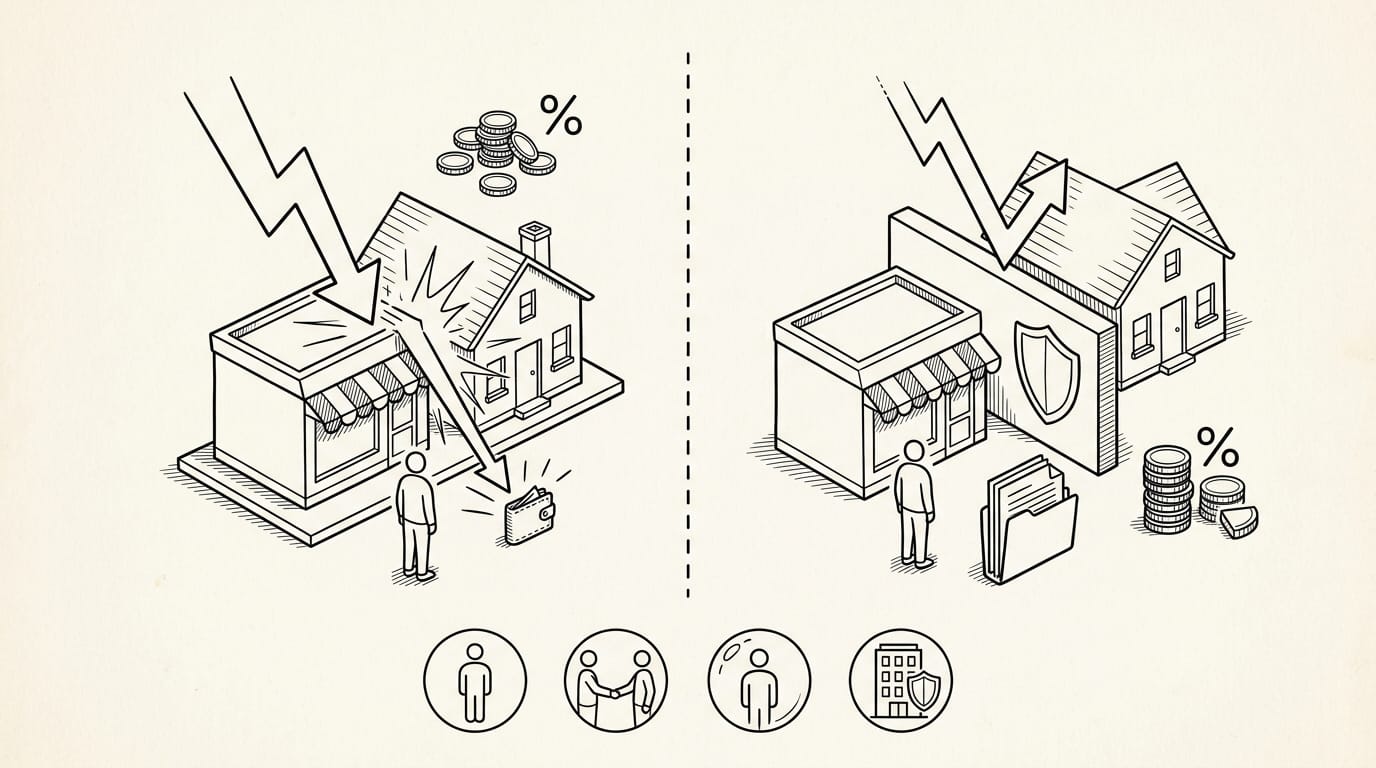
Business organization is the legal and operating form a business takes, defining who owns it, who makes decisions, who bears debt and lawsuit risks, and how income is taxed. Choose a structure by weighing personal liability, taxes, control, formation costs and paperwork, and whether the business should continue when an owner leaves; keep business and personal finances separate to support liability protection. The practical choice is the simplest form that fits your current goals and risk, then change it as the business grows.
In this guide
Think of your side hustle like a house. Paint and furniture matter, but the foundation decides what the whole place can hold up under.
For a business, that foundation is its business organization: the legal form it takes, who owns it, who’s on the hook when something goes wrong, and how the income gets taxed.
In this post, we’ll compare the main structures on liability, taxes, formation, and continuity, then show you how to choose one and what it costs in money and hours to set it up and run.
Why Structure Matters for Any Business Organization
Before you sell anything, you’ll need to choose a structure. It shapes who makes the calls, who carries the risk, and which rules apply.
How structure shapes ownership, control, and goals
A business organization is the legal and operating form a business takes. Forms include the sole proprietorship, the partnership, the limited liability company, and the corporation, which we’ll compare later.
Each performs the same core functions: it gathers money, people, and tasks, then makes and sells something. Structure decides who answers for each.
Structure answers three questions:
- Ownership: who holds the business
- Control: who makes decisions and signs contracts
- Responsibility: who’s on the hook for debts
Goals matter too. Take a woman who bakes sourdough for neighbors on weekends and wants extra income, not a company to sell.
A simple setup keeps her paperwork light, while a structure built for investors would add work she doesn’t need. Structure should follow the goal.
Chasing profit or serving the public good
Most businesses aim to earn profit for their owners. Some organizations serve a public mission instead. The real question is less about whether it makes money and more about what it’s for.
A nonprofit is usually not considered a business. It pursues a cause, such as a food pantry, and any surplus goes back into that cause.
How laws and government treat each type
State and federal rules both apply, and they vary by structure, so the same idea can play out very differently.
Incentives differ too. Some structures qualify for certain tax treatment, grants, or funding that others can’t access.
Structures that take in outside investors also face laws meant to protect those investors, such as rules requiring clear records. Learn the rules before you file.
The Main Ways to Organize a Business
Every business runs on an activity, either industry (making, building, or extracting goods) or commerce (moving, storing, and selling them, plus services like banking and transport). Your Class 11 course text lists the subtypes.
The structure you choose is a separate call, driven by liability, tax, formation, and continuity.
Going it alone as a sole proprietor
A sole proprietorship has one owner with full control and all the profit. The trade-off is unlimited personal liability: if the business loses a lawsuit, your personal assets are on the hook, not just the business’s.
Formation is easy and cheap, and profit goes on your personal tax return.
Think of a freelance photographer who books weddings on weekends. If a client sues over a ruined shoot, the claim can reach her savings. Full control, full exposure.
Sharing ownership with one or more partners
A partnership has two or more owners who share not just profits but the liability. The main variants:
- General partnership: all partners run the business and carry full liability.
- Limited partnership: general partners carry full liability, while limited partners risk only their investment.
- LLP (limited liability partnership): shields partners from most liability for a co-partner’s mistakes.
- LLLP (limited liability limited partnership): like a limited partnership, but even general partners get liability protection.
A partnership agreement should spell out contributions, profit splits, and how a partner can leave. Picture two friends running a candle shop.
If one signs a bulk supply order the shop can’t pay, a general partnership lets the supplier pursue both of them.

How a corporation protects its shareholders
A corporation is a separate legal entity: the company itself, not its owners, holds the assets and can be sued. Its shareholders, the people who own its shares, enjoy limited liability, and a board of directors oversees the company.
Because it has perpetual existence, it survives an owner’s death or exit, and transferable shares let ownership change hands. The charter, filed with the state, creates the company, and the bylaws set its internal rules.
LLCs blend partnership and corporate features
A limited liability company (LLC) is a hybrid of partnership and corporation, with limited owner liability and flexible management. Members can run it or appoint managers, under an operating agreement rather than a corporate board.
Forming one means filing with the state.
Take a woman selling handmade soap from her spare room. Once her LLC is filed, a supplier’s unpaid invoice is the company’s problem, not a claim on her savings. Flexible, yes. Free of paperwork, no.
C, S, and nonprofit corporation taxes
A C corporation is taxed as its own entity, and shareholders may be taxed again when profits are paid as dividends. An S corporation elects to be taxed like a partnership, so profits are taxed once, on shareholders’ personal returns.
S corporation eligibility rules limit who can own shares and how many, so check them before you elect.
A nonprofit corporation serves a public purpose rather than paying profits to owners, and it can seek tax exemption, a separate status you typically apply for.
Indian forms, including cooperatives and joint stock
These forms sit alongside the structures above:
- Joint Hindu Family Business: run jointly by family members, with ownership tied to the family rather than outside investors.
- Cooperative society: owned and controlled by its members, who share its benefits.
- Joint stock company: capital split into shares, so it can raise money from many investors.
- Indian legal acts: each form follows its own law for registration and reporting, so check that law before you register.
Comparing Liability, Taxes, Formation, and Continuity
Four questions separate business structures: personal risk, taxes, paperwork, and what happens when an owner leaves. Here’s how we compare the main options.
Whether your personal assets are at risk
Unlimited liability means the law treats you and the business as one, so business debts and lawsuits can reach your savings and home. Limited liability builds a legal wall between the two.
Sole proprietorships and general partnerships carry unlimited liability, while limited liability companies (LLCs) and corporations usually offer limited liability.
Consider a photographer sued over a ruined shoot. As a sole proprietor, a judgment could reach her bank account. As an LLC owner, she’s generally protected unless she personally guaranteed debts or mixed business and personal money.
Limited liability depends on how you run the business, not just what you call it. Keep the money separate.
How each form gets taxed
With pass-through taxation, the business generally pays no income tax itself, and profit lands on the owners’ personal returns. A sole proprietor files no separate business return at all.
A C corporation (the standard corporate tax setup) pays tax on its profit first, and shareholders pay tax again on dividends. That’s double taxation.
An S corporation election lets profit pass through to owners and can avoid it, subject to eligibility rules.
Setup paperwork, cost, and ongoing rules
Filing requirements grow with the protection you get. A sole proprietorship often needs little more than a local business license. An LLC or corporation files formation documents with the state, then keeps up with recurring filings.
Cost and complexity rise as you add protection, through fees and bookkeeping. Corporations carry the heaviest regulatory burden: board meetings, minutes, and strict separation of company and personal money.
Sole proprietors face the fewest formalities. Less paperwork, more exposure.

Keeping the business going after owner changes
Perpetual existence means a business can exist apart from its owners. A corporation has it by design, and an LLC often does too, depending on its operating agreement.
A sole proprietorship ends with its owner, and a partnership usually dissolves when a partner dies or leaves.
Shares in a corporation can usually be sold, while LLC interests typically need the other members’ consent.
What are the pros and cons?
- Sole proprietorship. Pros: cheapest, simplest setup. Cons: unlimited liability, and it ends with you.
- General partnership. Pros: shared work and costs. Cons: shared unlimited liability, and each partner can bind the business.
- LLC. Pros: limited liability, flexible management. Cons: state filings and fees.
- Corporation. Pros: limited liability, perpetual existence. Cons: the most paperwork, plus double taxation for C corporations.
A corporation’s main drawbacks are overhead and tax. Board meetings and minutes take time you’d rather spend selling, and a C corporation’s profit can be taxed twice. Here’s the side-by-side:
| Structure | Liability | Taxation | Setup | Continuity |
|---|---|---|---|---|
| Sole proprietorship | Unlimited | Personal return | Minimal | Ends with owner |
| General partnership | Unlimited, shared | Pass-through | Minimal | Ends when a partner leaves |
| LLC | Limited | Pass-through | State filing | Often continues |
| Corporation | Limited | Double taxation (C corp) | Most formalities | Perpetual |
How Do You Choose the Right Form?
The right form depends less on what sounds most official and more on where your business stands today.
What should guide your choice
- Business size and capital: A weekend seller needs far less structure than a team with inventory and a lease.
- Risk tolerance: A sole proprietorship leaves your personal savings exposed to business debts. A limited liability company (LLC) keeps most personal assets apart from business debts.
- Control desired: A sole owner makes every call. Partners share decisions, and corporations divide control among shareholders and a board.
- Tax and management considerations: Sole proprietorships and partnerships pass profit to owners’ personal returns, while a standard corporation is taxed as its own entity.
- Ease of formation: A sole proprietorship starts the day you begin selling. An LLC or corporation needs a state filing.
- Start sole proprietor, upgrade later: Most side hustles begin this way, and that’s fine.
To start a business organization, you’ll generally:
- Choose and check a business name.
- File formation paperwork if your structure requires it.
- Open a separate bank account for business money.
Changing form as the business grows
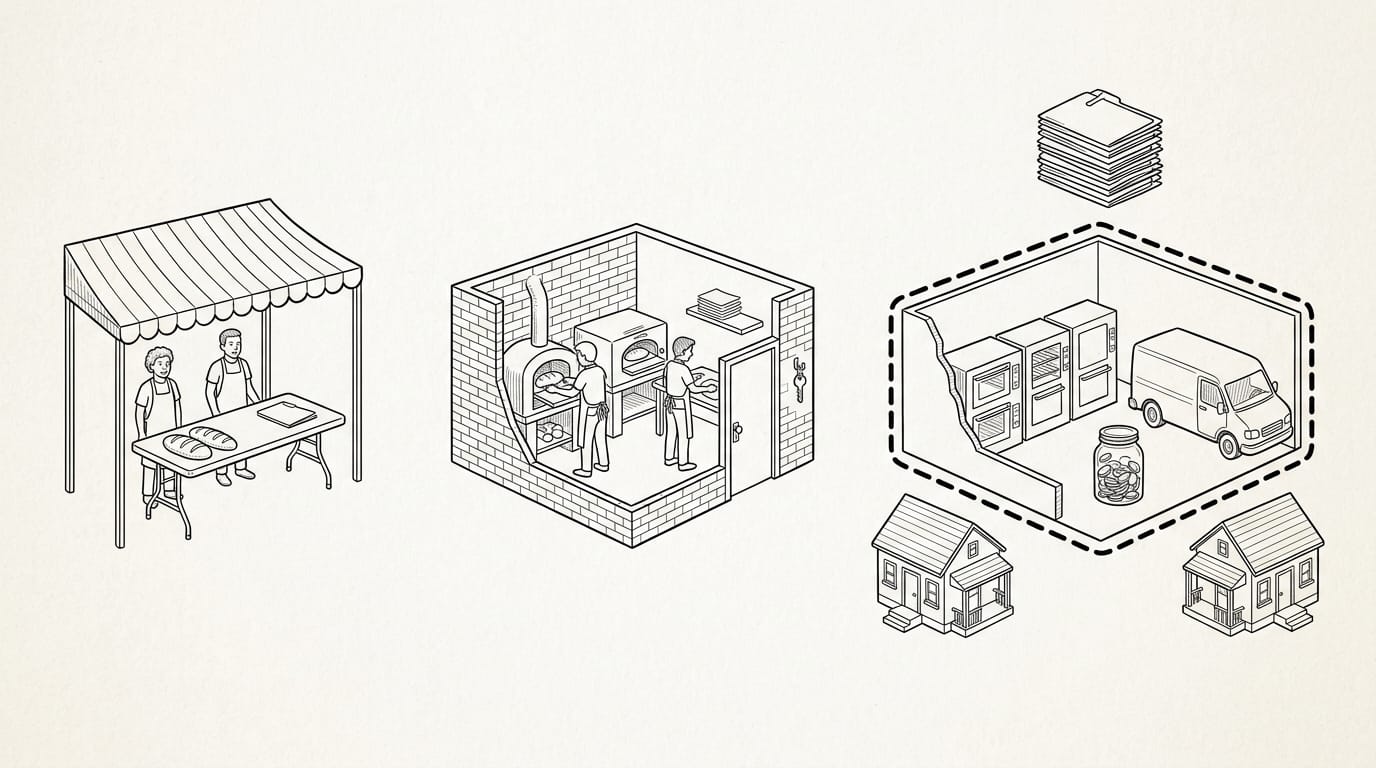
Take two friends selling bread at farmers markets as a partnership. When they sign a kitchen lease and borrow for ovens, converting to an LLC keeps that debt on the business, not their personal finances. Upgrading is normal.
Match the form to the business you’re running now, not the one you hope to build. A weekend side hustle rarely needs more than a sole proprietorship. Once you hire, take on investors, or carry real debt, look at an LLC or corporation.
Paperwork grows with the structure: a sole proprietor usually files a personal return, while LLCs and corporations often add annual state filings.
How Internal Management Is Organized
Decisions and work both move down a chain inside a company. Here’s how that chain works and how to hand tasks along it.
The chain from shareholders to executives
Owners choose who sits on the board, and the board chooses who runs things day to day. In a typical corporation:
- Shareholders, also called stockholders, own the company and vote to elect the board.
- The board of directors oversees the company for its owners and elects the managers.
- Executives, such as a chief executive, run the company day to day.
- Managers turn executive goals into work for their teams.
- Workers carry out the tasks.
Corporate compliance asks whether the company follows the rules that apply to it, from the law to its own policies. Corporate culture, the habits leaders model every day, keeps that answer a yes.
Handing off tasks and supervising workers
Delegation means handing off a task with its outcome and authority attached. Compare “Can you handle invoices?” with “You own invoicing, send them every Friday, and flag any that bounce.” The second one shows what done looks like.
Start with a plan: set the goal, the deadline, and who does what. Then check progress on a set schedule instead of waiting for something to break.
A home bakery owner with one part-time packer plans the week’s orders on Sunday, hands over a checklist, and checks in midweek. Nobody guesses what’s due.
Software can carry much of the admin load. Three kinds help most:
- Bookkeeping apps track income, expenses, and receipts.
- Contract tools store signed agreements and flag renewal dates.
- Scheduling apps show who’s doing what and when.
Software doesn’t replace the plan. It makes the plan easier to see.
How Business Organization Has Changed over Time
Today’s business structures grew out of a few big ideas about who does what. Those ideas still shape how companies work.
How the Industrial Revolution split up work
When production moved into factories, owners needed work done reliably at scale. They split each job into small, repeatable tasks, a practice known as division of labor.
Adam Smith showed that this boosts output, and Babbage pushed it further, showing how skill-based splits could cut costs.
Once work was divided, someone had to coordinate it. That’s where the chain of command came in: a clear line of who reports to whom. Without one, the pieces don’t fit.
Frederick Taylor’s principles and fast-food examples
Frederick Taylor took the idea further as scientific management, built on three principles:
- Study each task to find the best method.
- Separate planning from doing, with managers designing the work.
- Train workers in that method and reward them for sticking to it.
In a modern fast-food kitchen, one person works the grill, another assembles orders, and a third runs the register, each following the same steps. That’s Taylor’s thinking at work.
Putting customers at the center of strategy
Eventually, businesses learned they could stand out through customer service differentiation. When products look alike, how you treat buyers sets you apart.
Market research shows you what buyers want before you build it. Picture a side hustler selling custom dog collars. If she asks her first ten buyers which sizes and colors they want, she’ll know what to stock instead of guessing.
Some businesses go further with service strategies. Dell, for example, built its business around letting customers configure and order their own computers directly. The customer shaped what got built, not just how it was sold.
The right structure isn’t the fanciest one. It’s the one that fits your risk, your tax picture, and how much paperwork you can realistically handle right now.
Weigh each option on liability, taxes, formation, and continuity, then price out the setup costs and the hours each month it will take.
You don’t need a perfect setup on day one. Get the foundation right, and every sale you make after that stands on solid ground.
Questions
What is the number of business activities?
There is no single fixed number of business activities. They are commonly grouped into industry, which produces or extracts goods, and commerce, which moves, stores, and sells goods and includes services.
What are the functions of a business organization?
A business organization gathers money, people, and tasks to make and sell goods or services. It also sets who owns the business, makes decisions, and is responsible for debts.
What are the disadvantages of a corporation?
A corporation can require substantial paperwork and ongoing formalities, including board meetings, minutes, and detailed recordkeeping. A C corporation may also face double taxation: the company pays tax on profits, and shareholders may pay tax again on dividends.
What are the different types of businesses?
Common business structures include sole proprietorships, partnerships, limited liability companies (LLCs), and corporations. Other forms include cooperatives, joint stock companies, and, in India, Joint Hindu Family Businesses.
What are the types of business activities class 11?
Class 11 business activities are generally divided into industry and commerce. Industry includes activities such as manufacturing, construction, and extraction; commerce includes trade and services that help move and distribute goods, such as transport, storage, and banking.
What are core business activities?
Core business activities are the work of organizing resources and carrying out the business’s main purpose: making or providing something and selling it. Depending on the business, this can include production, operations, marketing, sales, and customer service.
How to start an organizational business?
Start by choosing and checking a business name, then select a legal structure that fits your ownership, risk, and goals. File formation paperwork if that structure requires it, obtain any necessary licenses, and open a separate bank account for business finances.
What is business with examples?
A business is an organization or activity that makes or sells goods or services, usually to earn profit. Examples include a bakery selling bread, a photographer providing wedding services, or a shop selling clothing.